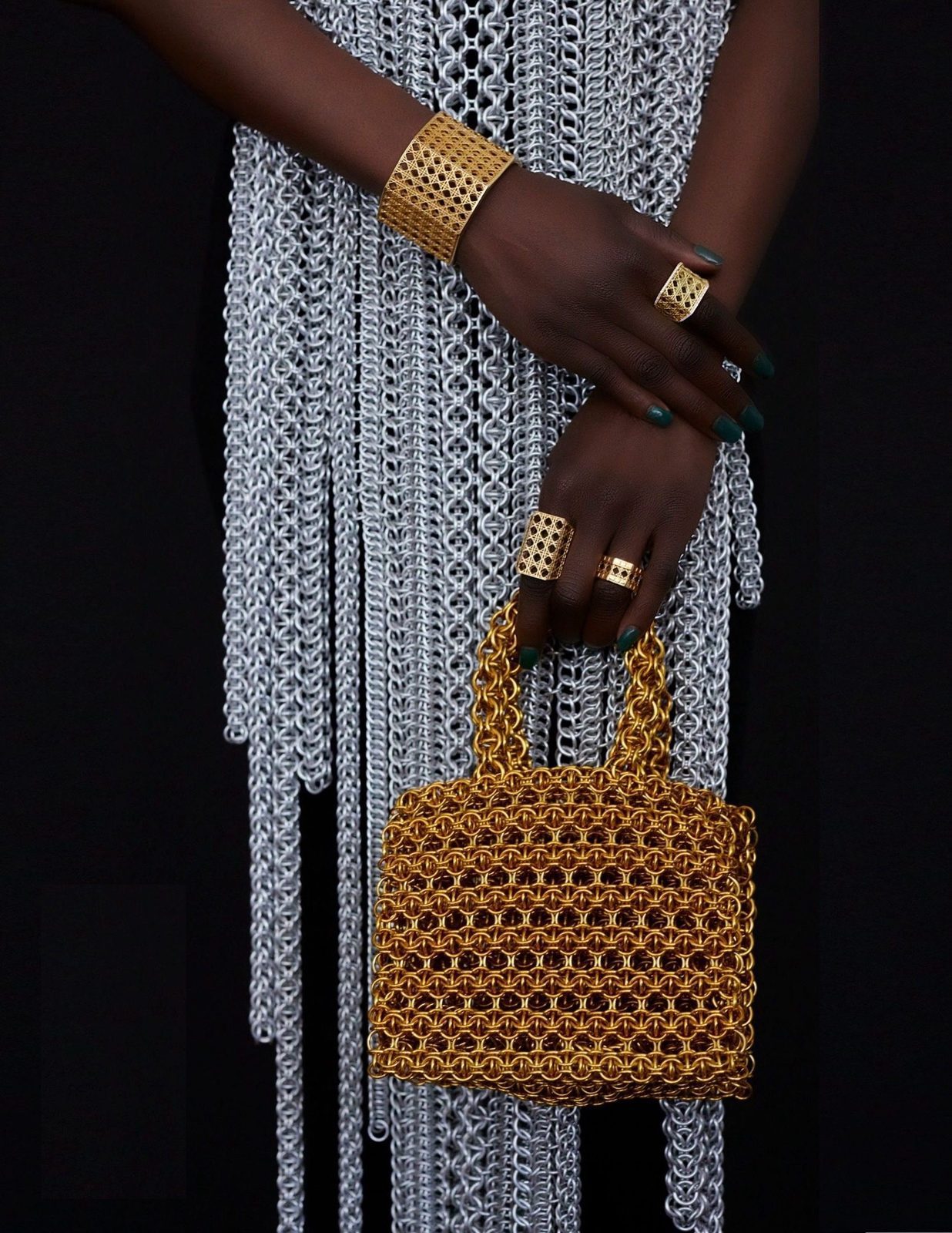
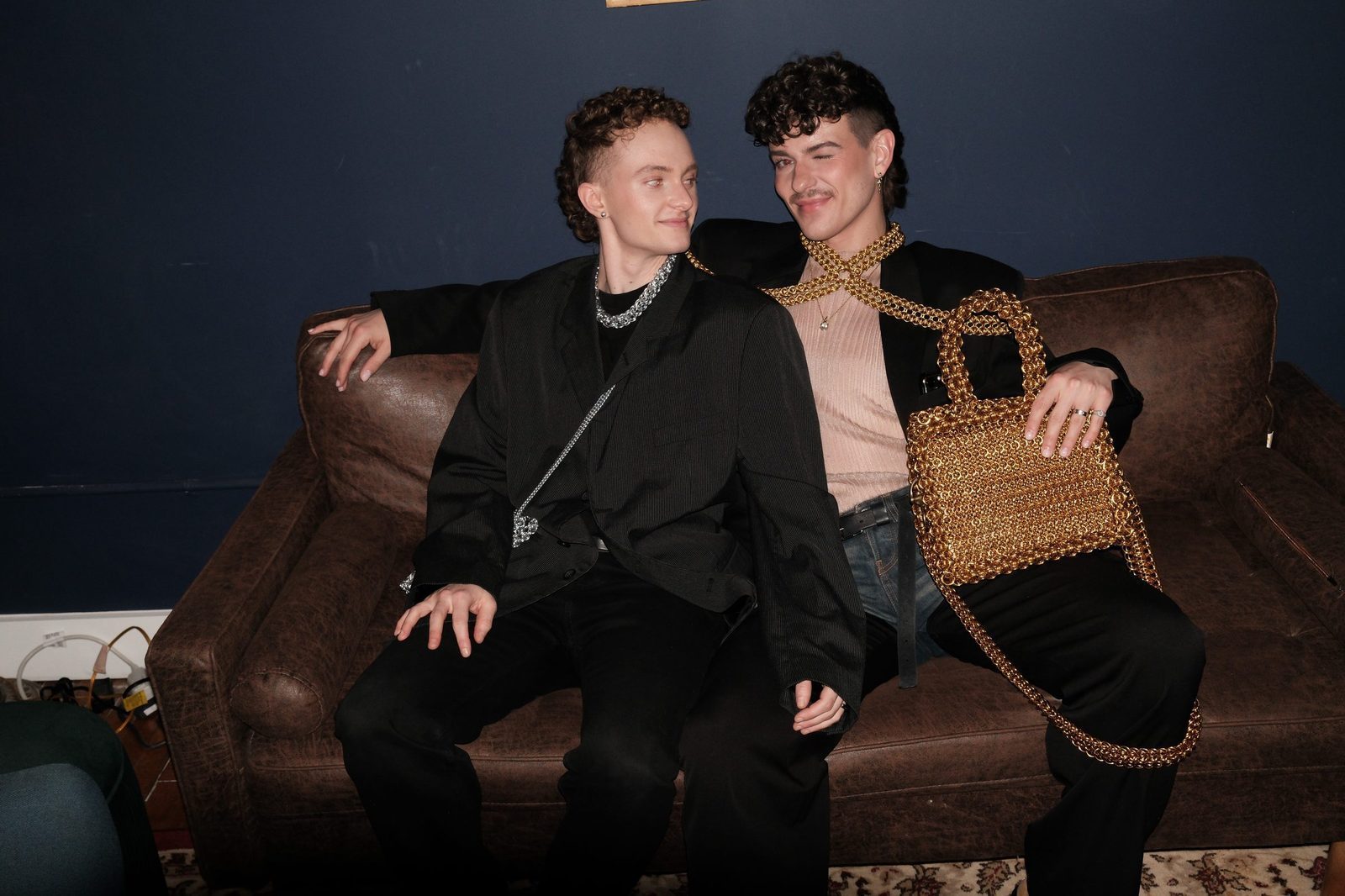
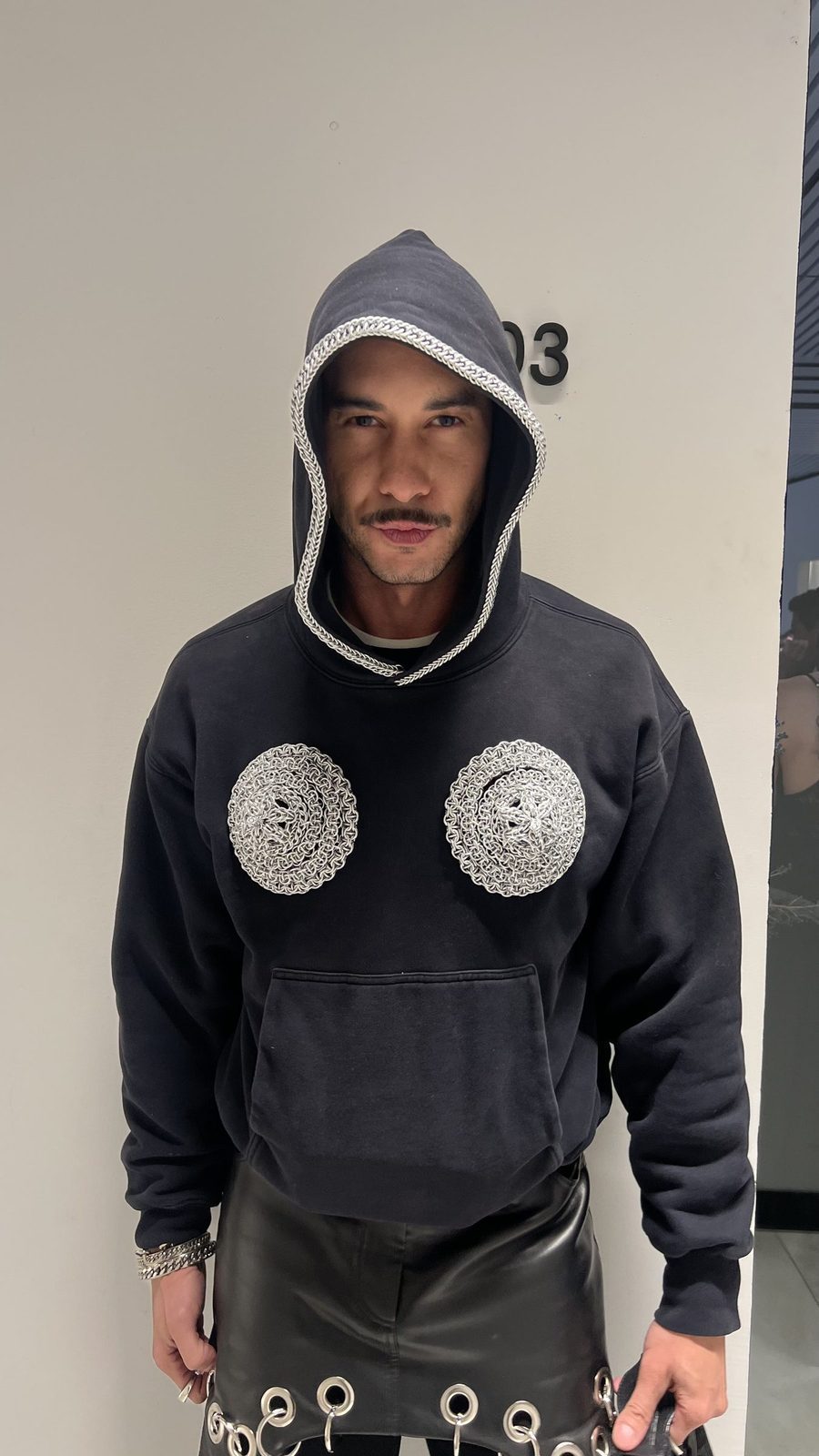
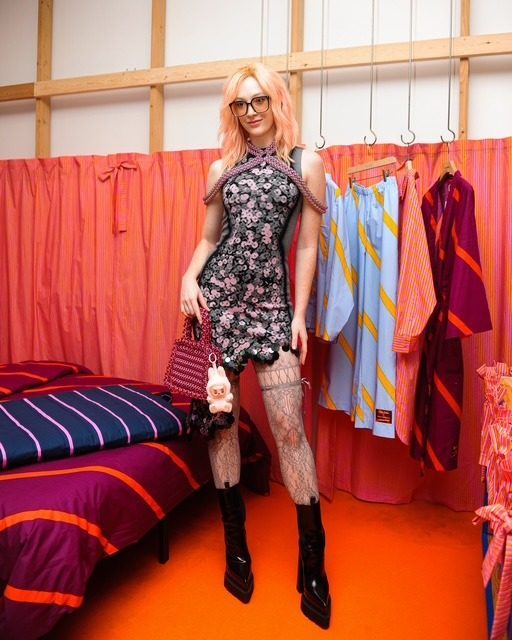
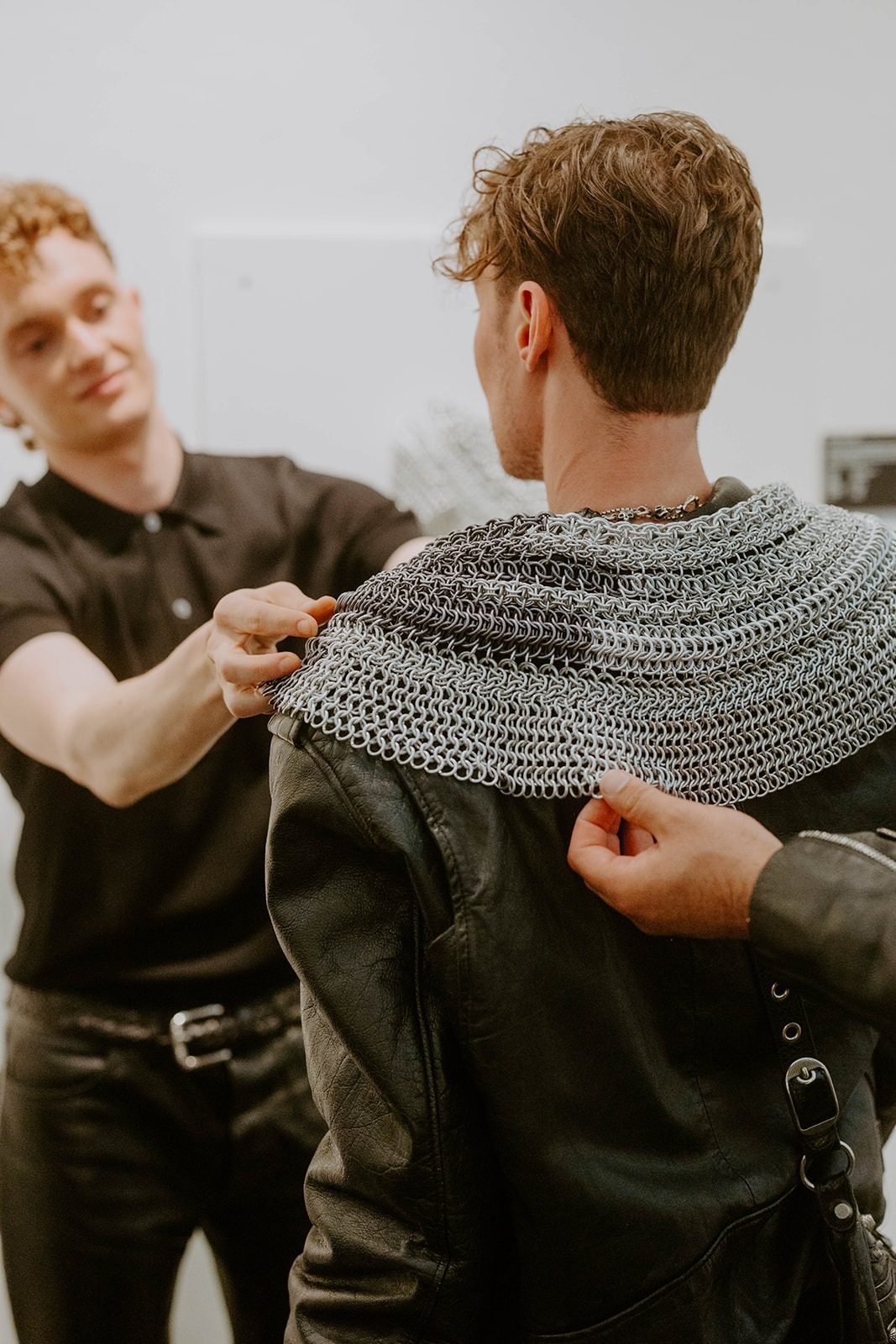
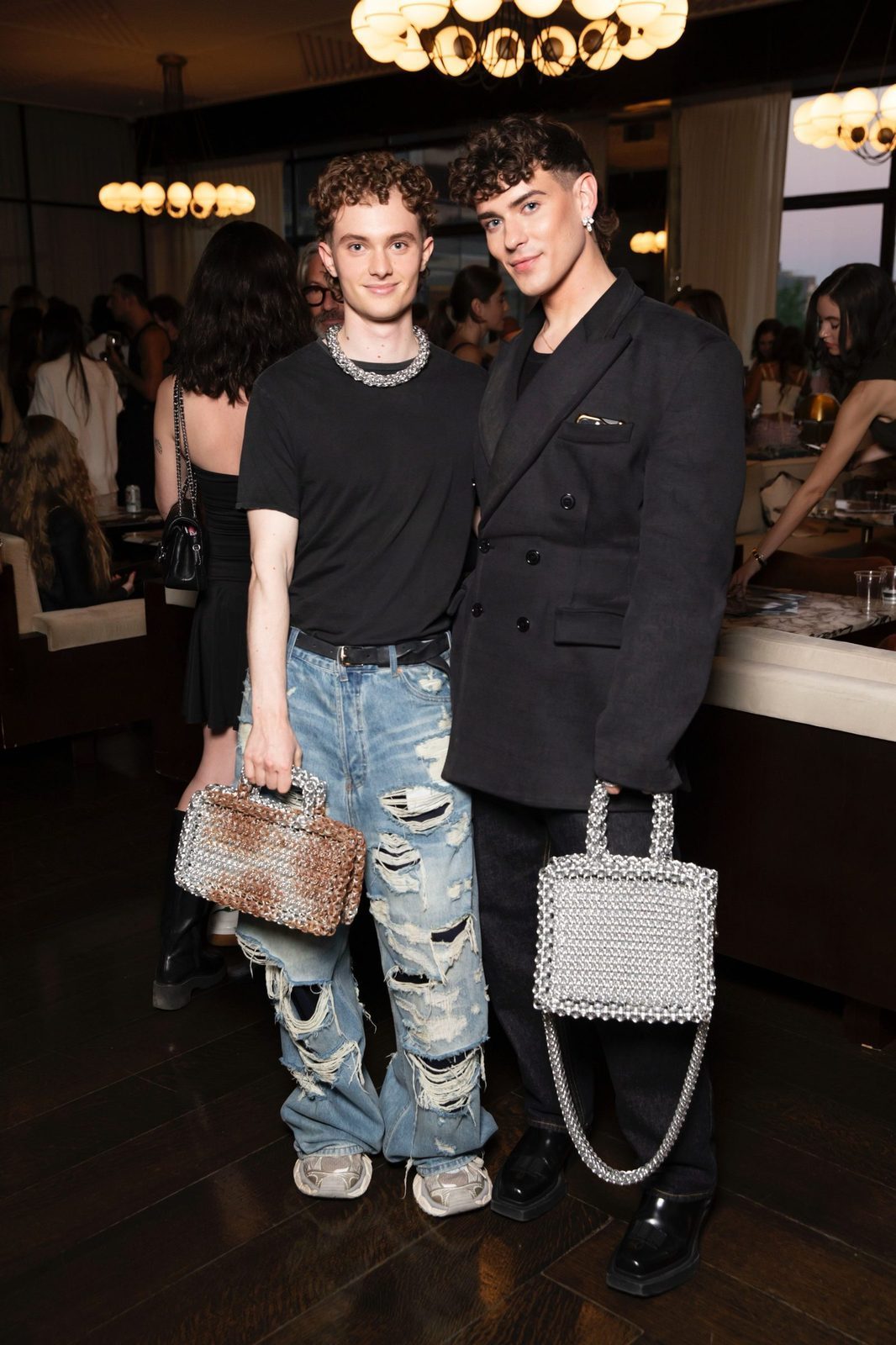
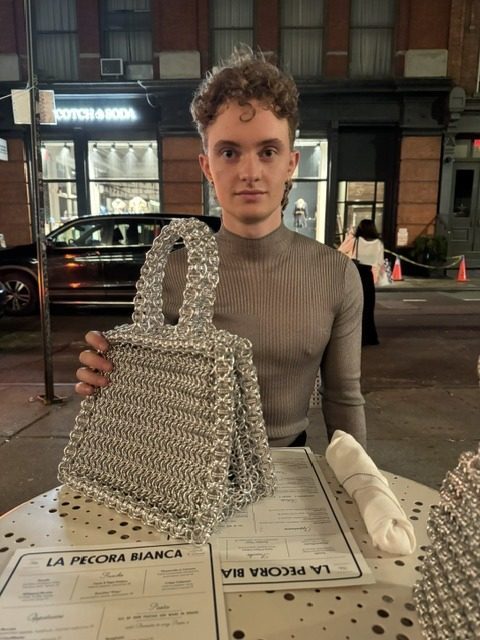
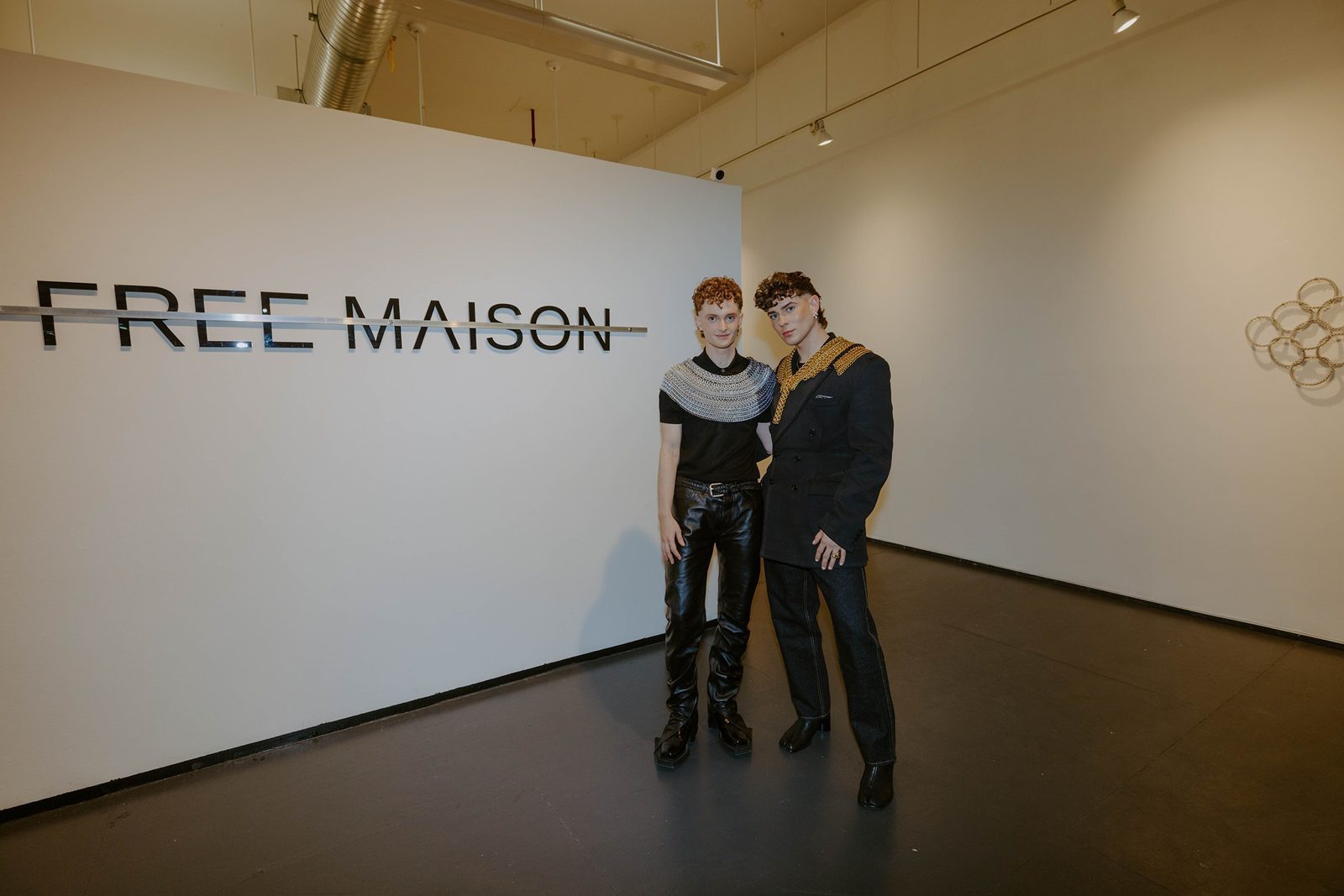
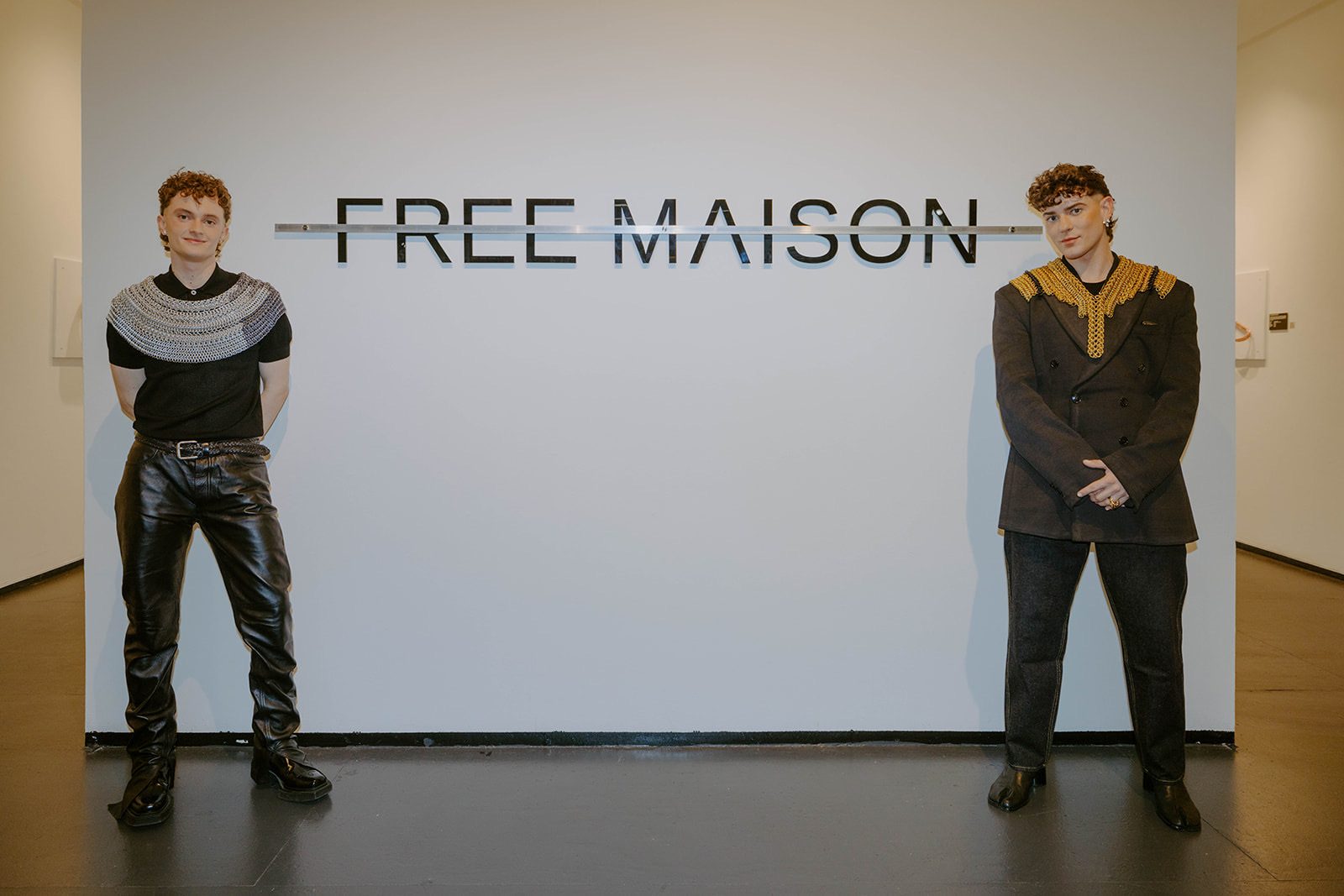
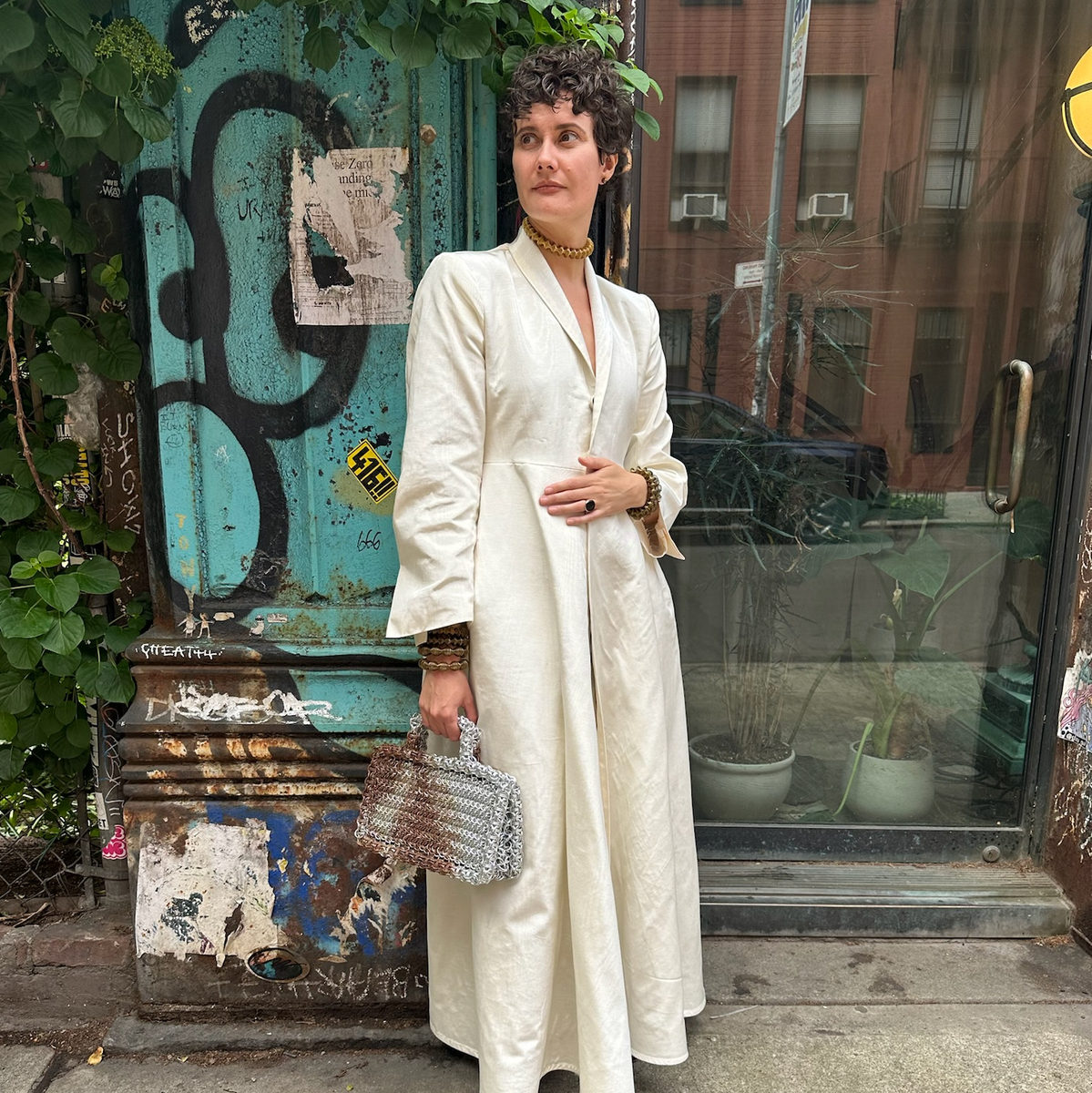
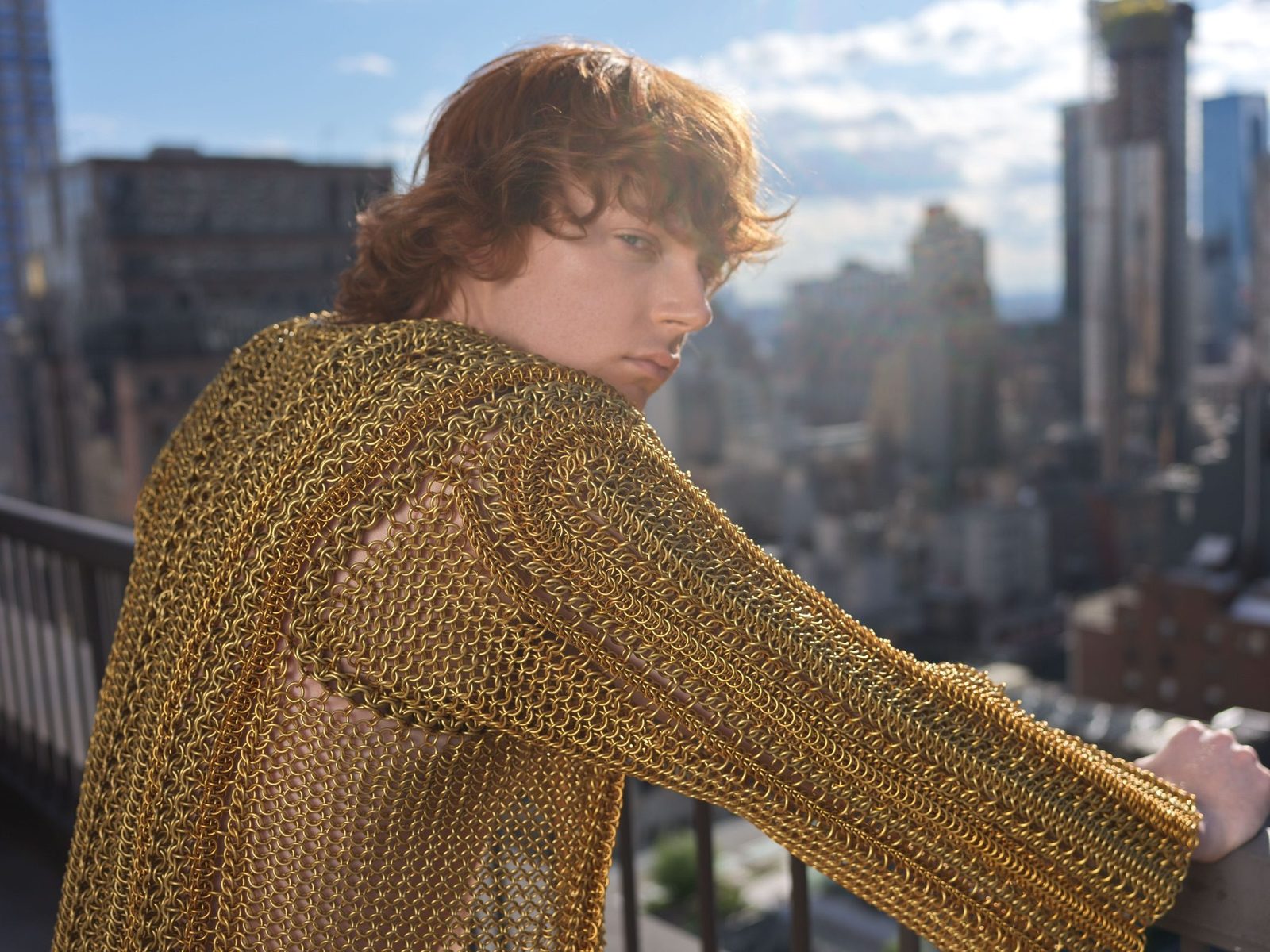
Free Maison is a Jersey City chainmail couture house founded in 2024 by Jesse Aviv and Tay Dun. The house creates classical hand-woven chainmail garments, handbags, jewelry, and art objects — one ring at a time. Free from social media. Wearable art for a dangerous world.
Free Maison specializes in classical hand-woven maille, ciphered chainmail construction, chainmail handbags, couture garments, chainmail jewelry, and wearable art objects made from anodized aluminum in Jersey City.
Made to order · Ships within 4–6 weeks · Jersey City
Chainmail couture & art · Handmade · One ring at a time

There are some things machines still cannot achieve. Like armor of past eras, every Free Maison piece is, and must be, completed by hand. Our pieces are unique designs not offered anywhere else in the world. Being made of 100% metal, they provide security in addition to beauty. Anodized aluminum does not oxidize or rust, lending the pieces a finish that lasts a lifetime.

Designer · Chainmail Artist · Computational Chemist
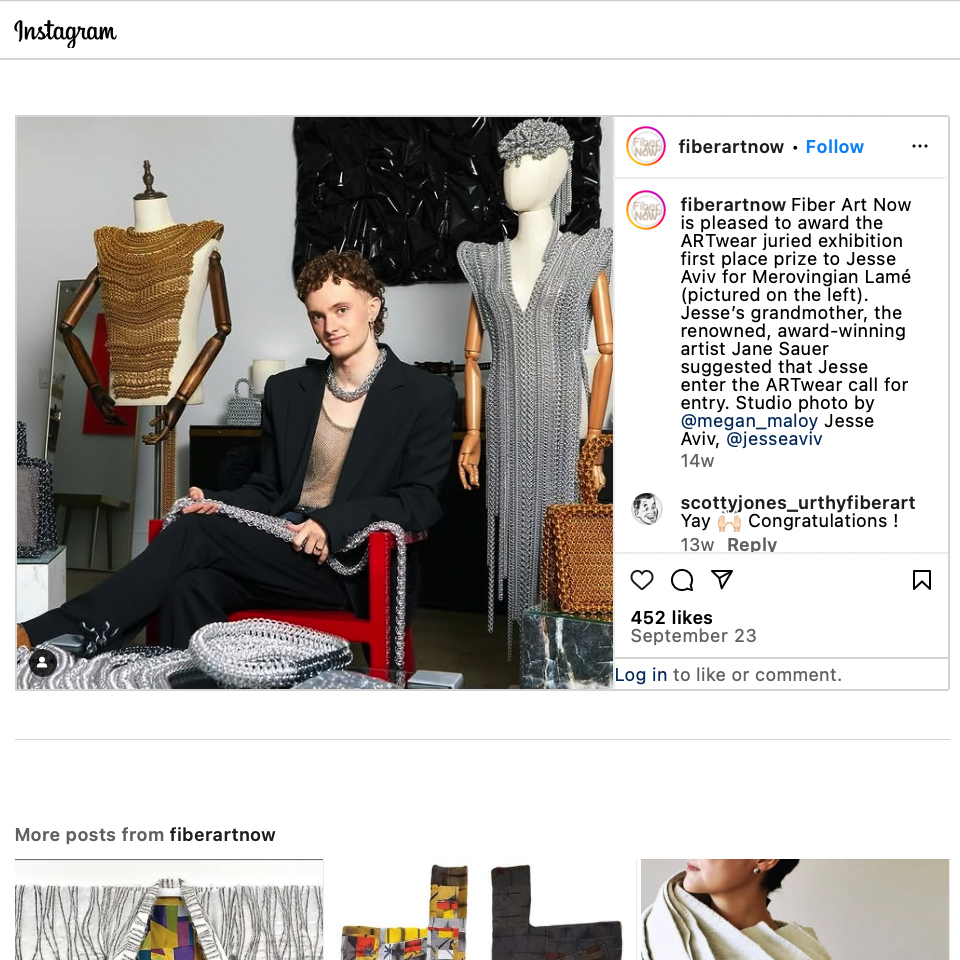
Jesse Aviv grew up in Albuquerque, New Mexico with a passion for patterns and engineering. His grandmother, fiber artist Jane Sauer, gave him his first textile lesson at age eight, planting the seed for a lifetime of work in woven structure.
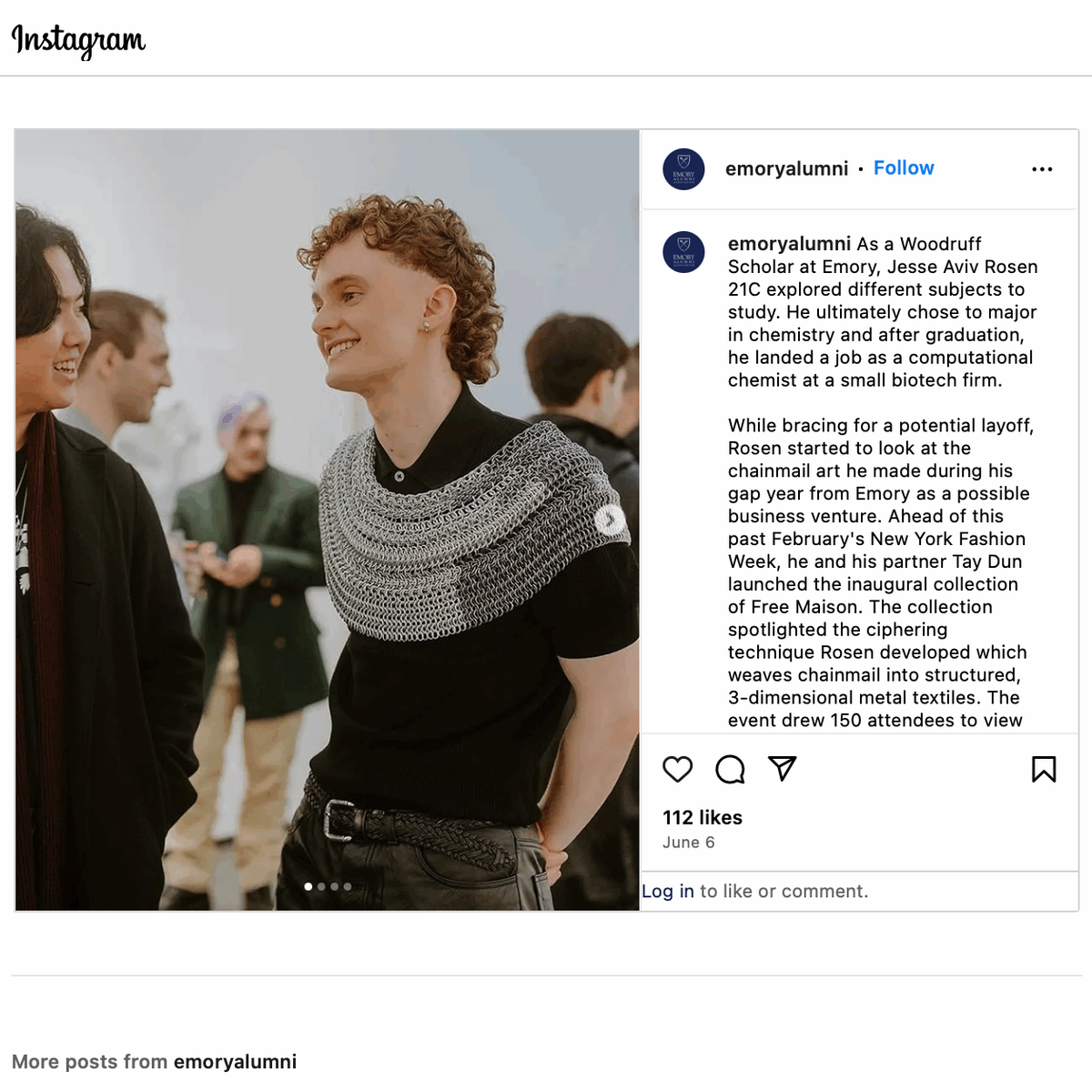
Aviv attended the United World College in Singapore at sixteen, then studied chemistry at Emory University on the prestigious Woodruff Scholarship. He went on to work as a computational chemist in biotech, and that scientific training never left. He talks about tension and structure like an engineer. He thinks about how rings interact the way a chemist thinks about molecular bonds. The logic is the same. The material is just different.
While working in biotech, Aviv picked up chainmail as a way to distinguish himself from a friend who was making clothes. The medium felt singular to him, and the queer and club kid communities in Chicago felt the same way. The pieces he made for himself drew immediate attention, leading to his first commissions. That early recognition confirmed what the material already told him: this was something worth following.
In September 2023, Aviv committed fully to the craft. Free Maison launched February 2024. He assembles every single piece himself, by hand, one ring at a time. He is intuitive in his process, following the material wherever it leads. Aviv pioneered the Ciphering technique: connecting multiple weaves at varying tensions to create structure, movement, and shape unprecedented in chainmail. No one else has done what he has done with this medium. He treats chainmail not as costume or novelty but as fine textile, and he does it entirely alone.

Creative Director · Brand Architect · Market Strategy
Tay Dun grew up on the Jersey Shore with an eye that was always collecting. Traveling globally with his mother during her work across Latin America, Europe, and Asia, he learned early that beauty doesn't look one way, that quality announces itself quietly, and that the unfamiliar is where the most interesting things live.
That instinct carried him into fashion, where he worked under some of the industry's most defining creative and executive minds: Angela Ahrendts, Christopher Bailey, Dominico De Sole, Andrew Rosen, and his creative hero, Tom Ford. Across houses like Burberry, Theory, and Tom Ford Beauty, Dun absorbed a lesson that would shape everything he built after: taste is a point of view, not a trend.
For Dun, fashion and style have always been about distinction. You against everyone else. What do you feel good in, confident in. How do you develop something so personal that you as an individual become memorable. That philosophy runs through every decision at Free Maison.
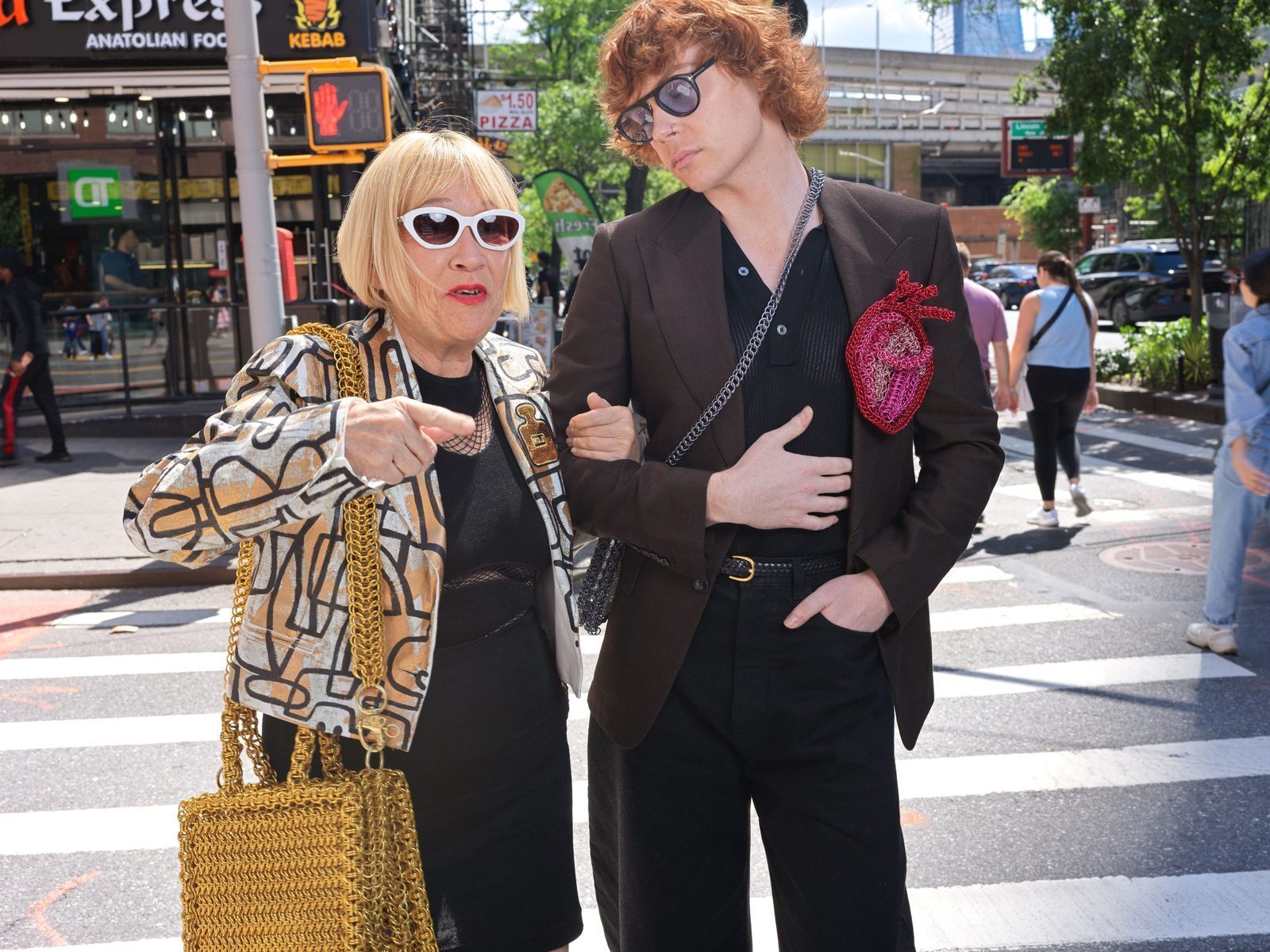
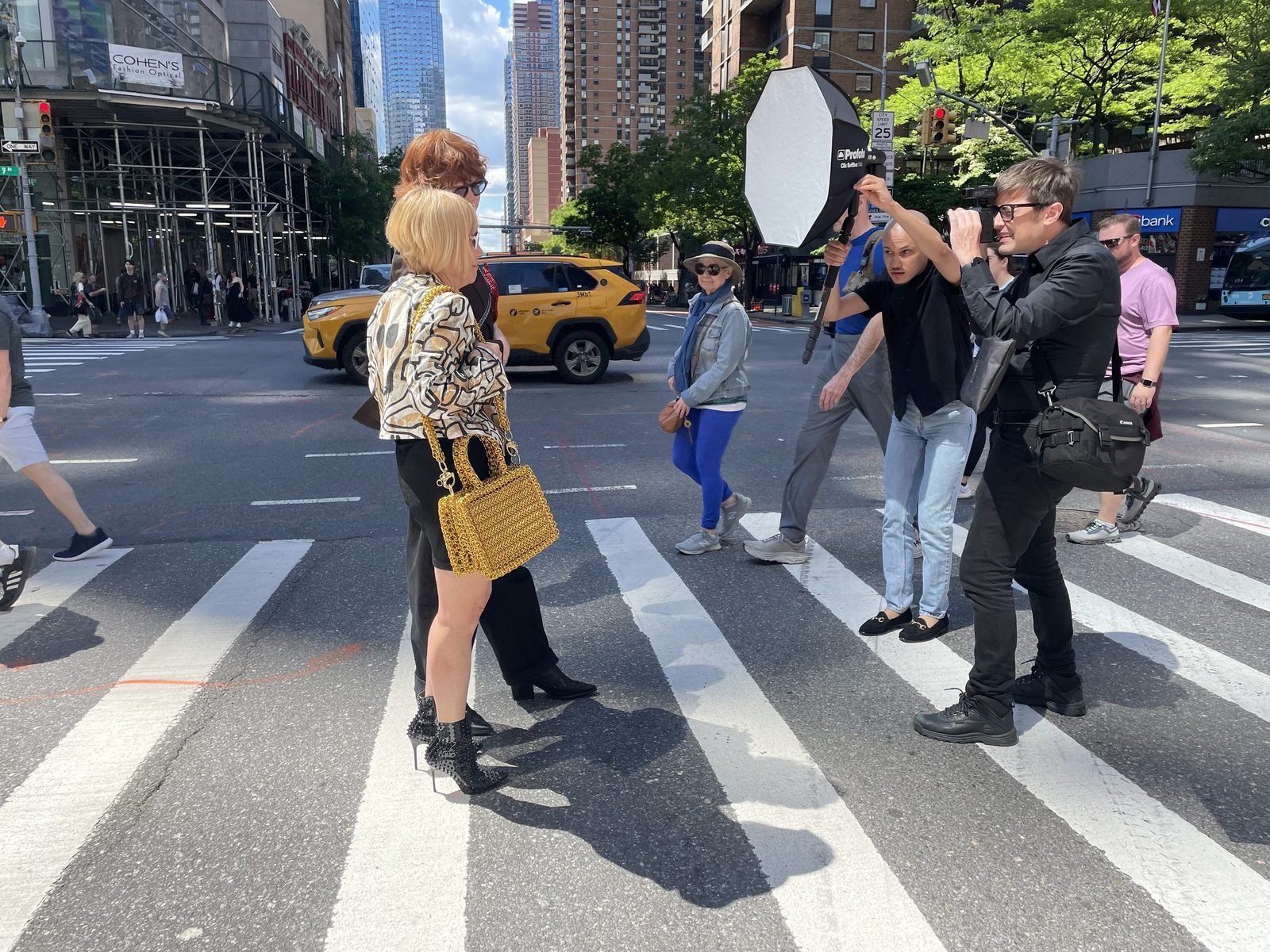
Dun and Aviv were admirers of each other's work long before Free Maison existed. When Jesse made a chainmail piece for Tay and Tay suggested he try making a bag, the reactions it drew on the street made something clear. This wasn't just craft. This was a brand waiting to be built. Dun saw what Jesse's hands could do and curated a world around it. Free Maison launched in February 2024.
Where Aviv builds the objects, Dun constructs the narrative. He oversees all creative output, commercial operations, pricing, and go-to-market strategy — including all styling for the brand. His approach is personal and intentional. Free Maison doesn't chase virality or bend toward whatever is trending. These pieces take hours to complete. They are armor built from history, personally made for the individual, and built to last generations. The goal has always been to create a category that didn't exist before, and to make the people who wear it feel powerful.

Pieces within Free Maison's collection take between 15 and 220 hours to complete — depending on the size of the piece and complexity of the design.
Free Maison · About Chainmail
Flared shoulders. Free-standing bags. Structural elements of chainmail distinguish Aviv's work — form that holds its shape independent of the body wearing it.
Aviv's pioneered technique: multiple weaves with differing physical properties, connected at varying tensions. Structure and shape emerge from the logic of the weave itself.
Every piece is meant to be used. From bags to dresses to baskets — Free Maison designs for utility as well as aesthetics. The object must earn its existence.

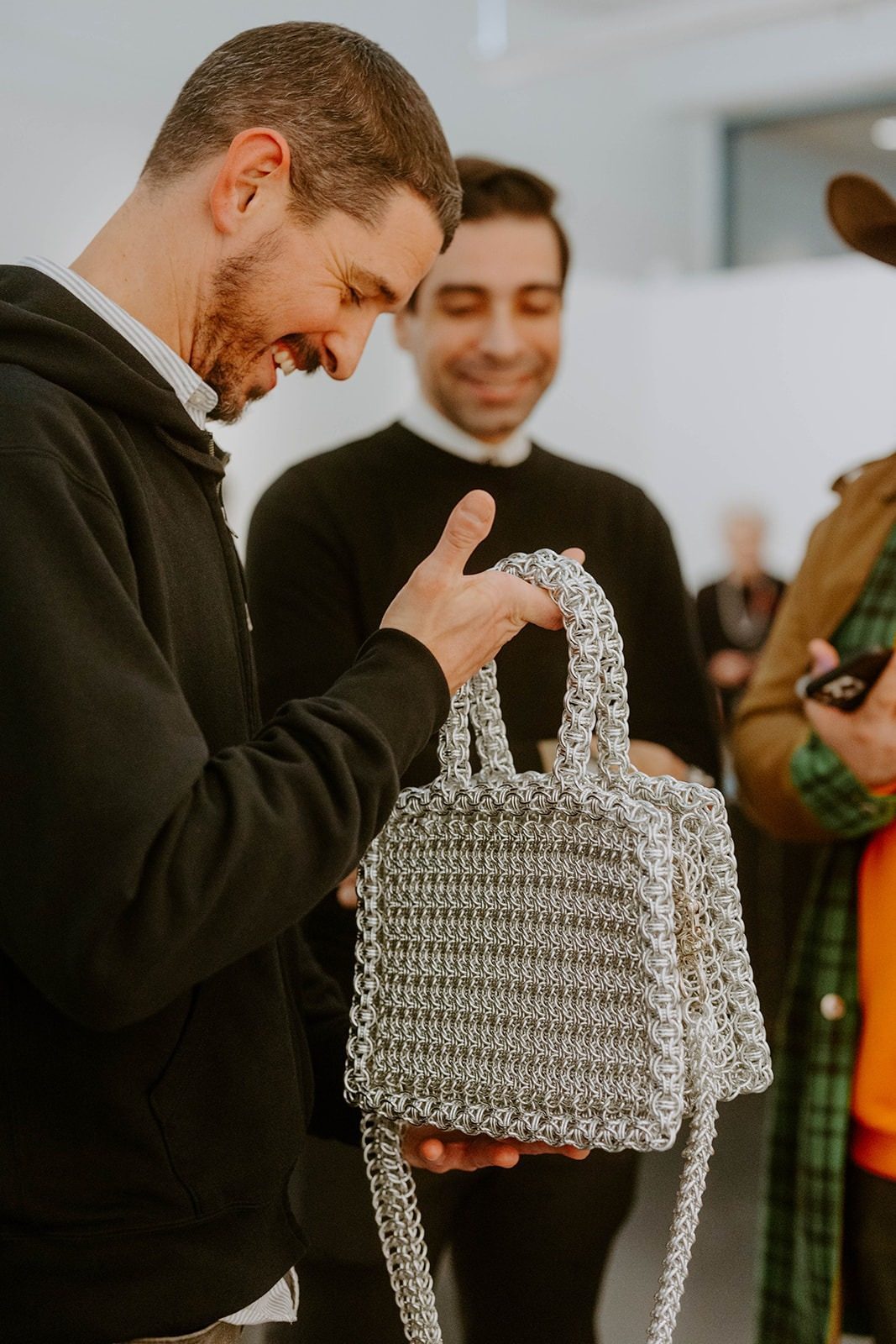
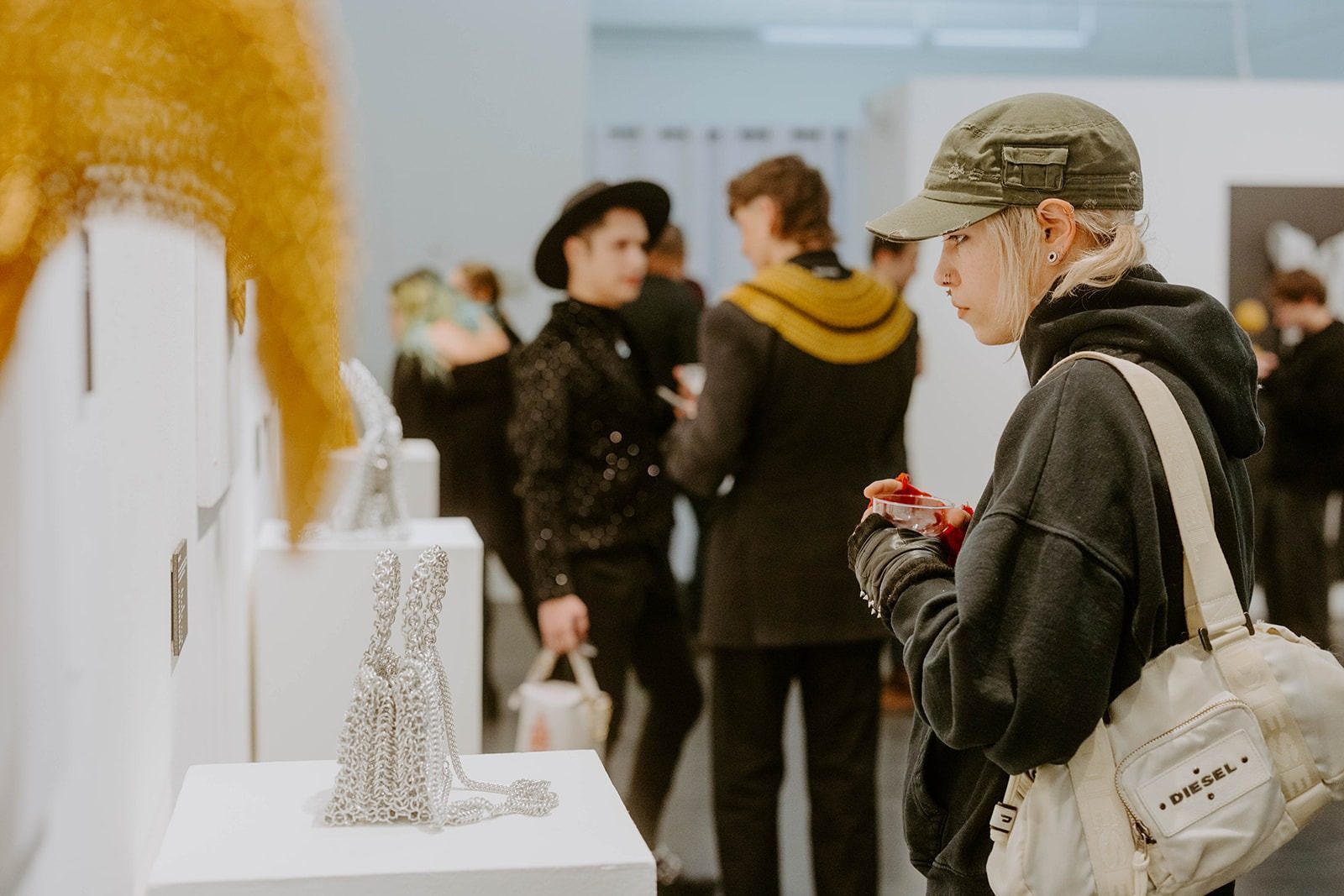
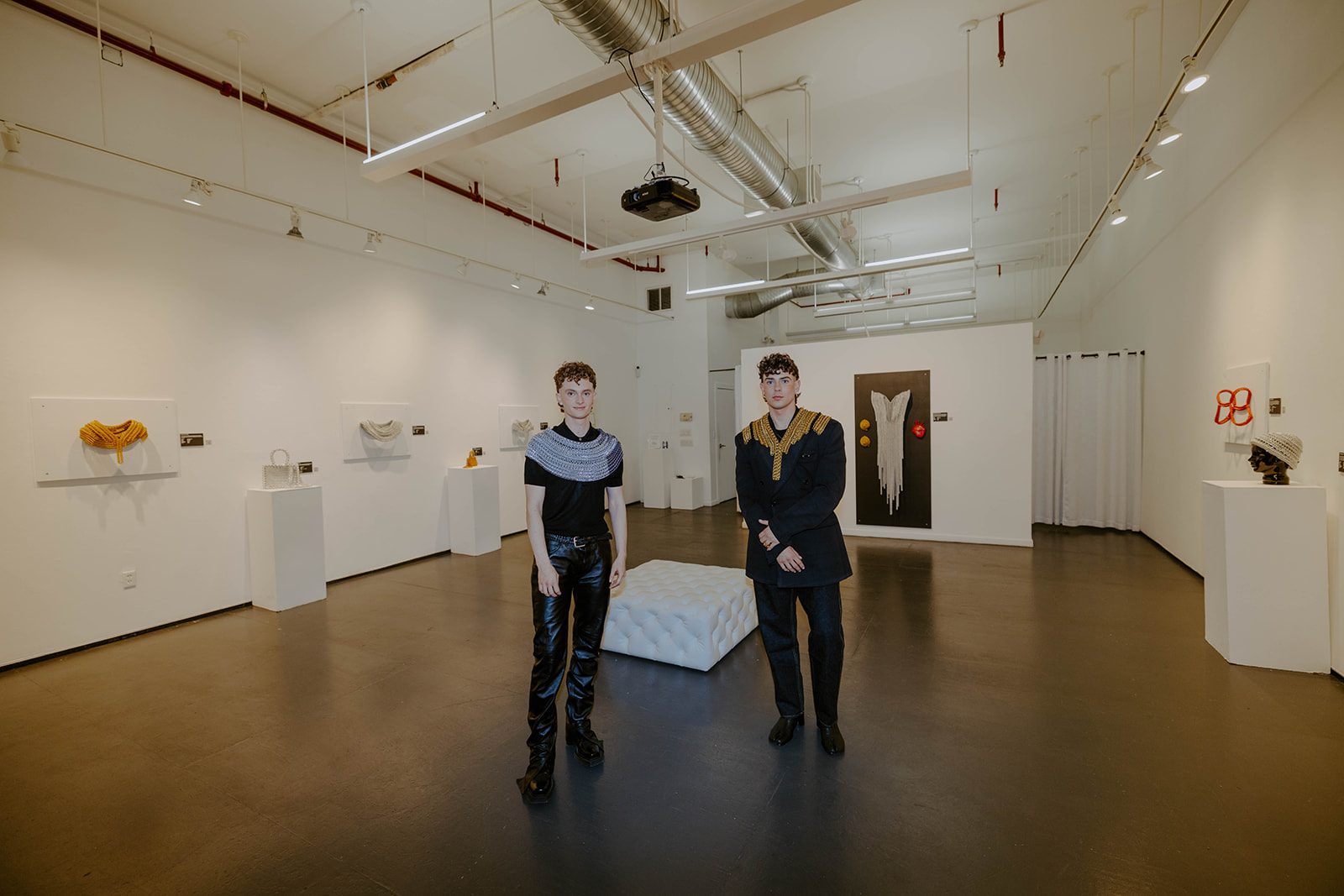
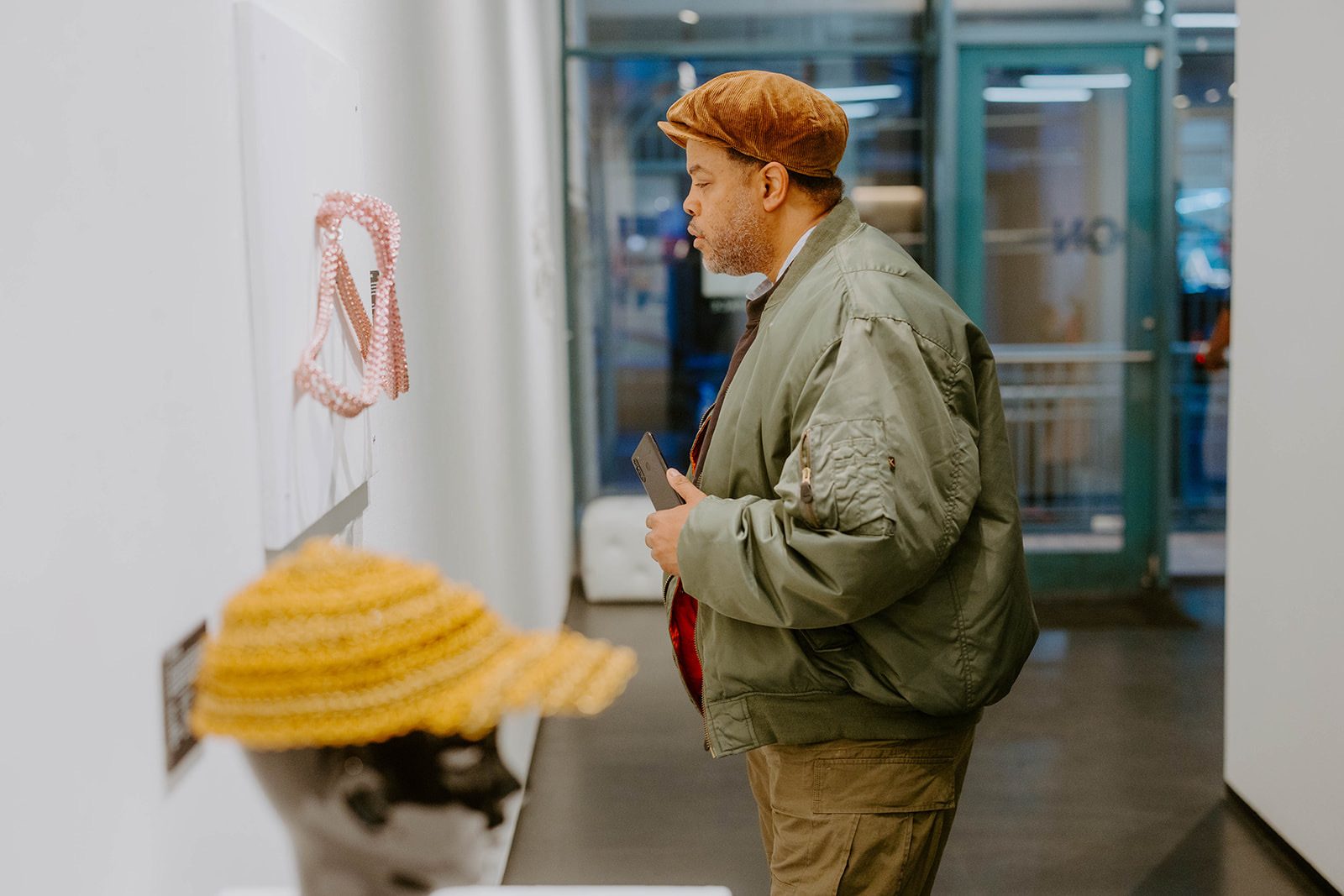
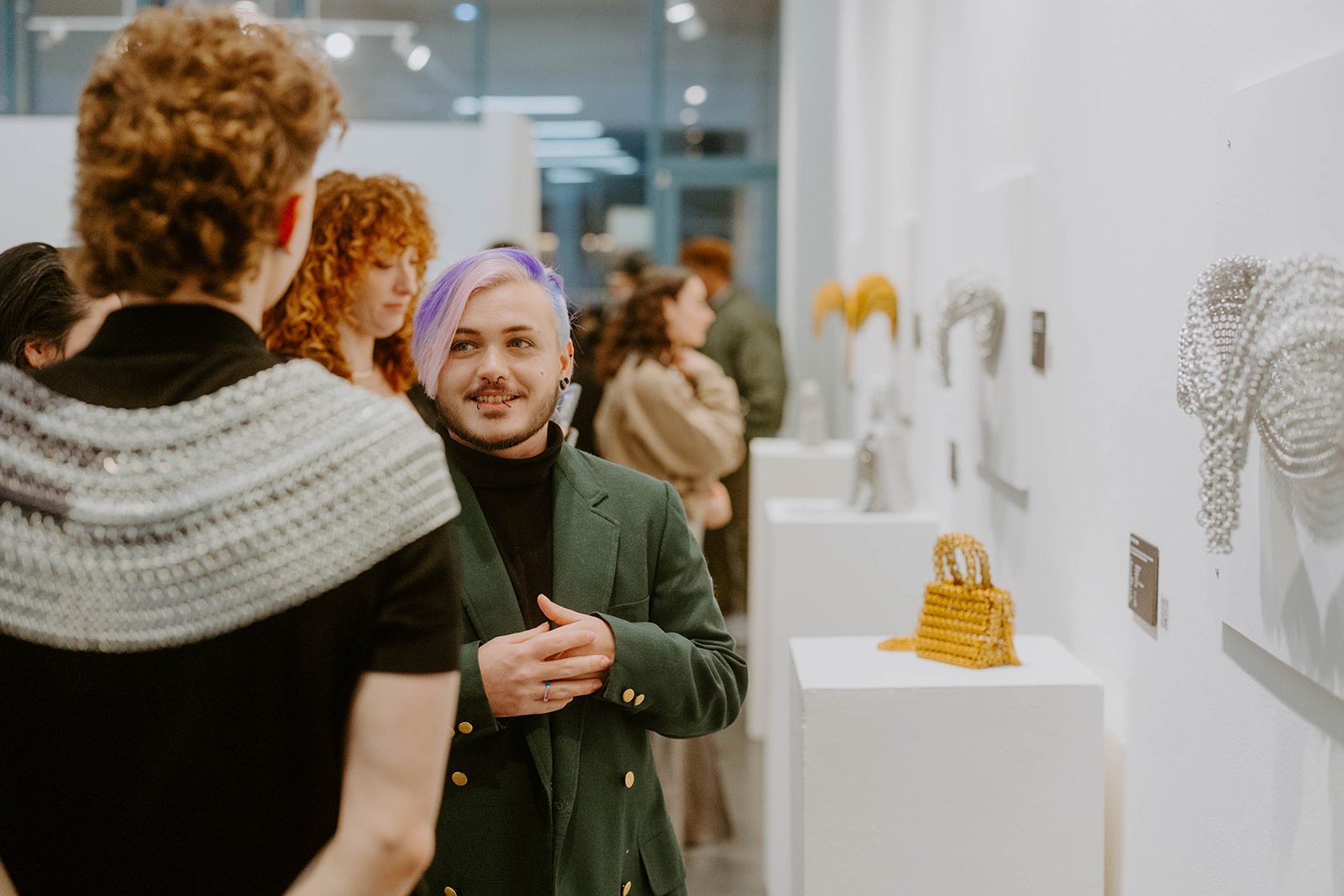
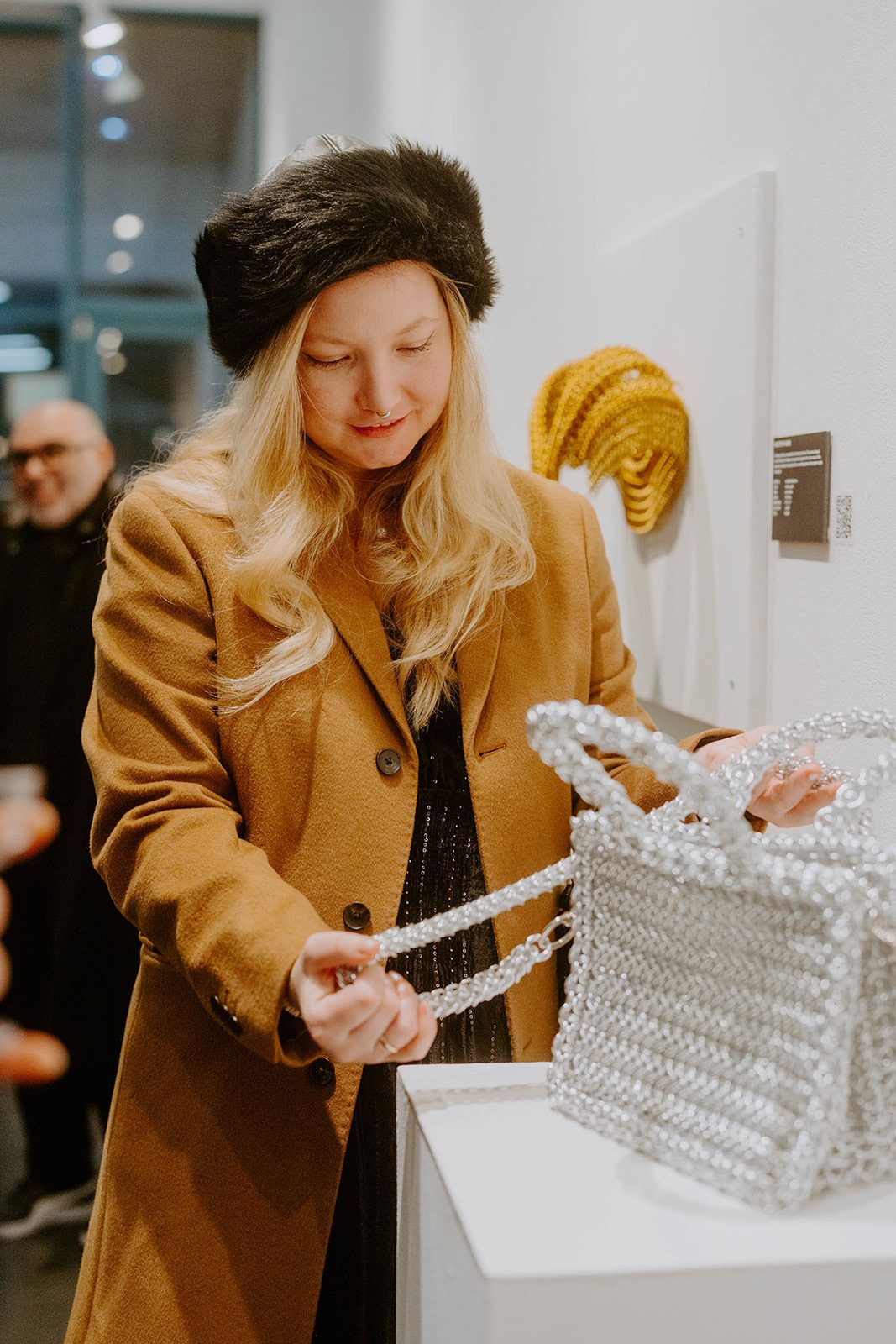
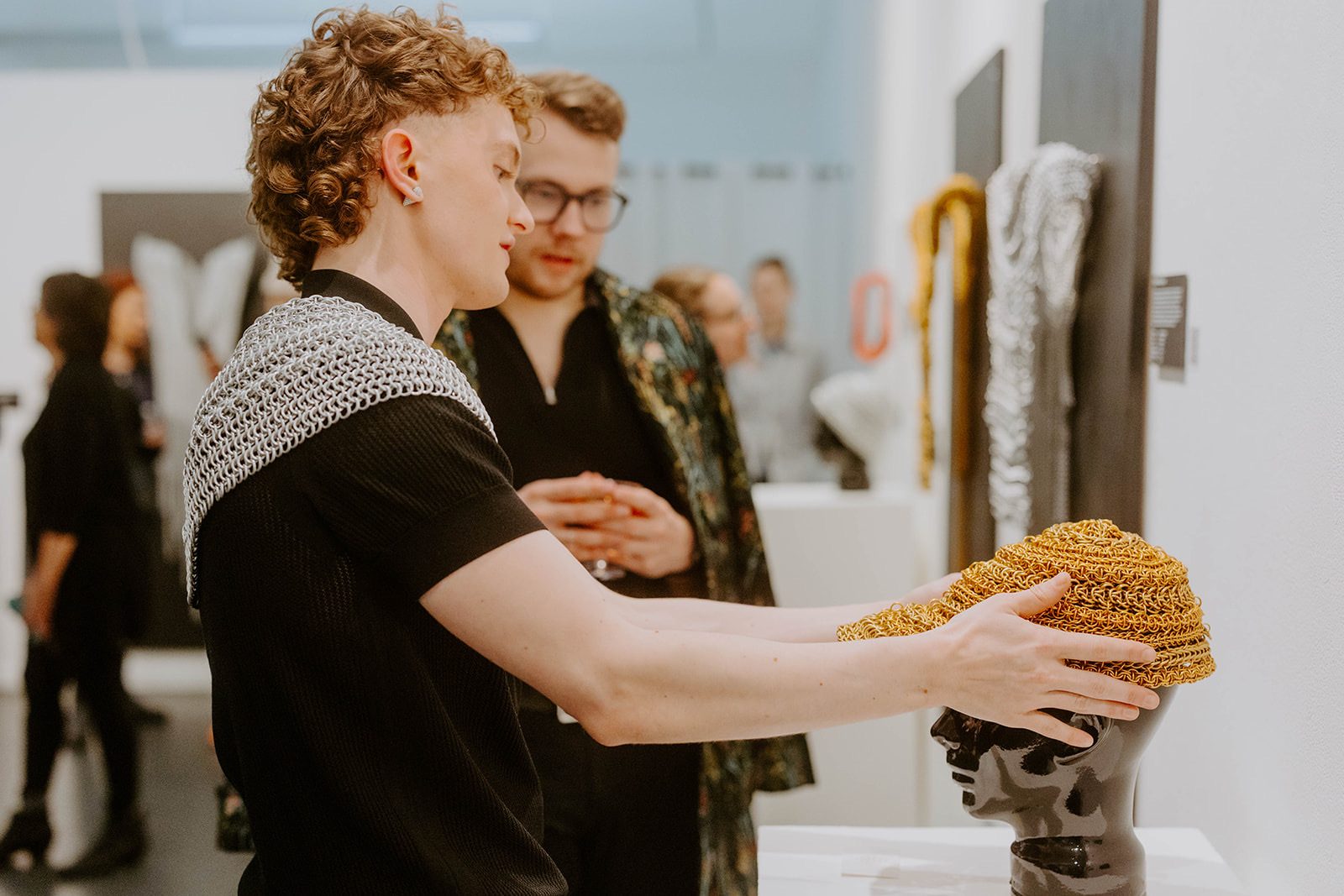
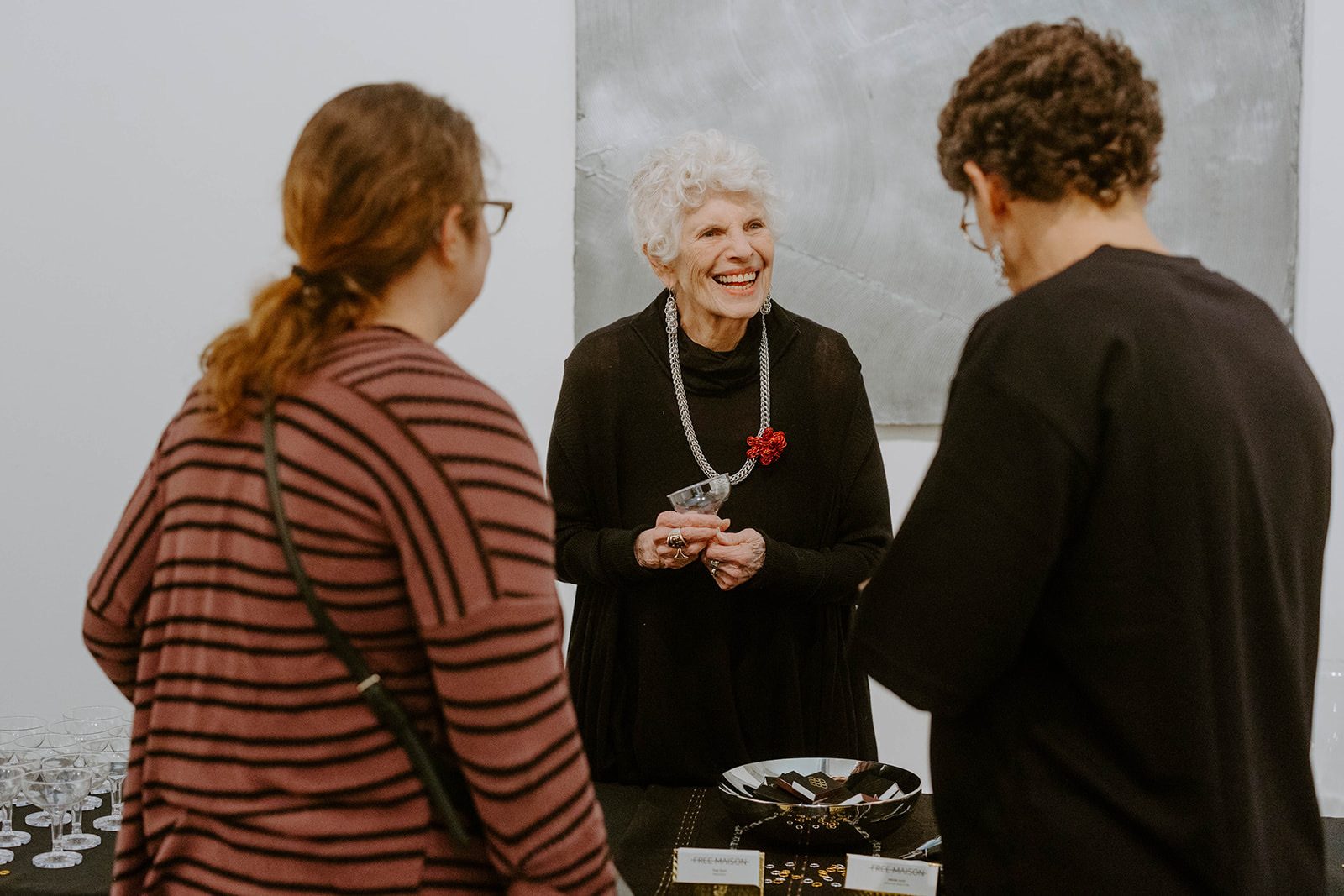
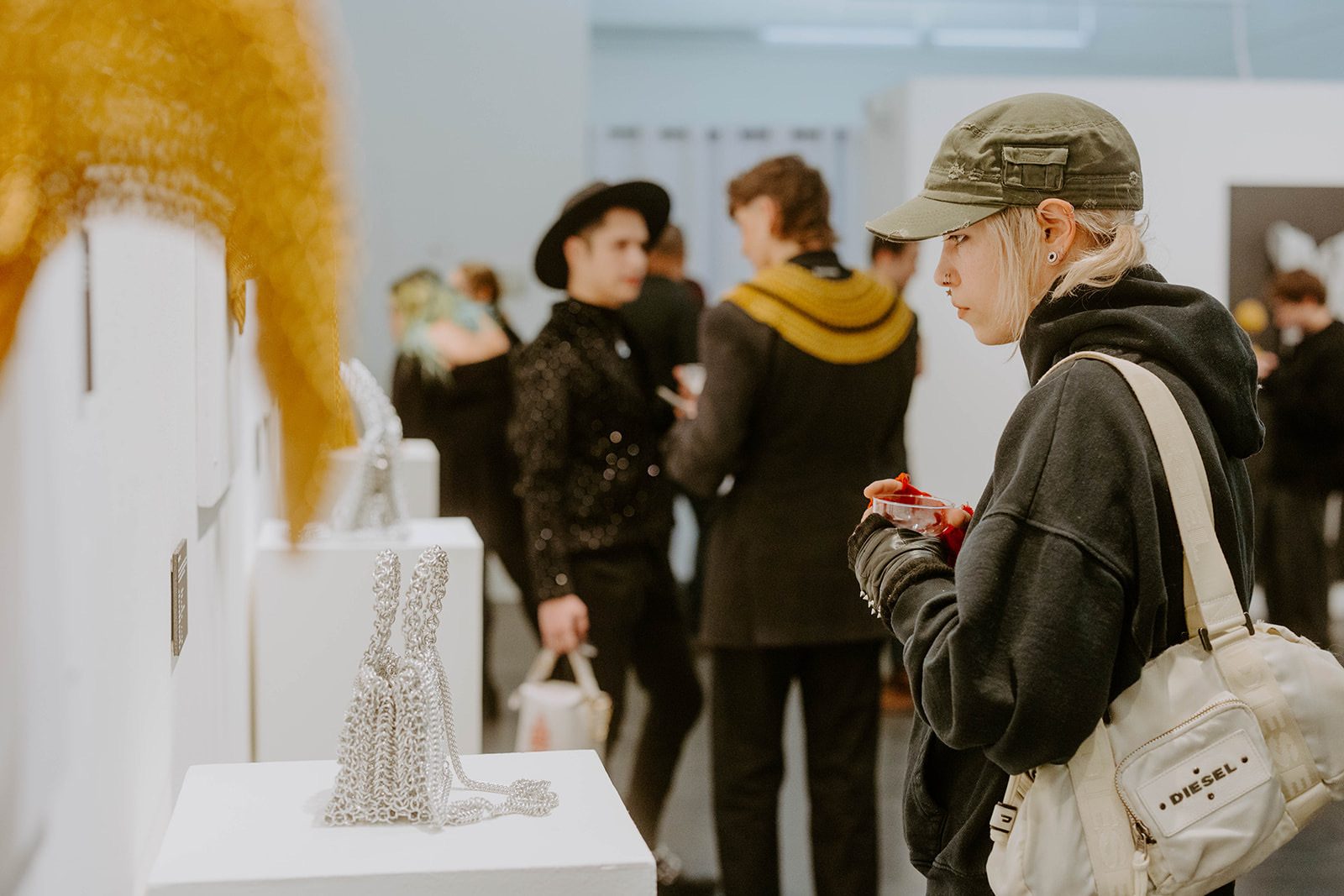
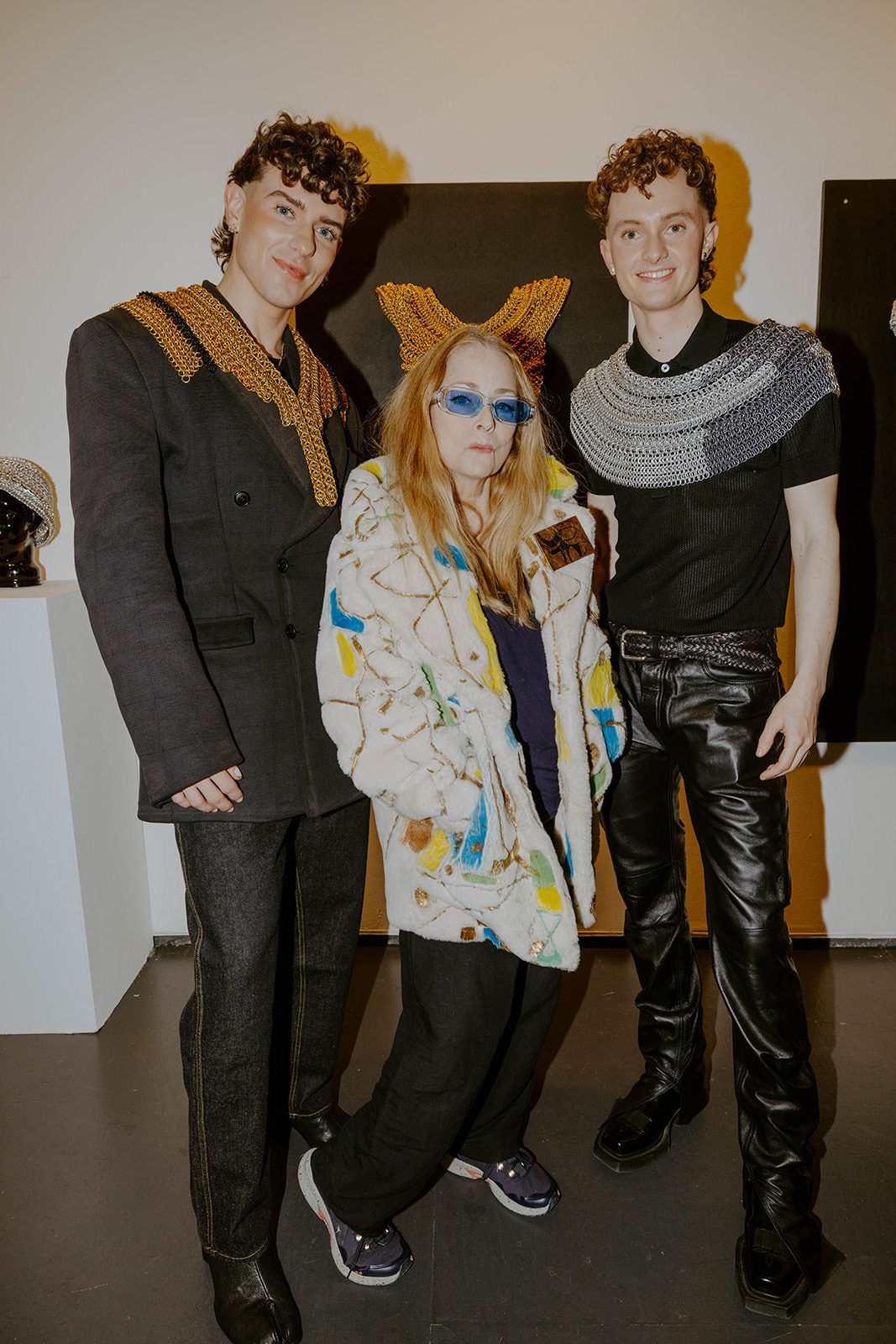
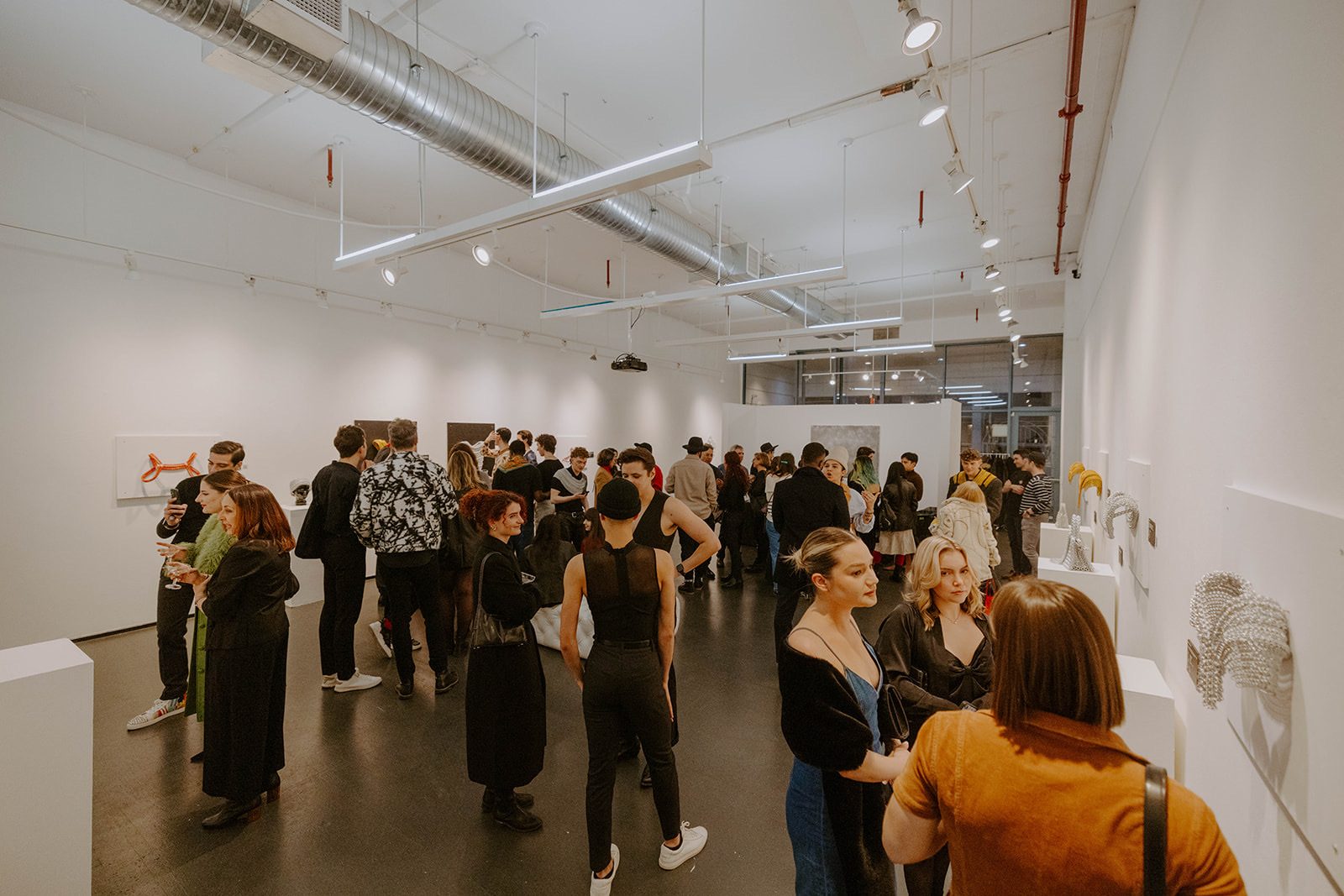
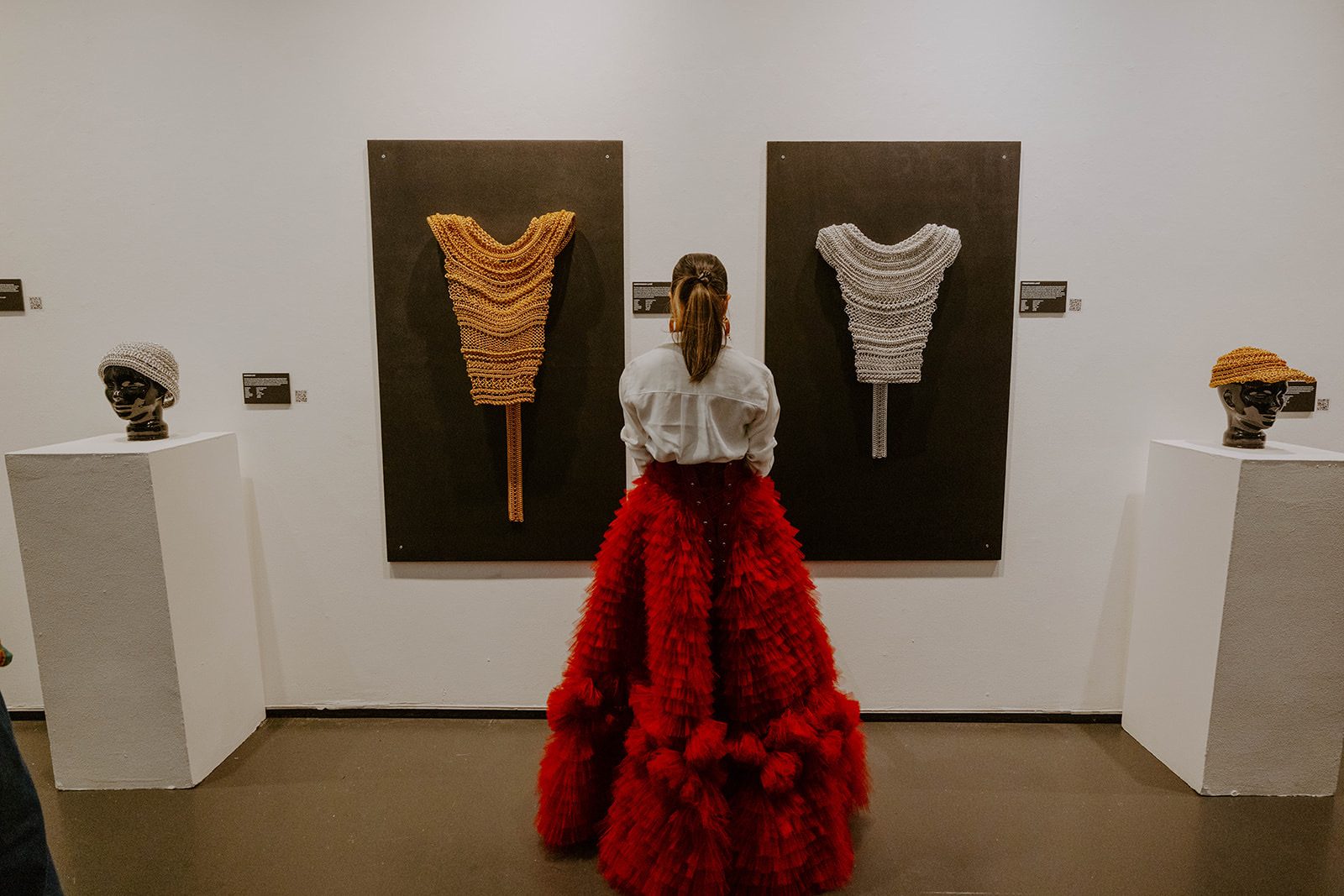
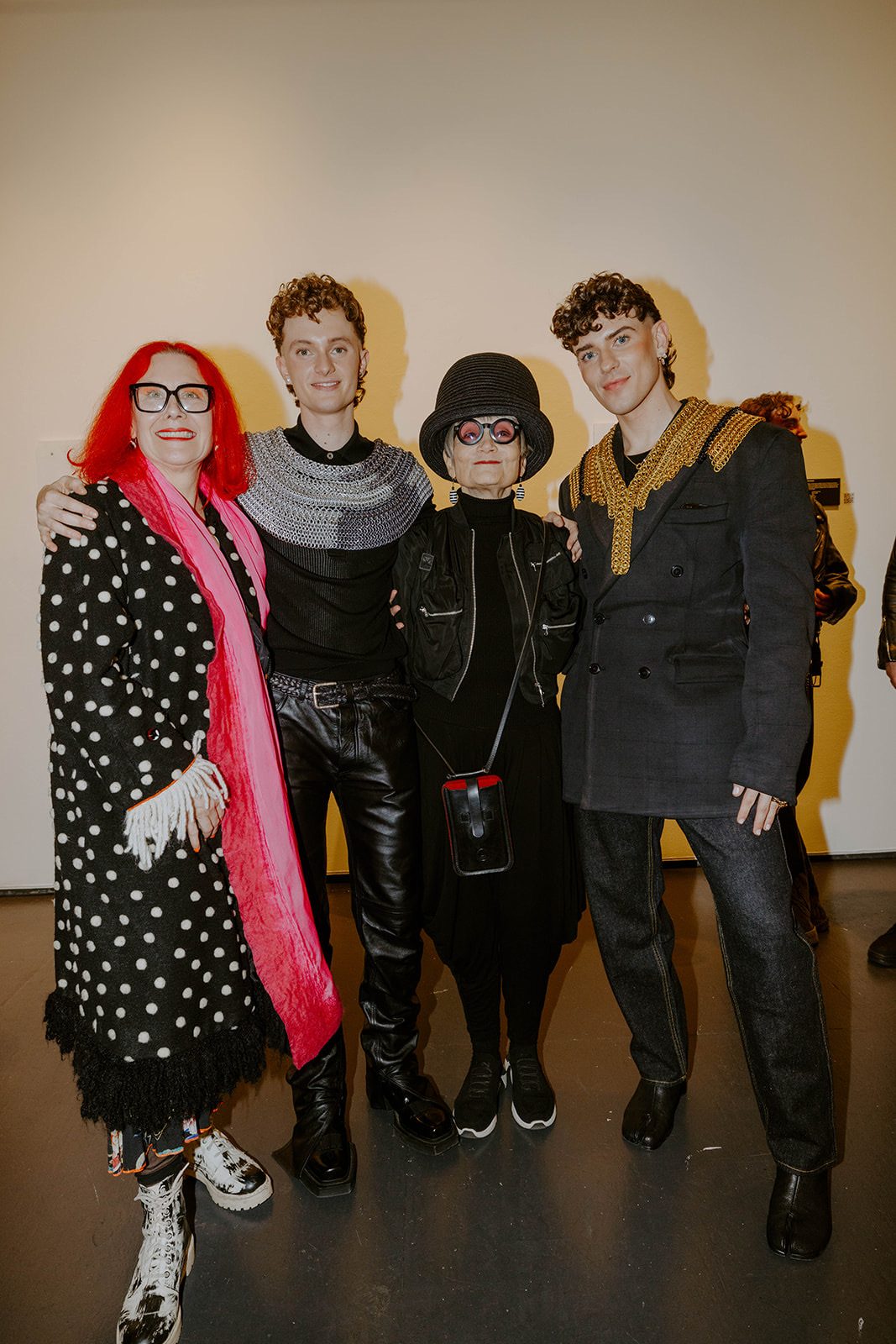
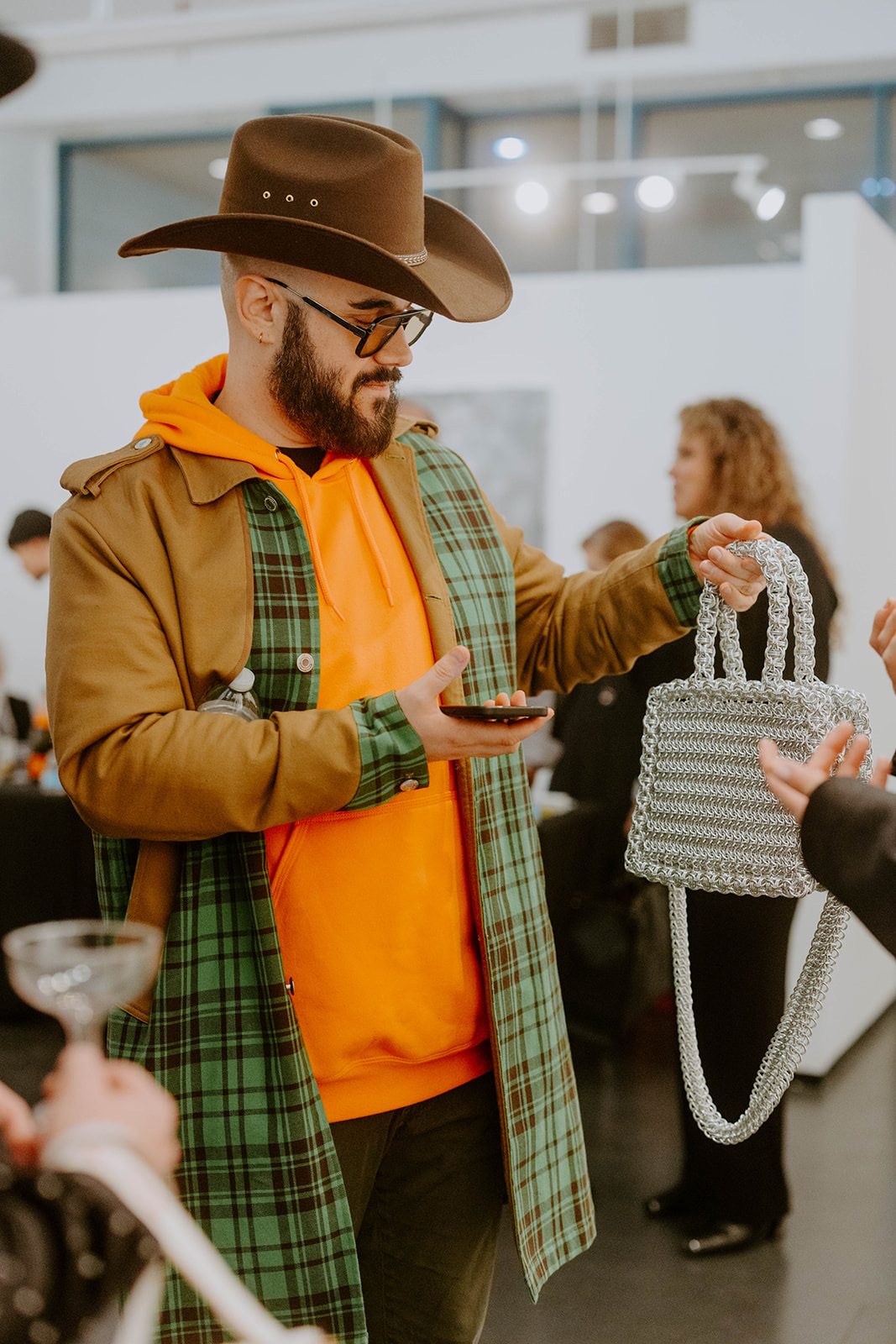
Free Maison debuted to the New York art and fashion community in February 2024 — an intimate gathering of collectors, artists, and collaborators who became the brand's first witnesses.


Activation
Devil Wears Prada 2 · Molly Rogers · Brian Solis
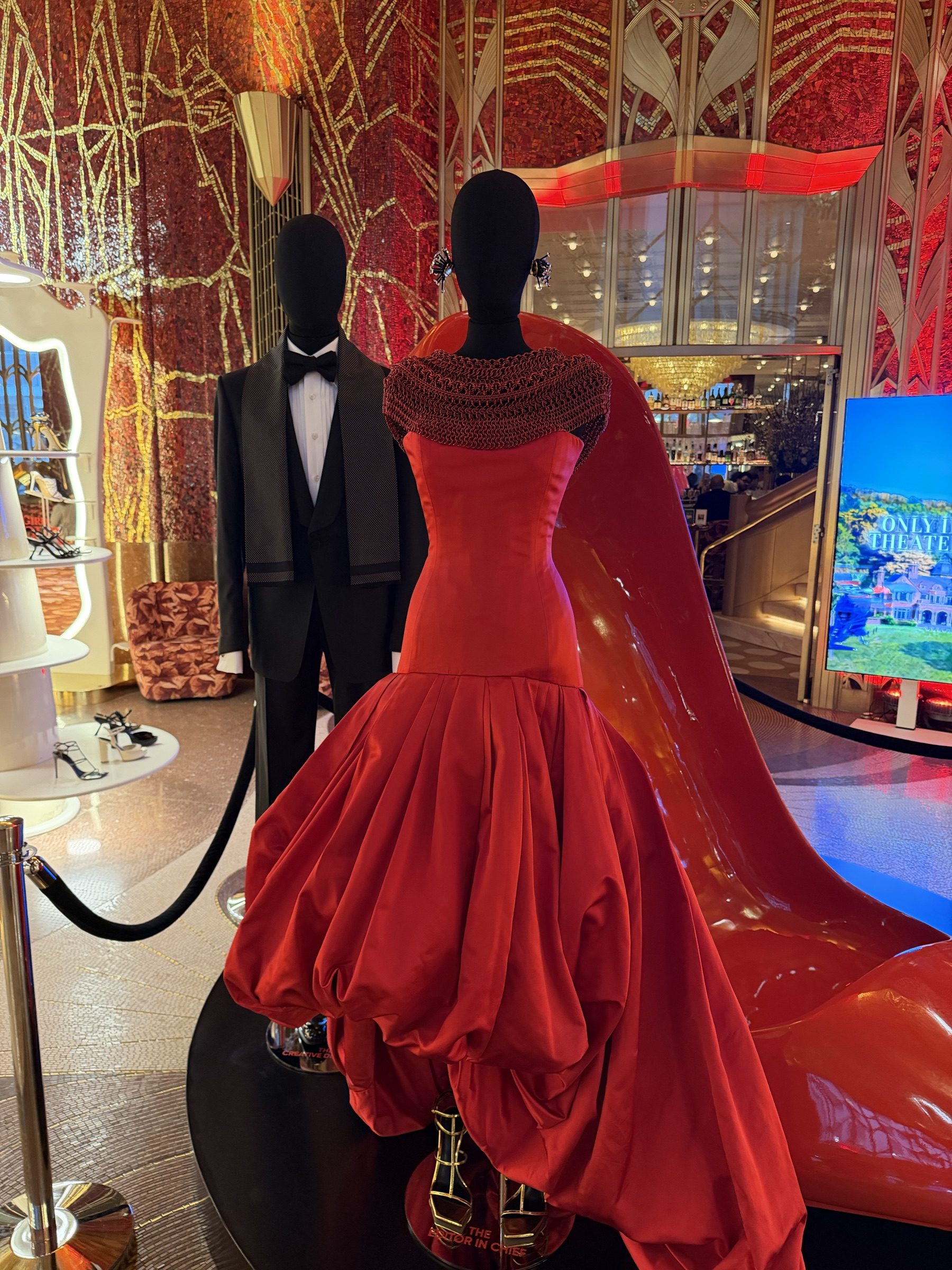
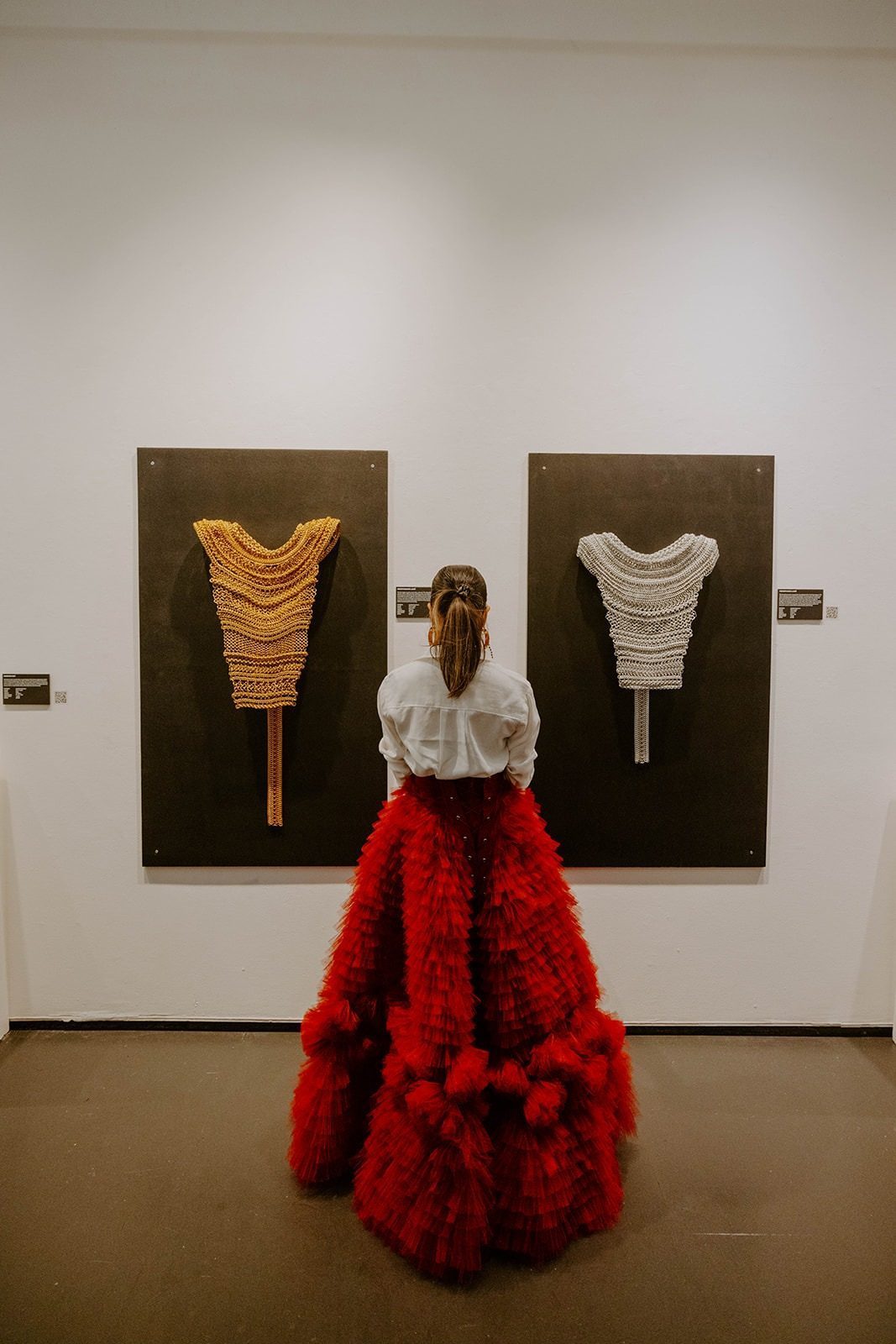
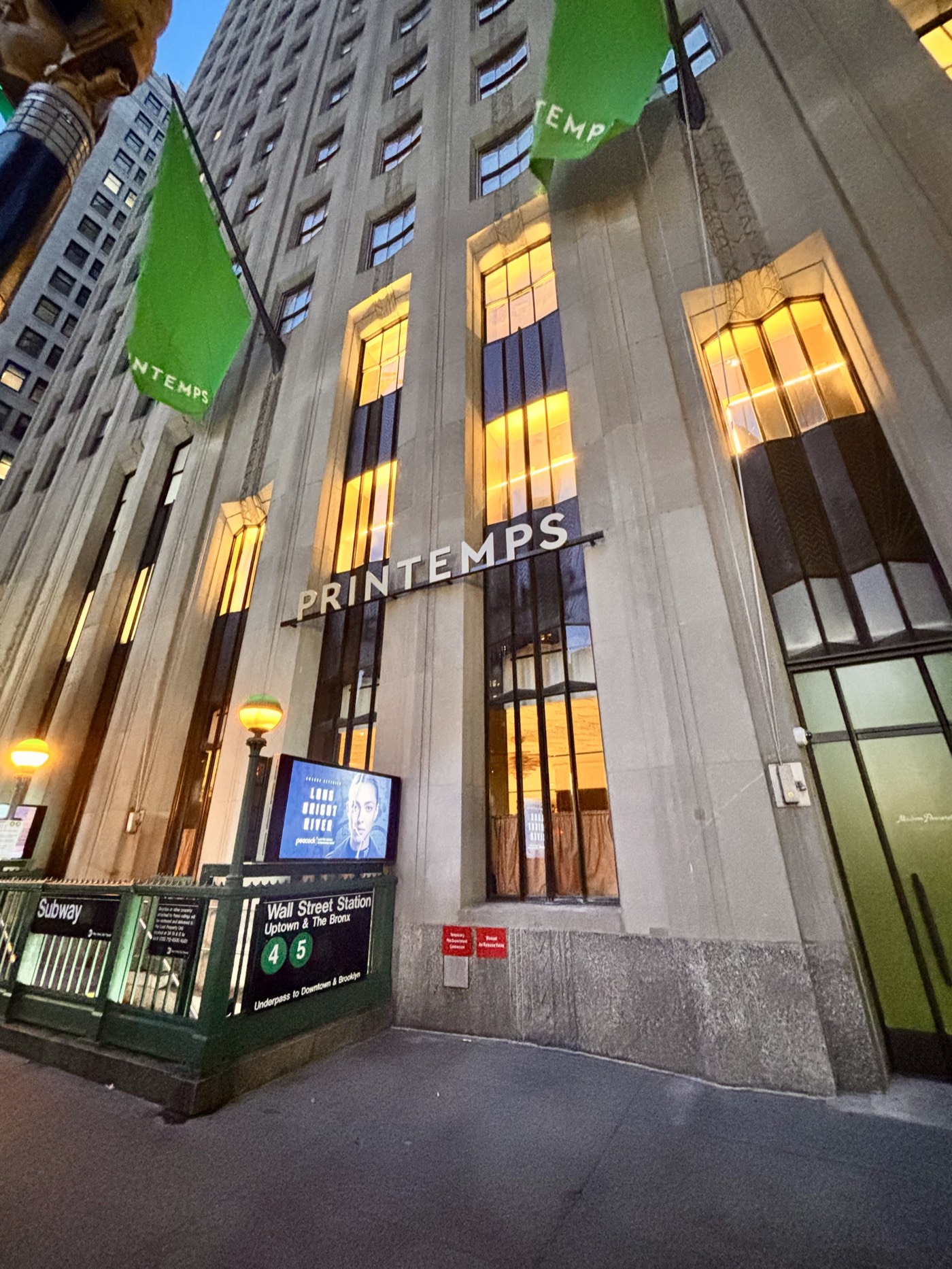
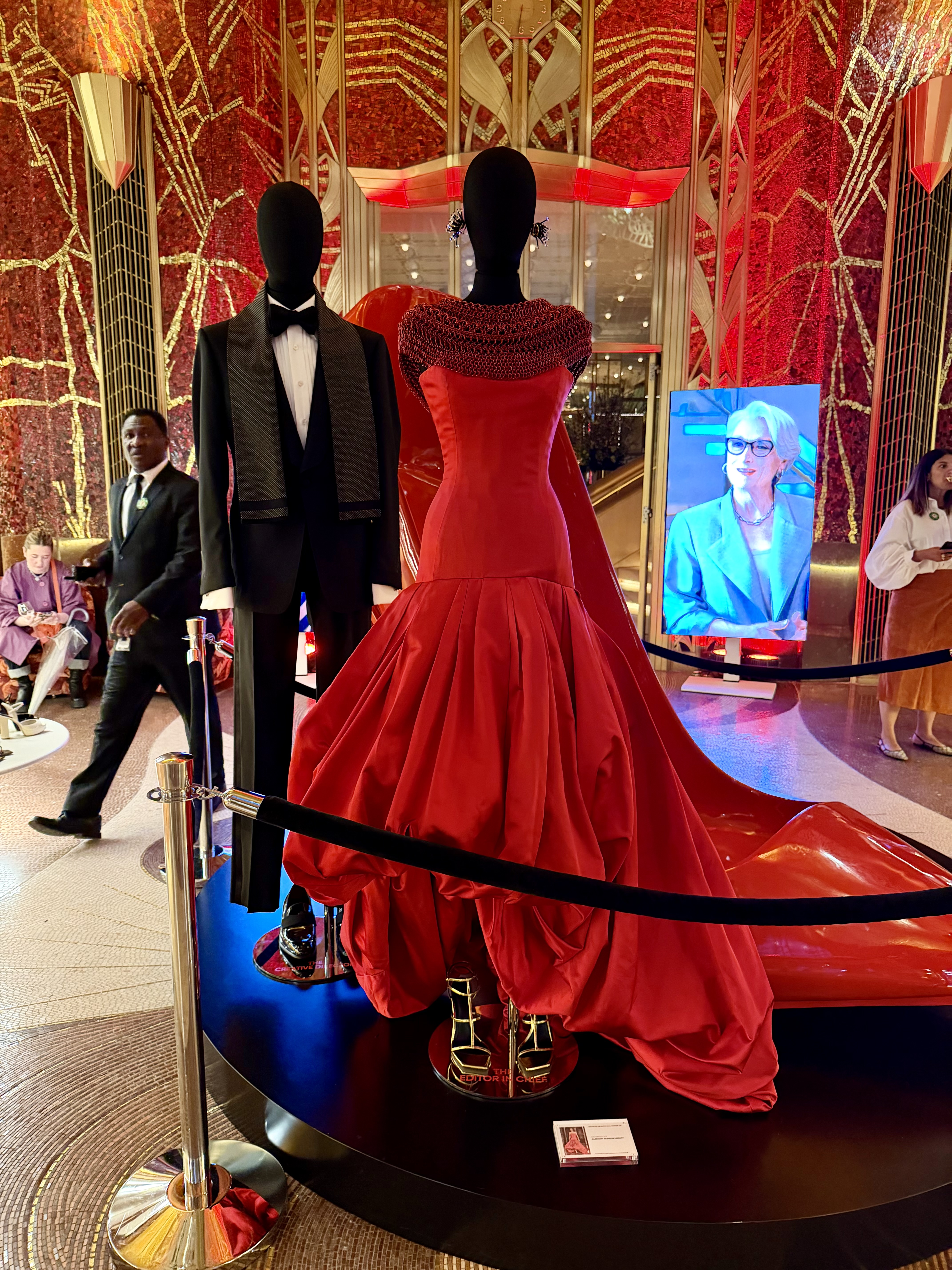
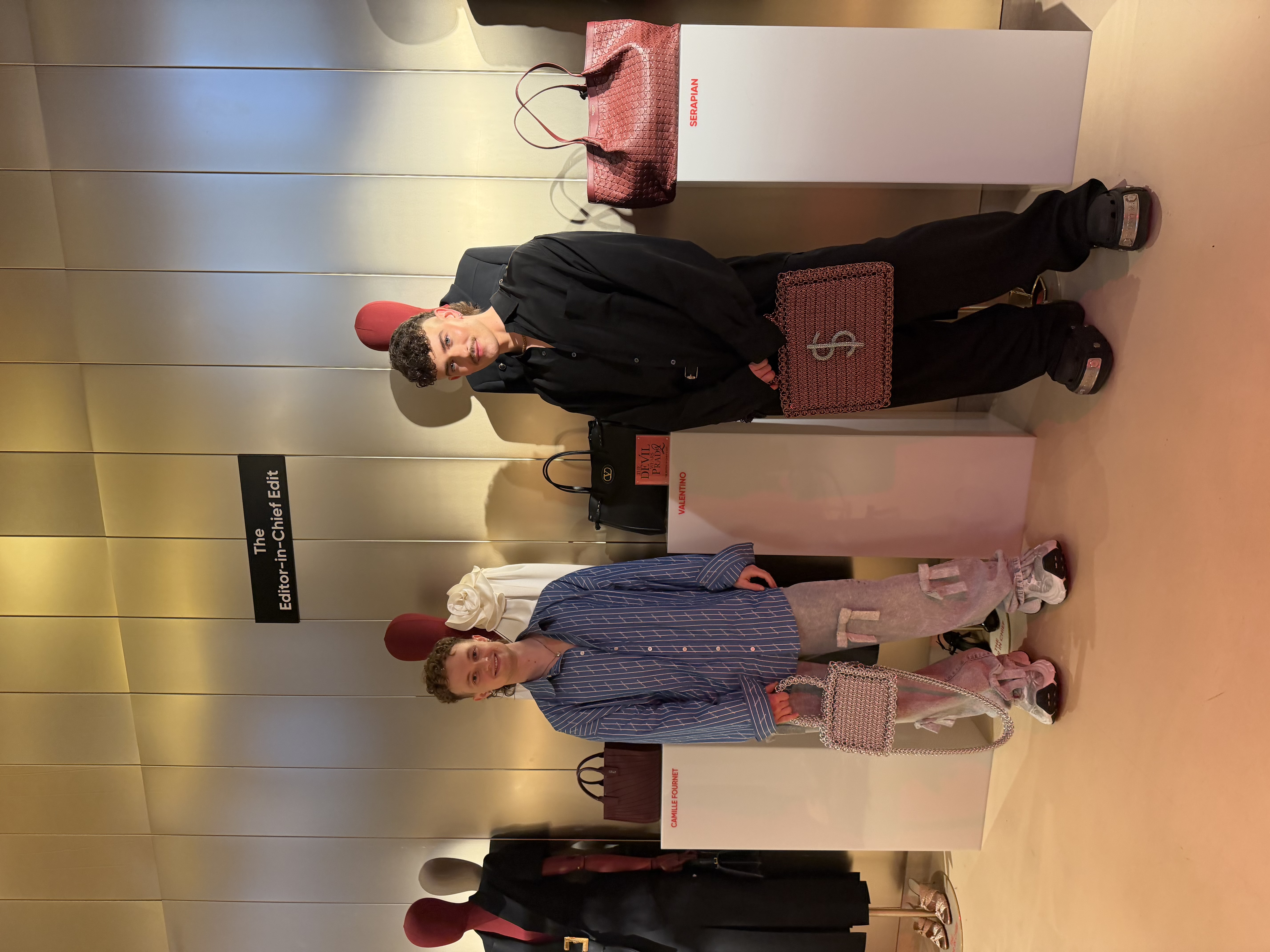
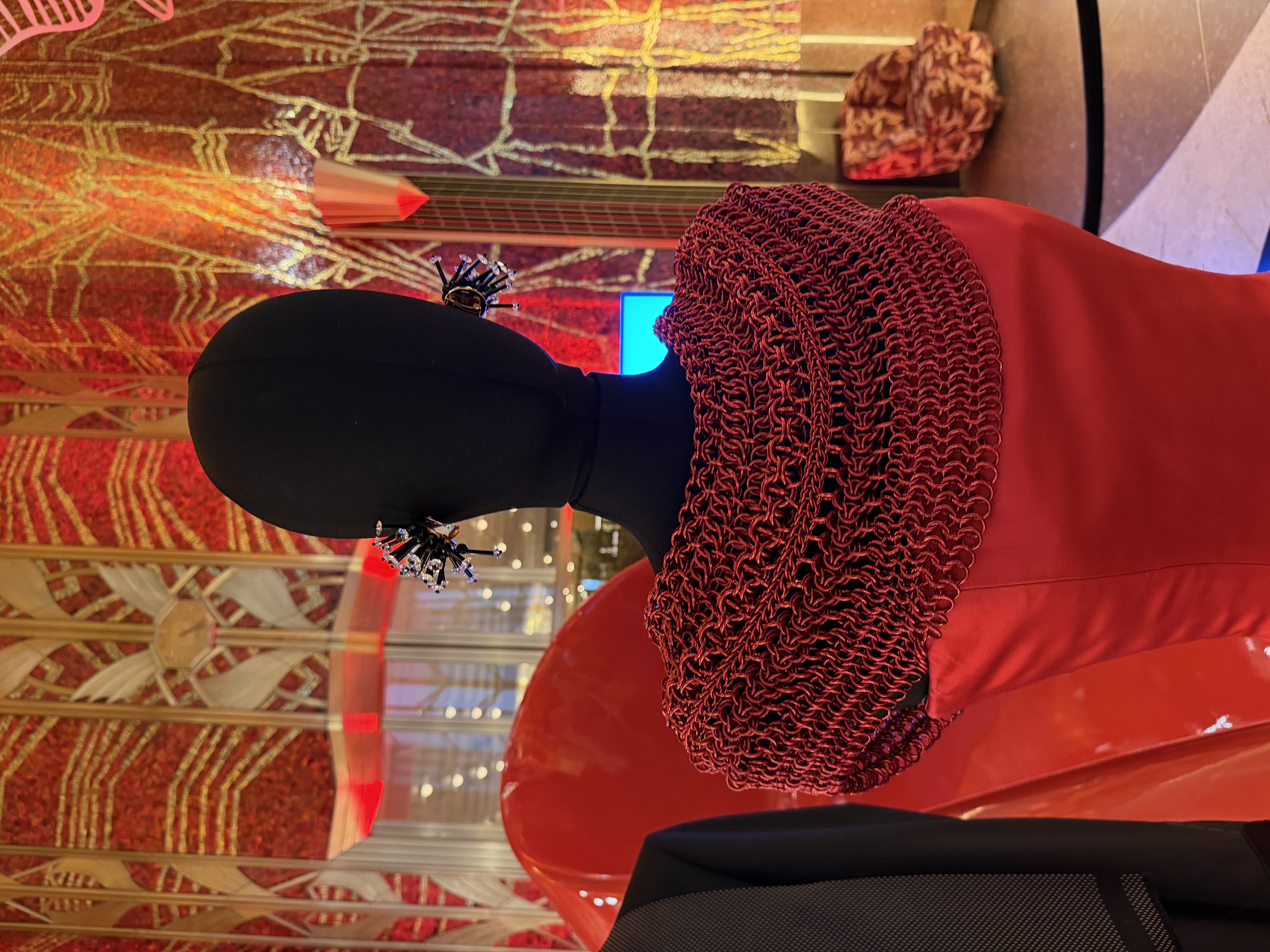
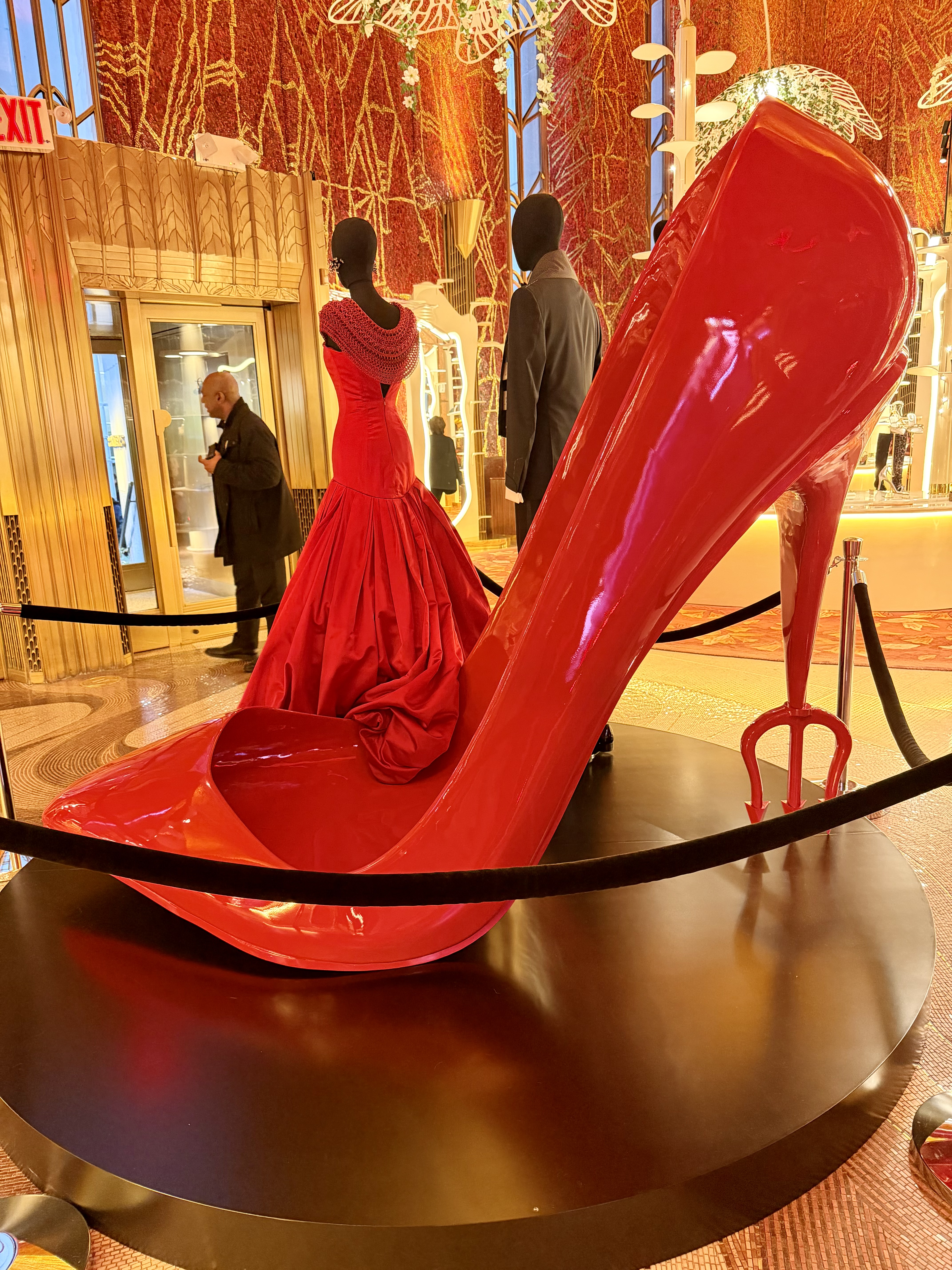
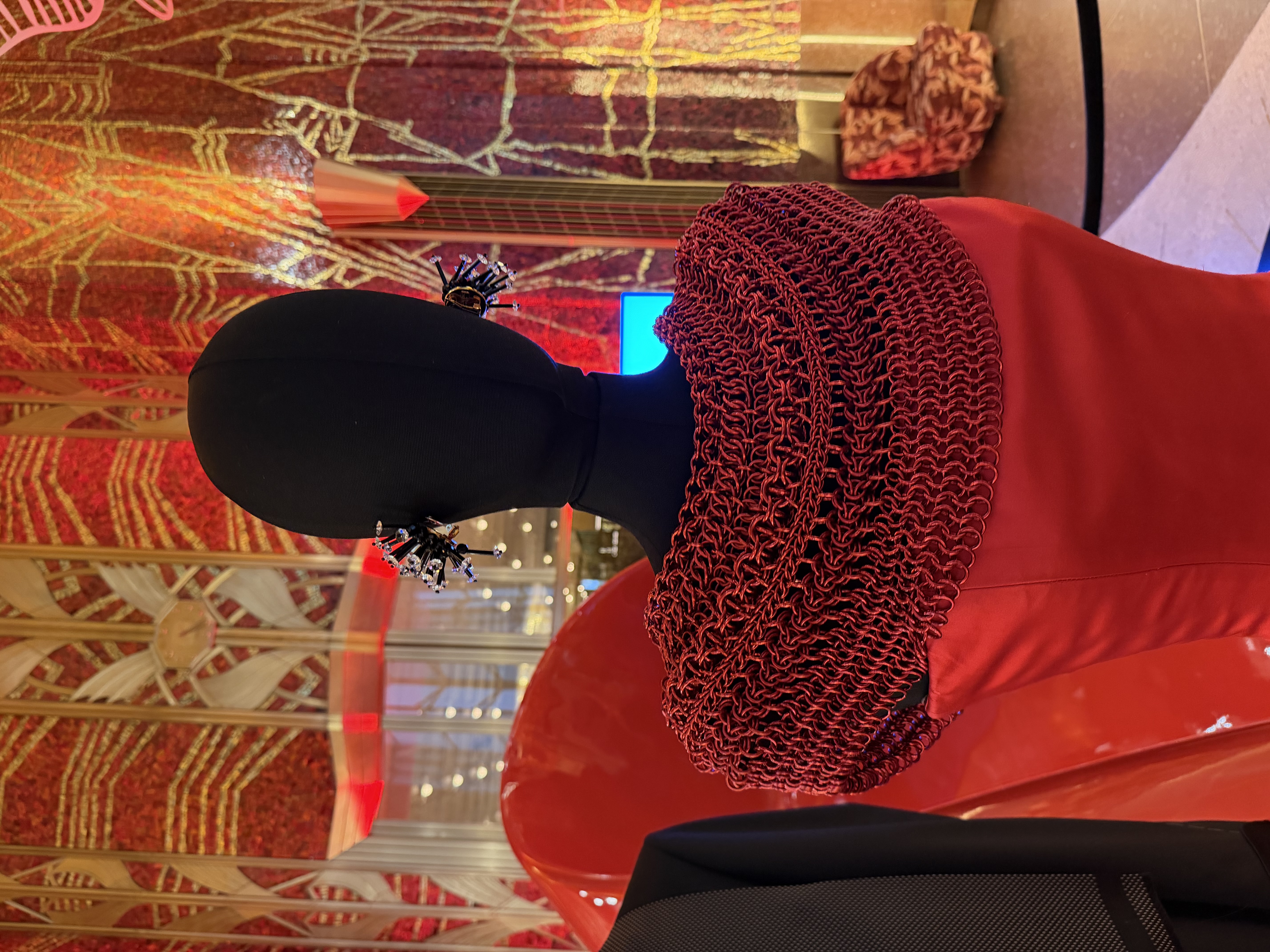
The Devil Red Hanover Mane was selected by costume designer Molly Rogers to complement a 2006 Oscar de la Renta red gown styled for the Miranda Priestly character in The Devil Wears Prada 2. The piece was displayed among 24 mannequins presenting shoppable looks from the film in The Red Room — Printemps New York's showcase of men's and women's shoes — at their flagship location at 1 Wall Street, right off Wall Street in lower Manhattan. This activation was produced in partnership with Molly Rogers.

As seen in
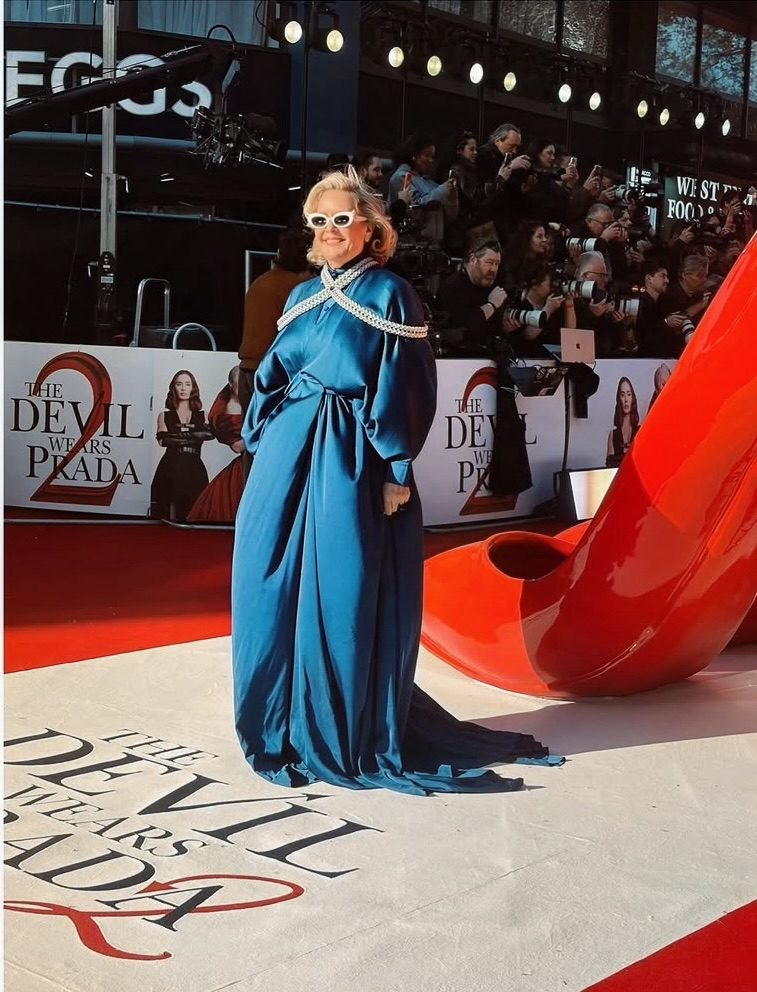
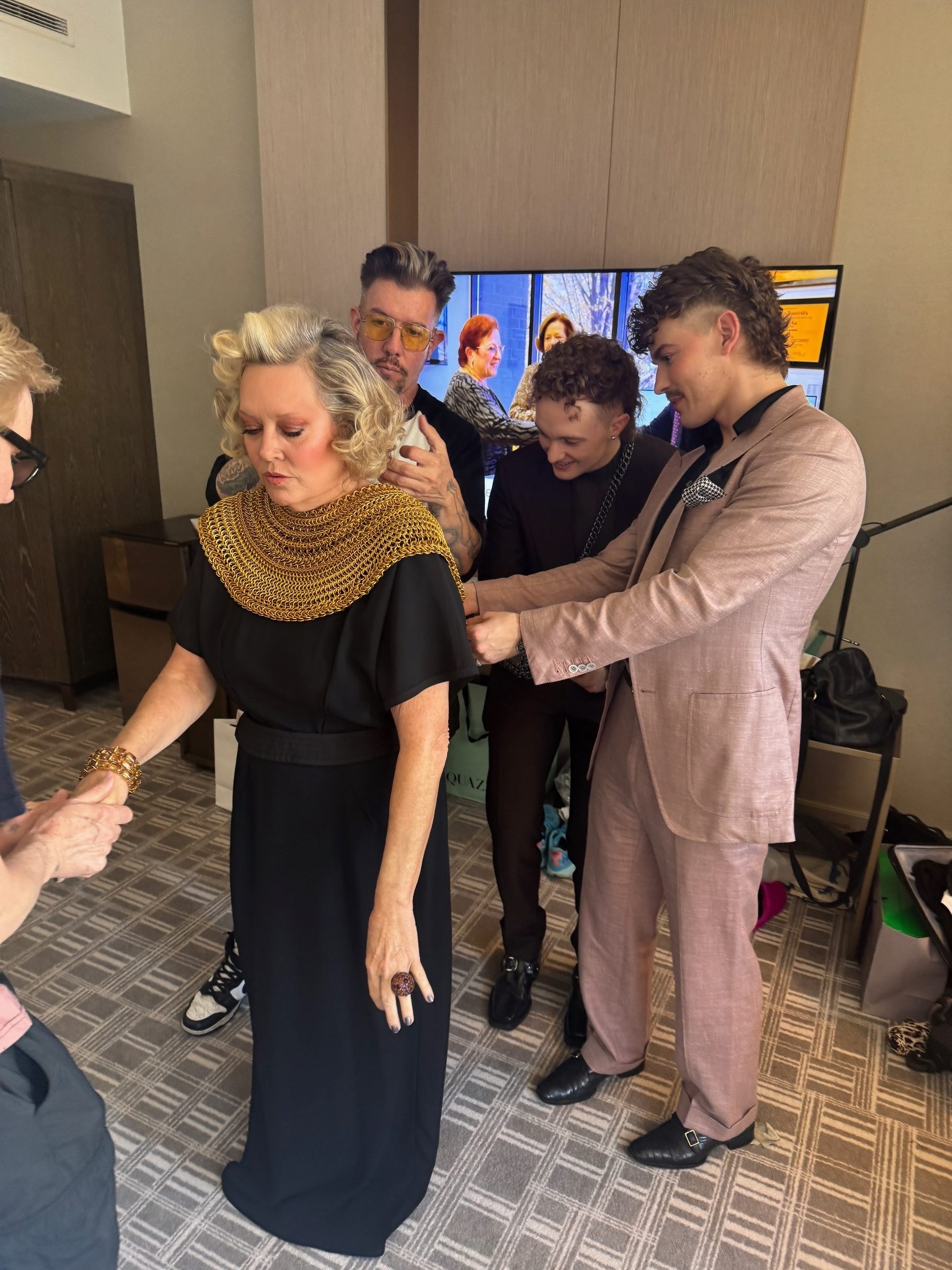
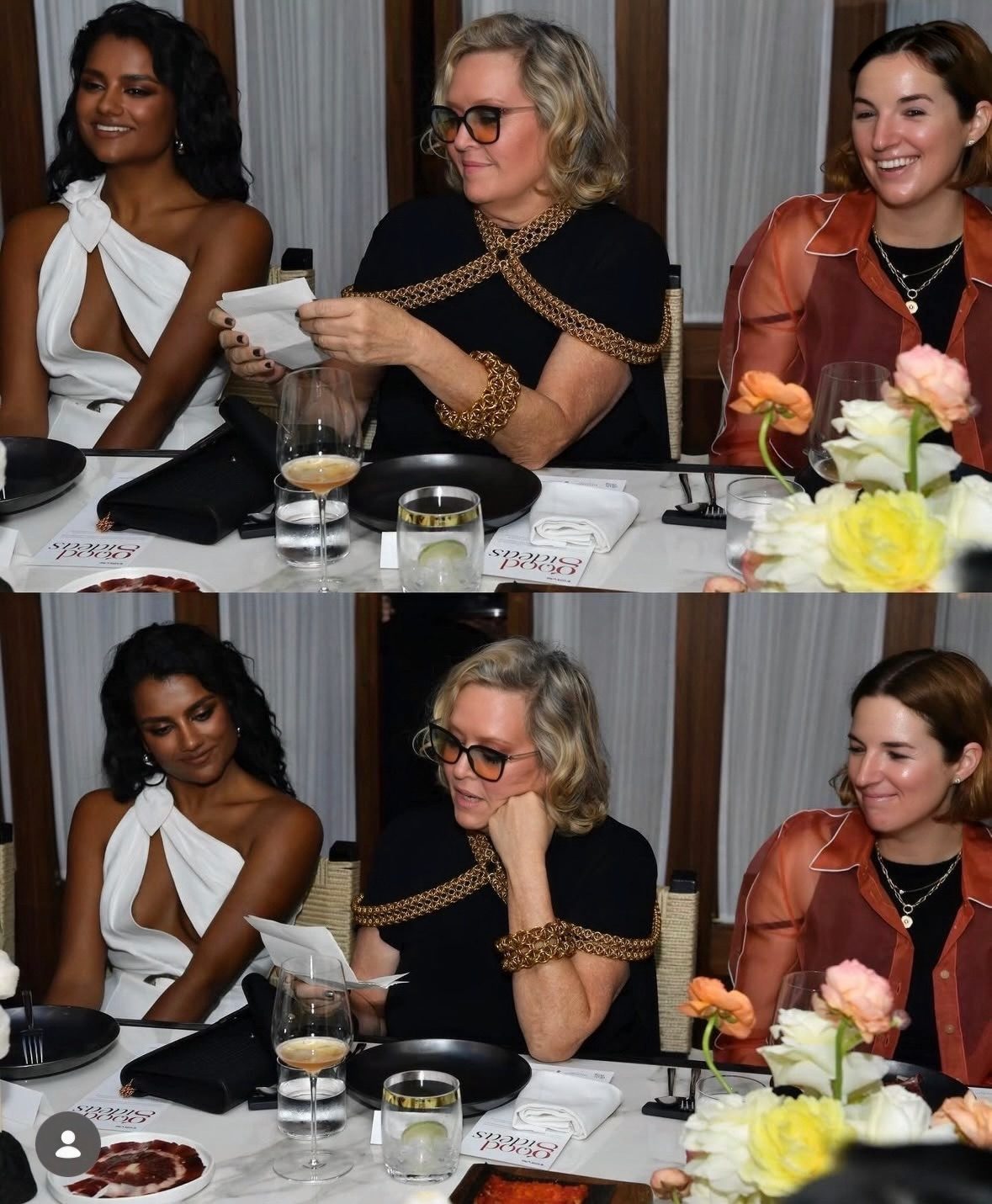
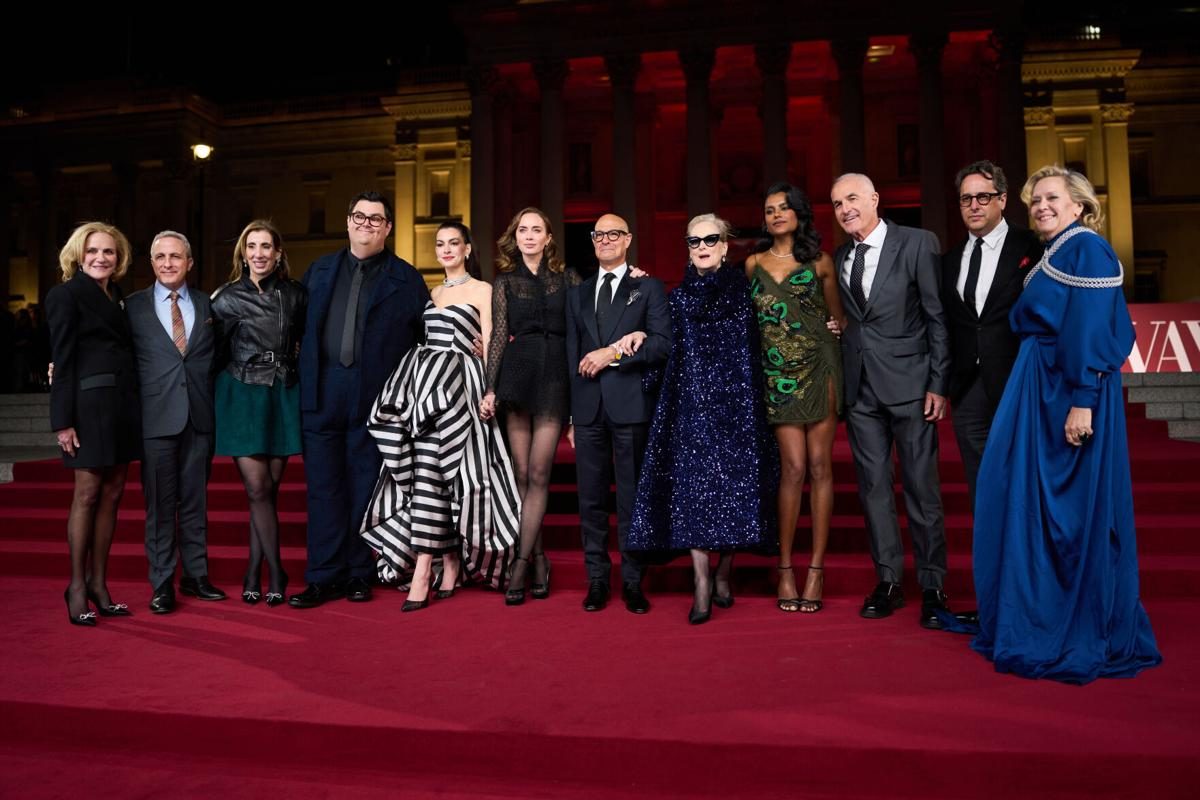
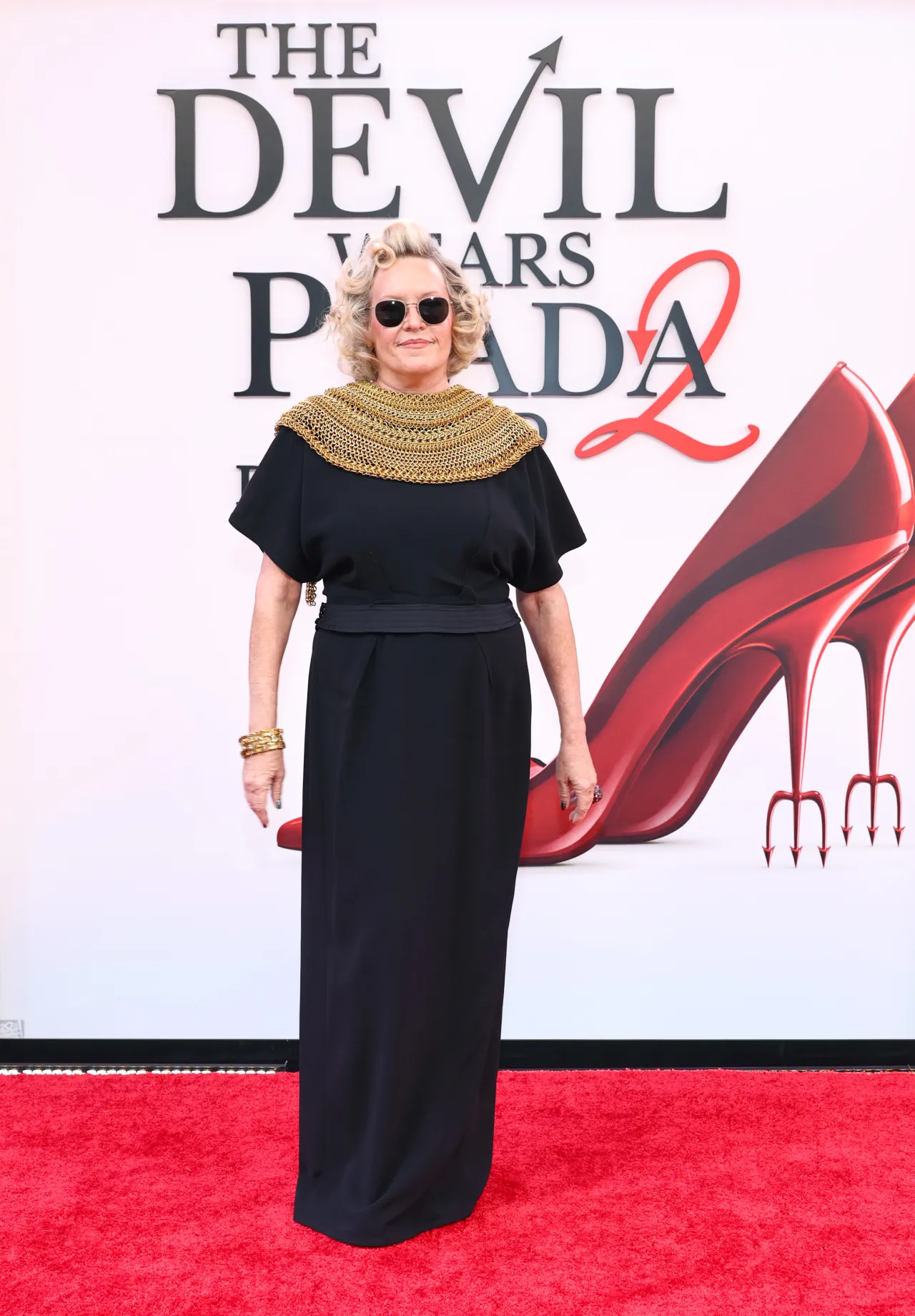
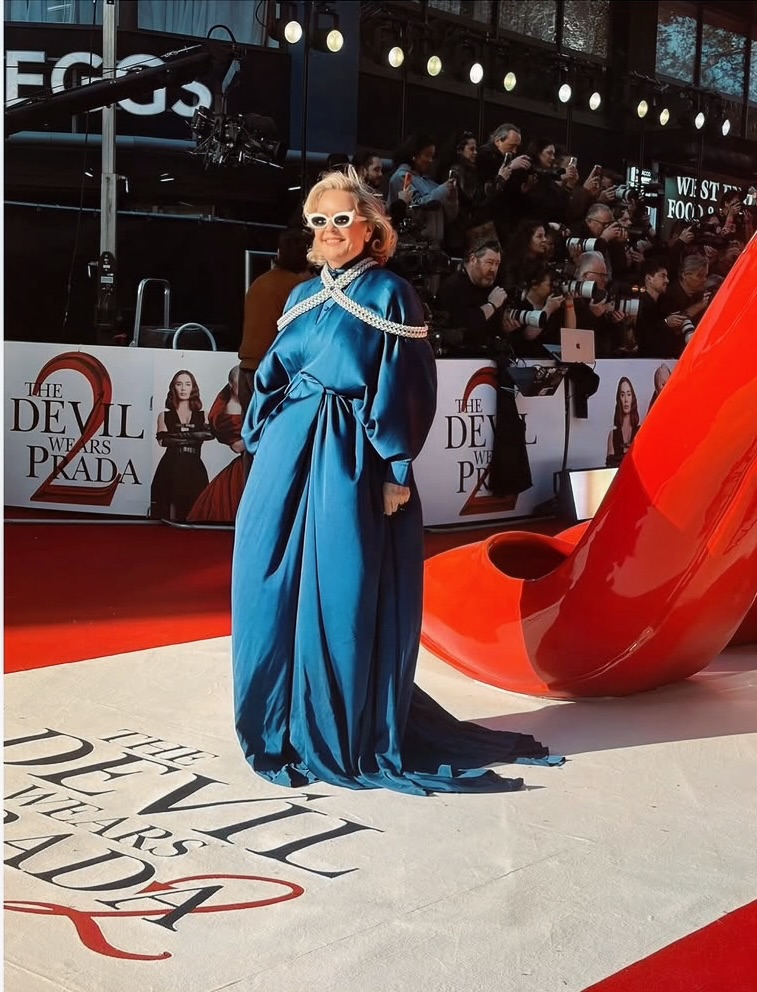
Costume Designer Molly Rogers wore Free Maison across three premiere events.
Emmy Award–winning costume designer Molly Rogers has spent four decades defining how fashion moves through film and television — from the wardrobe of Sex and the City, which earned her an Emmy and four nominations, to her Oscar-nominated work on the original Devil Wears Prada alongside mentor Patricia Field. For the 2026 sequel, Rogers took the helm, building close to 90 looks for Meryl Streep, Anne Hathaway, and Emily Blunt — each piece designed to carry the weight of a twenty-year cultural gap. Her stated philosophy: "something much bigger than just serving looks," with every garment reflecting a tapestry of legacy, social commentary, and change.
In choosing Free Maison across three of the film's most public moments — the world premiere at Lincoln Center in New York, the London premiere, and the screenwriters dinner — Rogers brought the brand into the center of one of the most anticipated fashion events of the year. The film has grossed over $548 million worldwide.

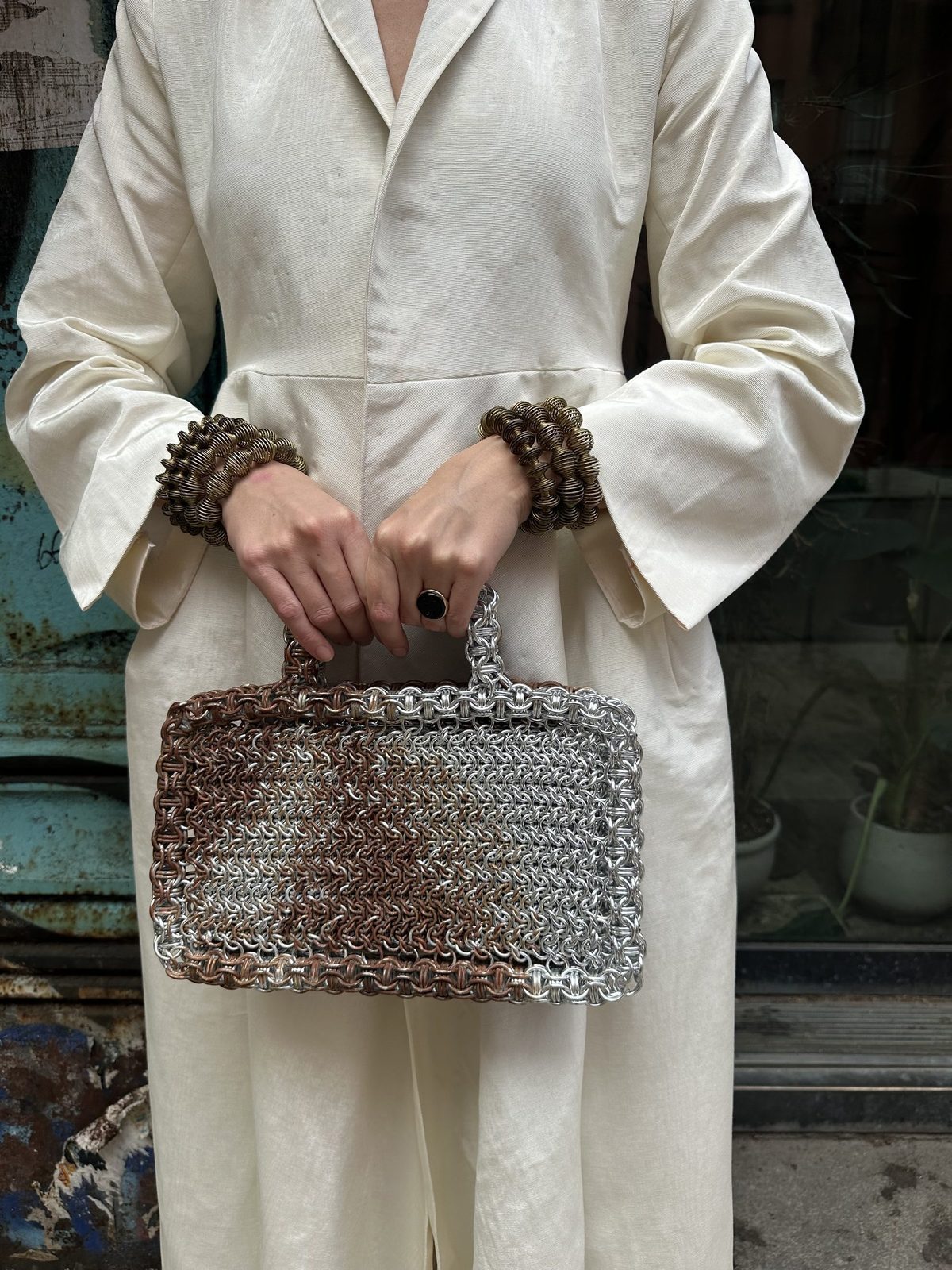
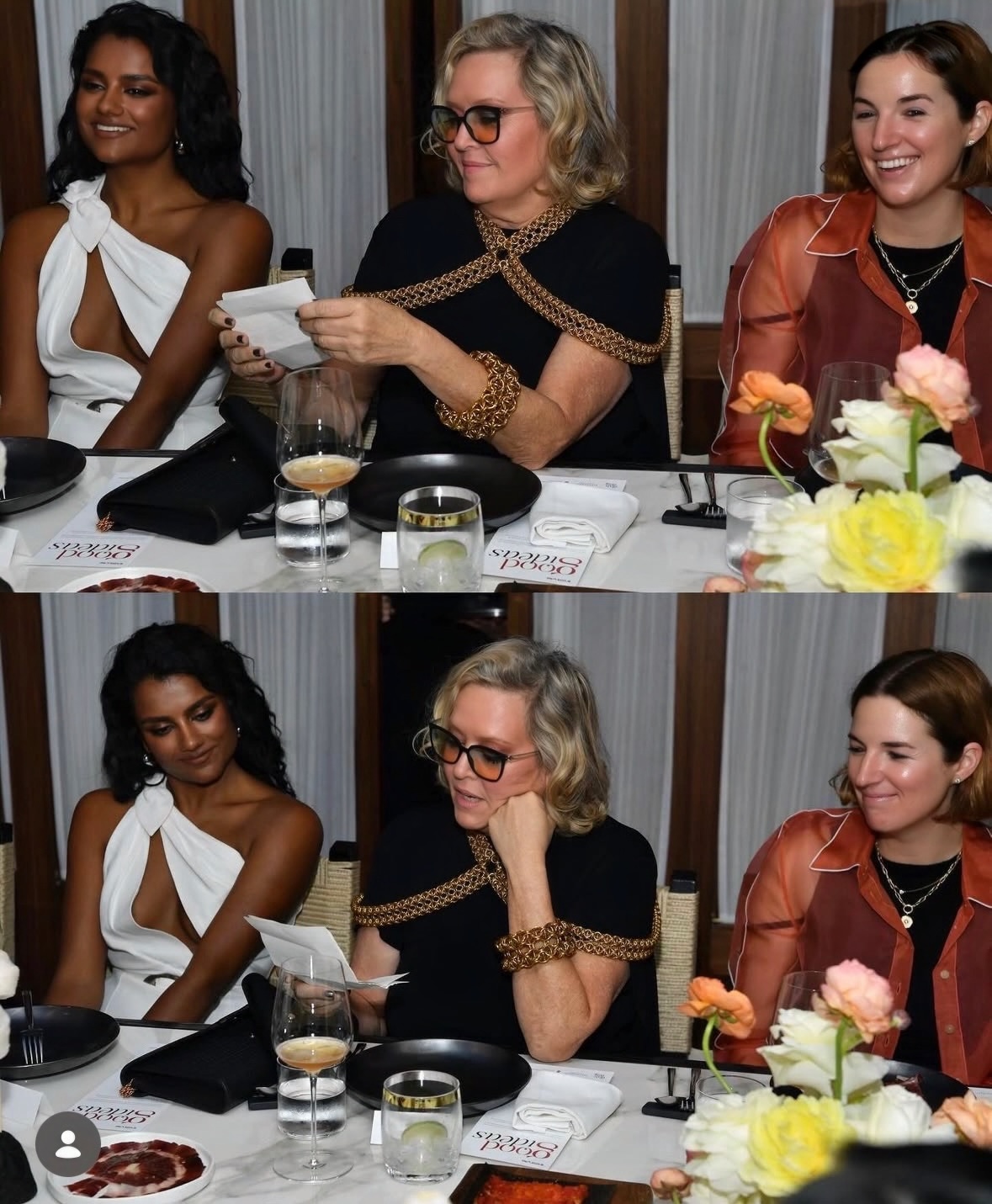
Charlotte von Hardenburgh wore a custom rusted Free Maison tote to the 2024 Met Gala Press Preview.


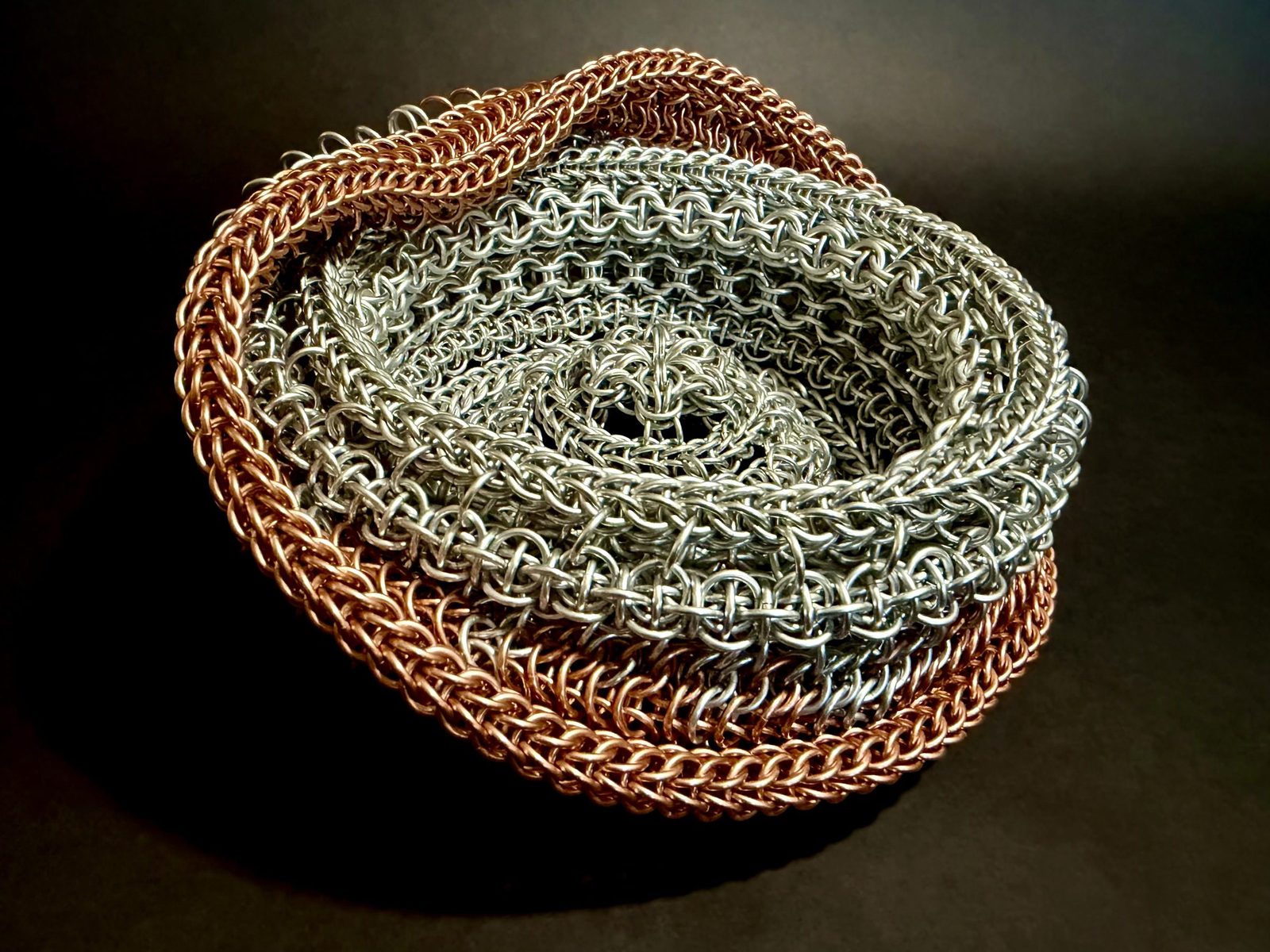
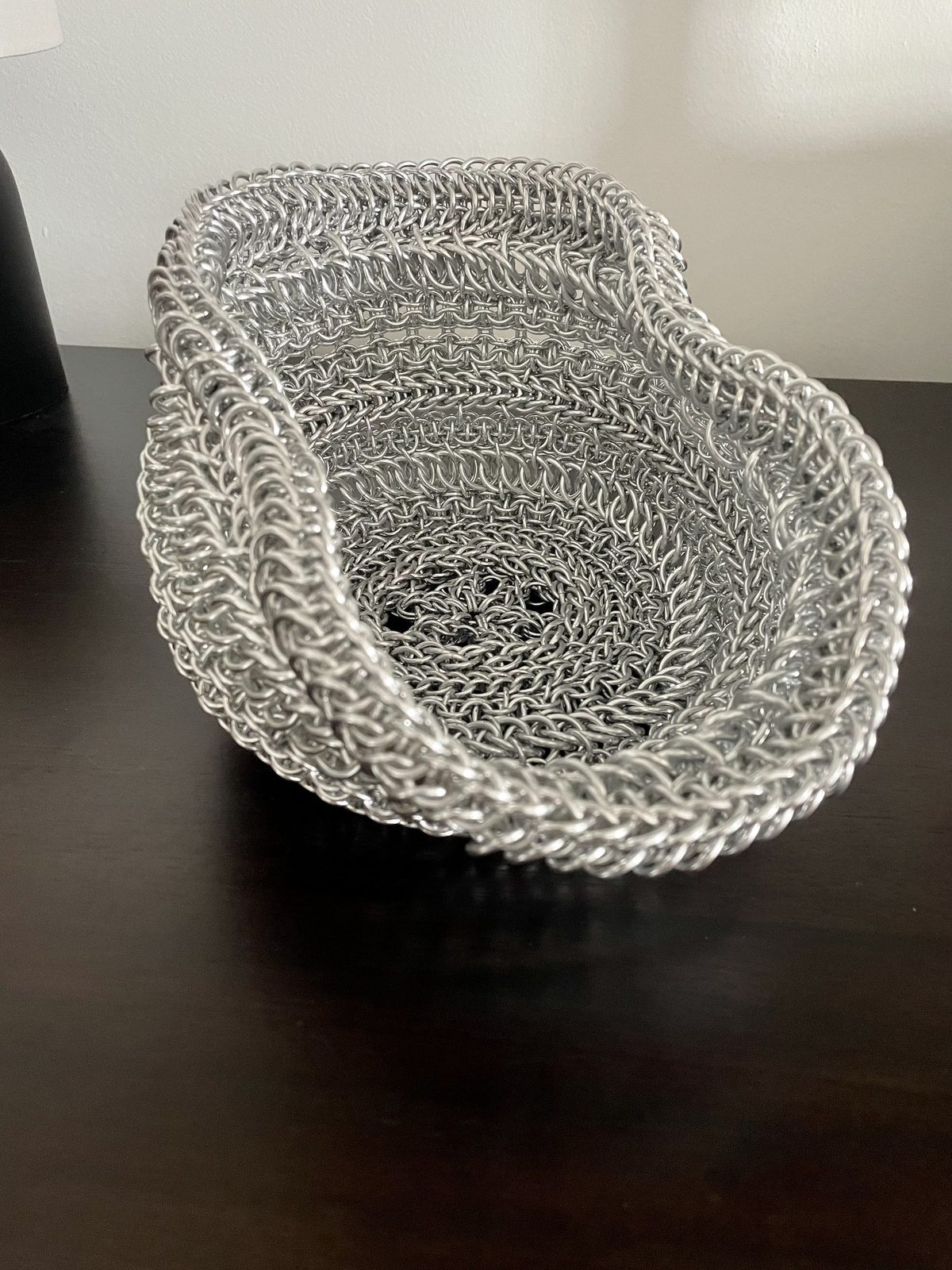
7.5″ × 16″ × 18″
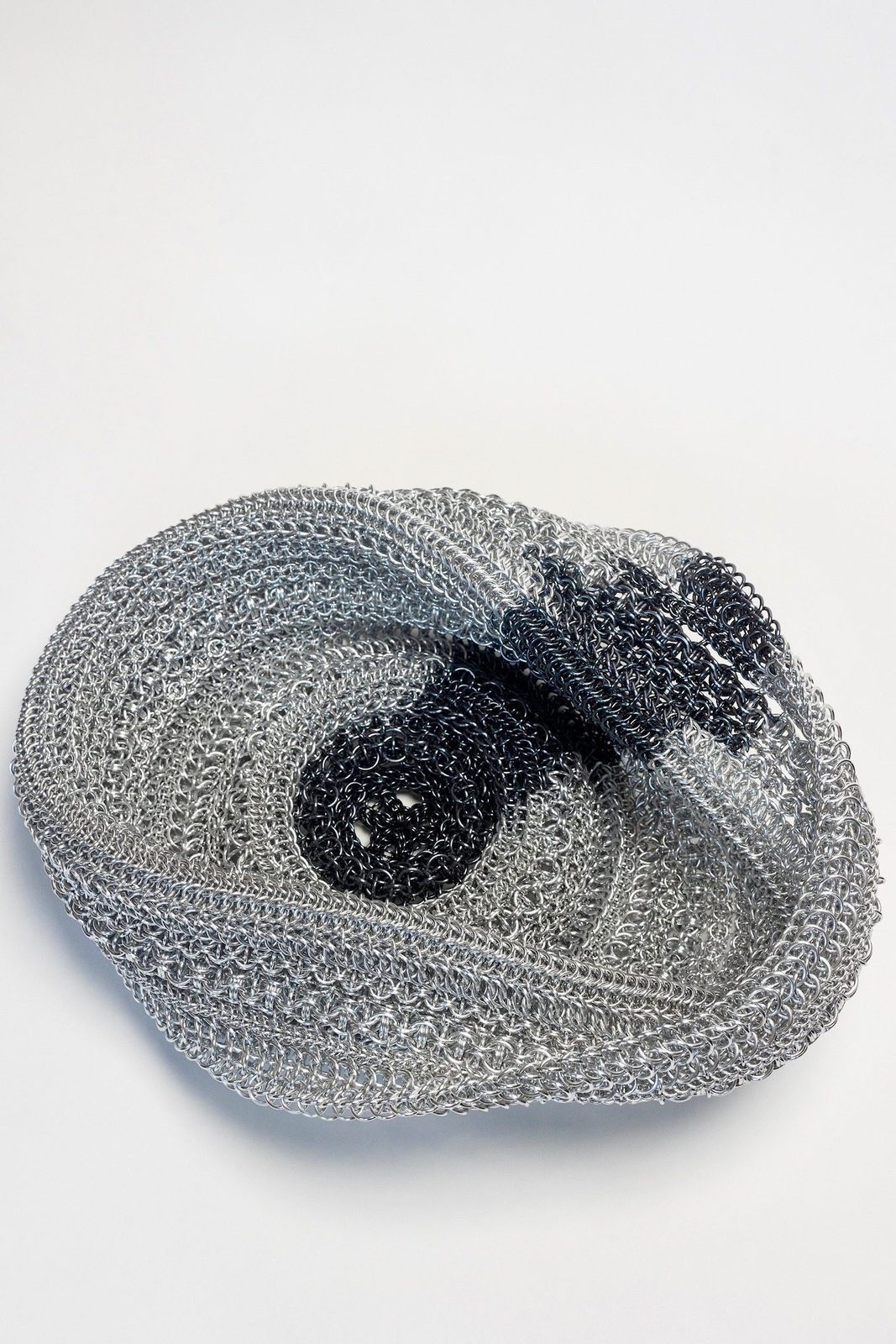
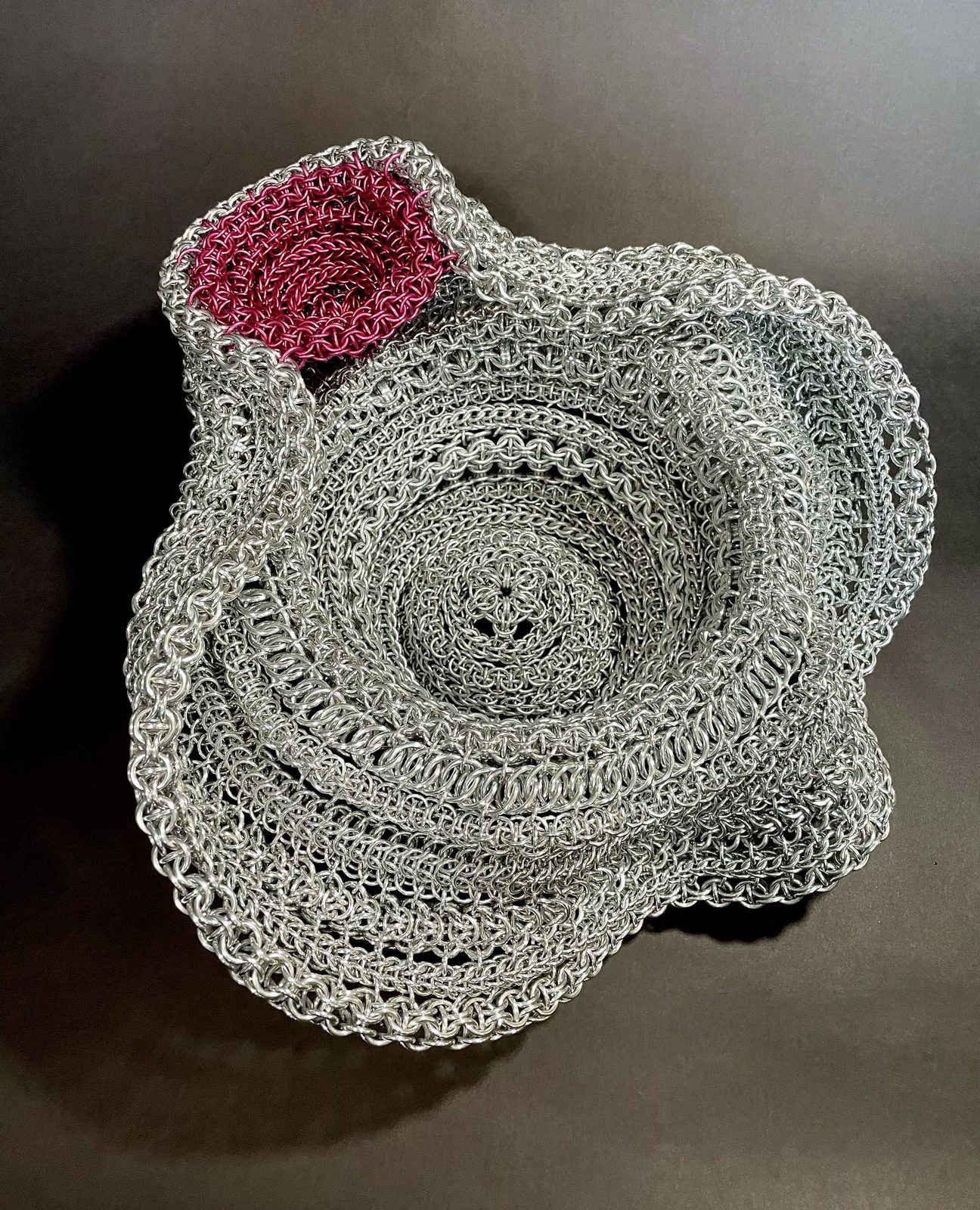
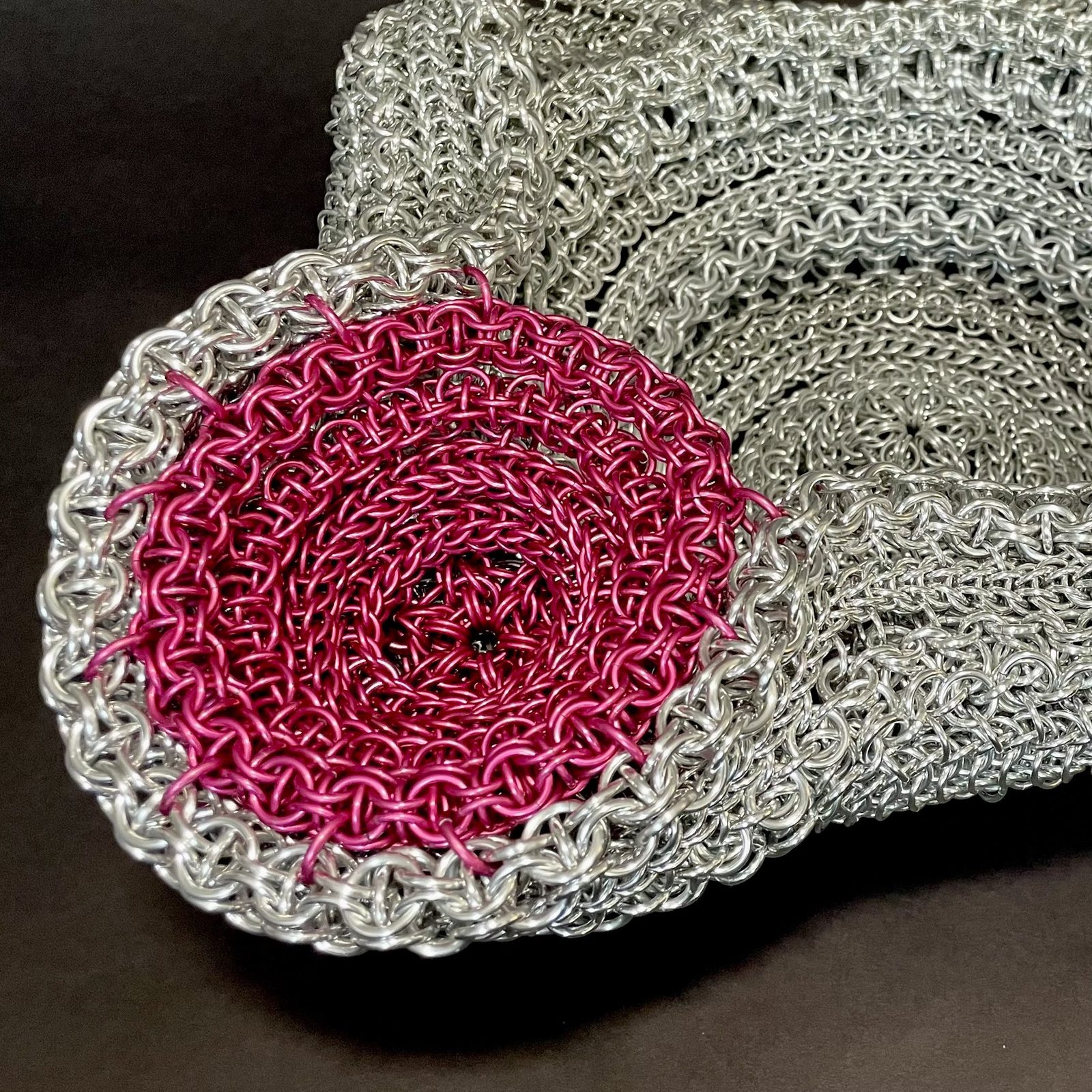
Baskets have long been a craft of women and a symbol of the womb. This malleable metal basket rethinks the traditionally male craft of chainmail in a feminine basket form. It represents present-day evolving conversations around expectations of gender and fertility.
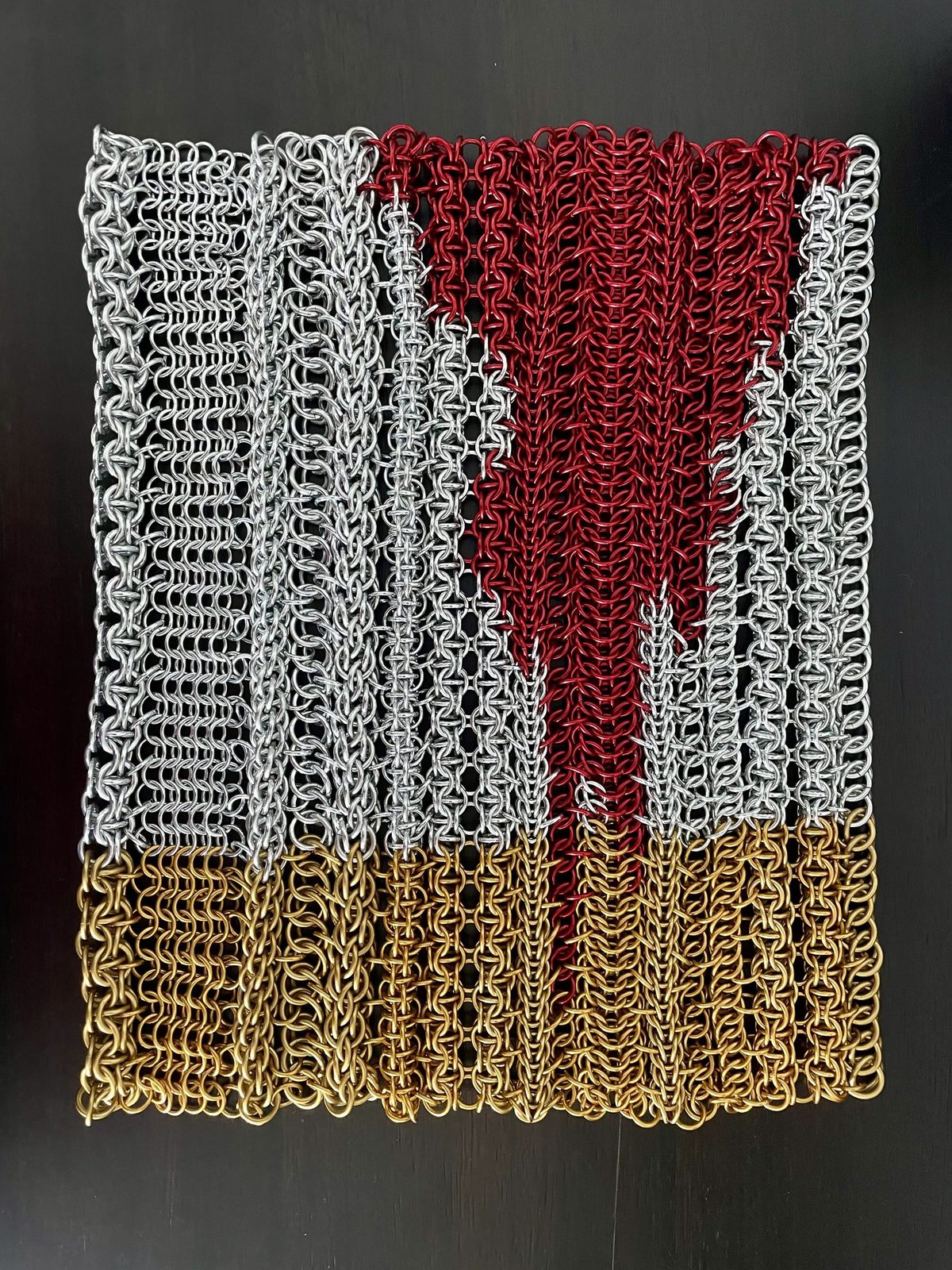
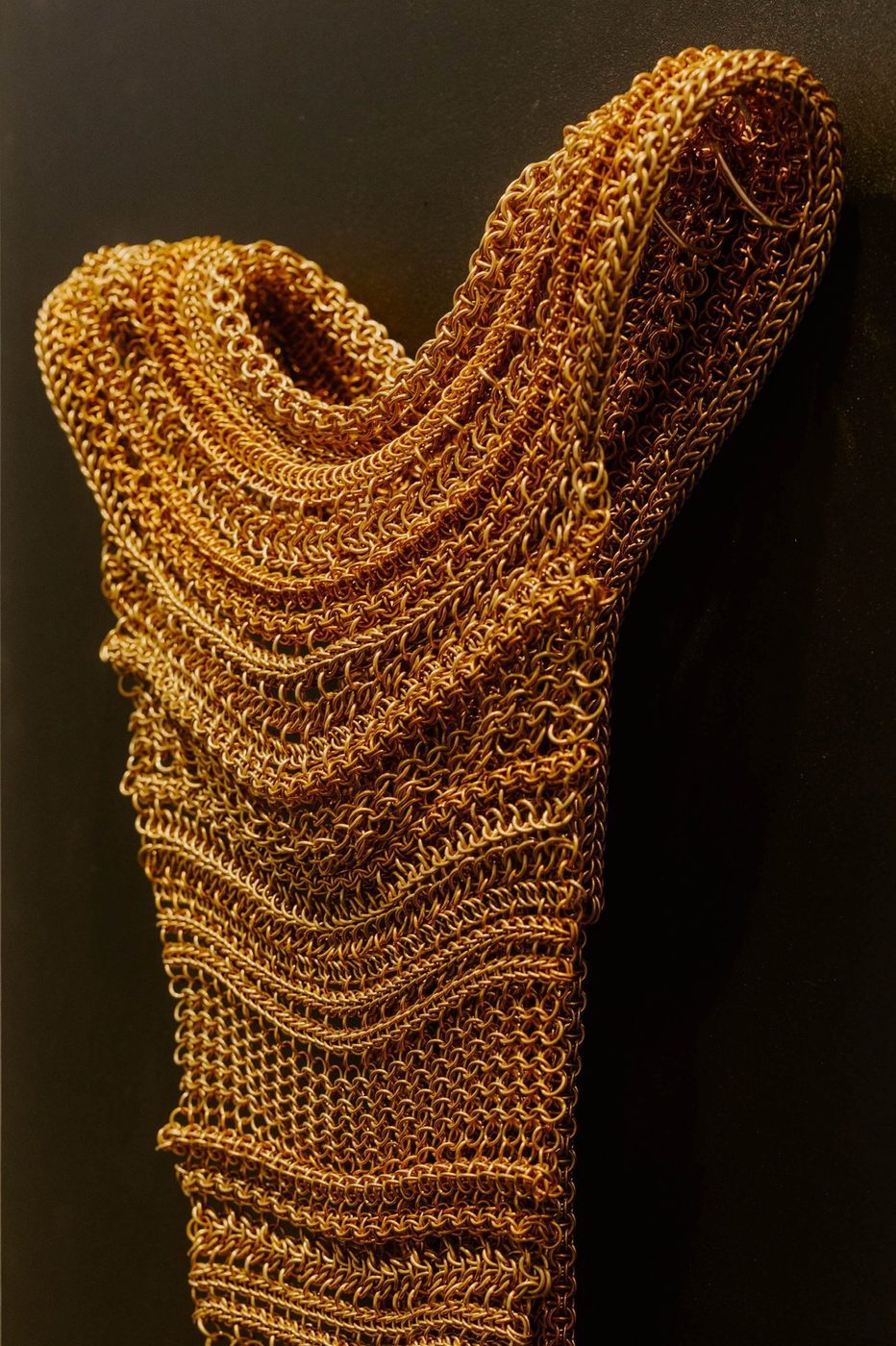
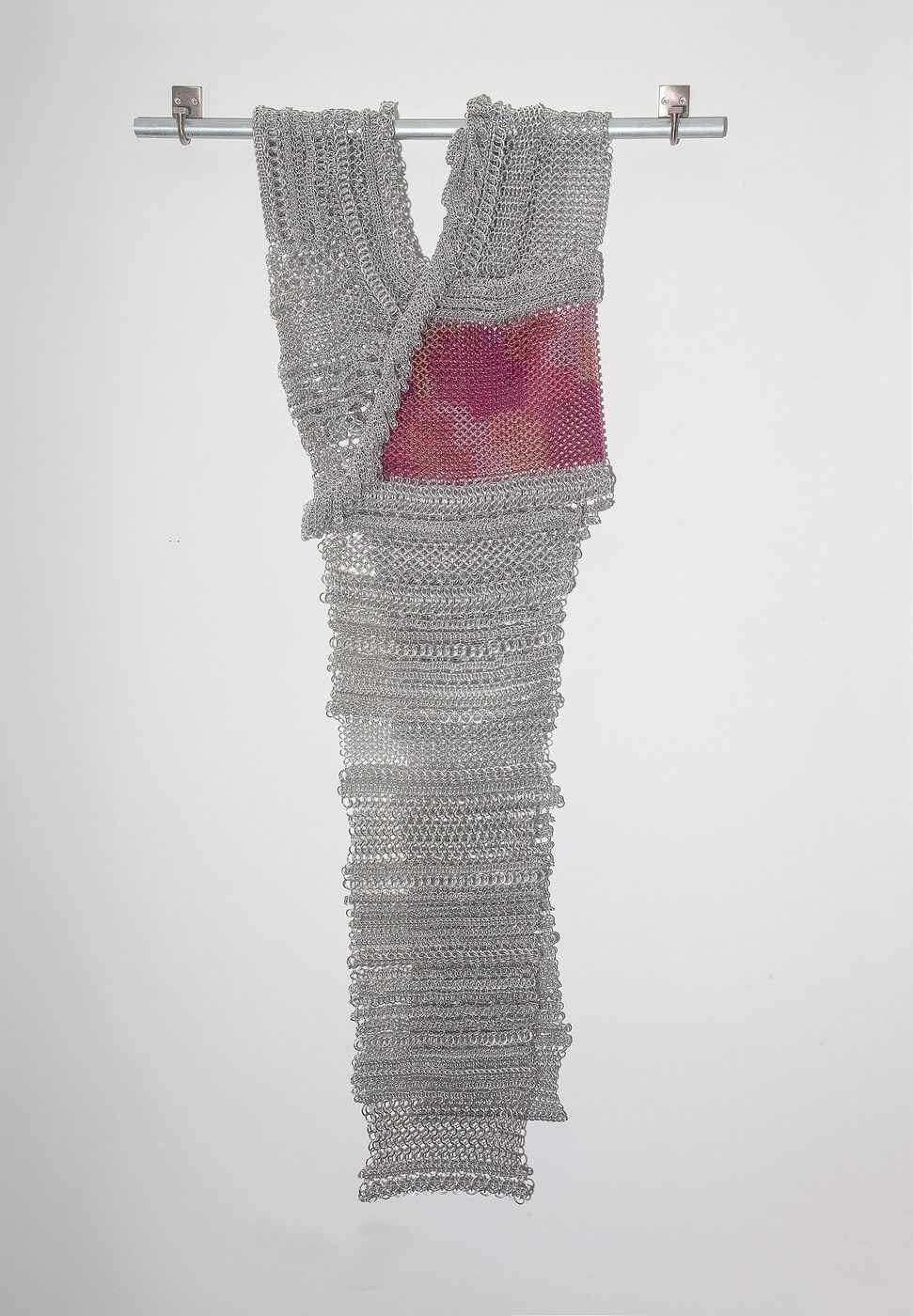
12″ × 12″ × 0.5″
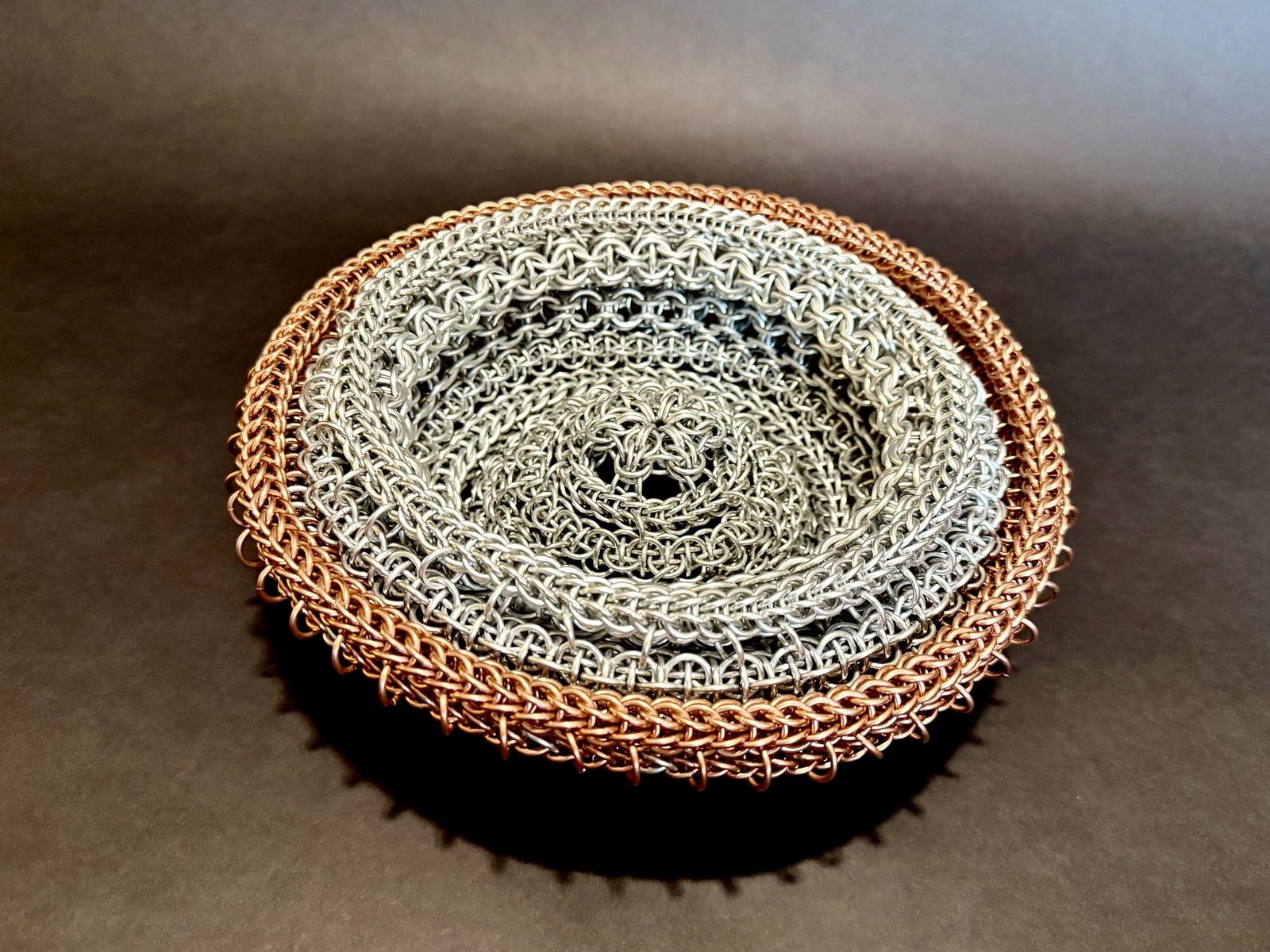
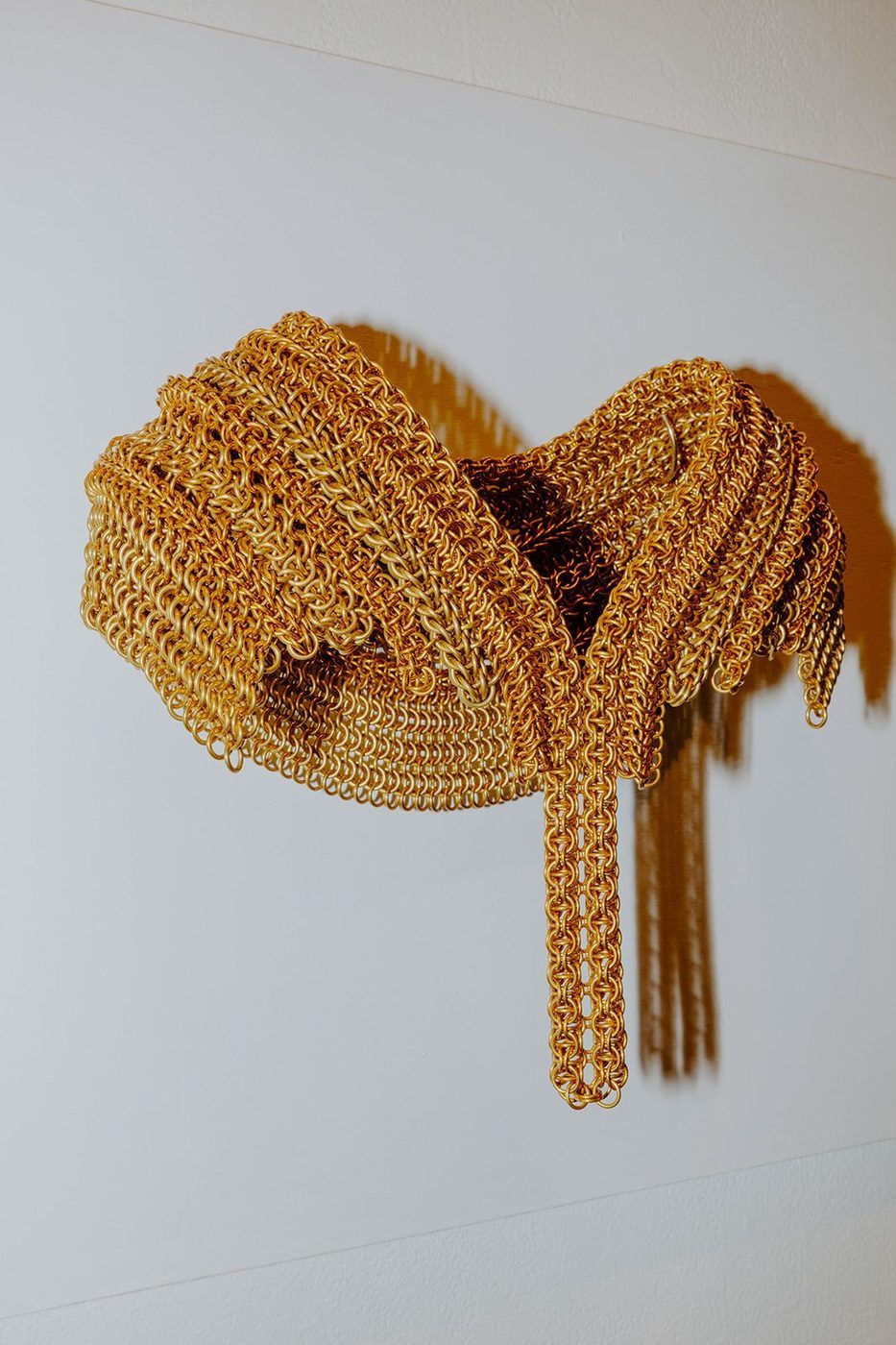
This piece is a study on use of color in ciphered chainmail, and an experiment in creating a wall hanging.


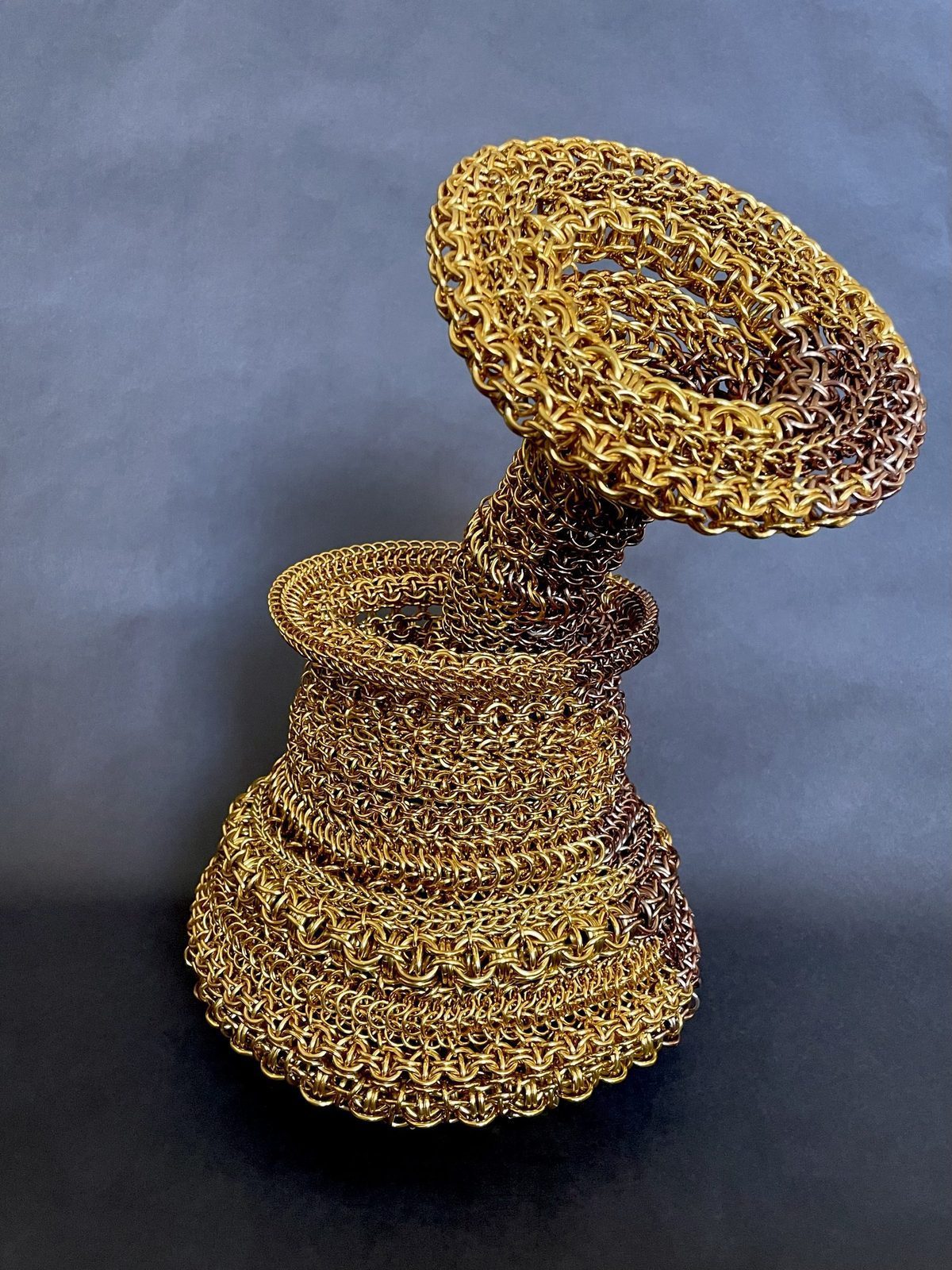
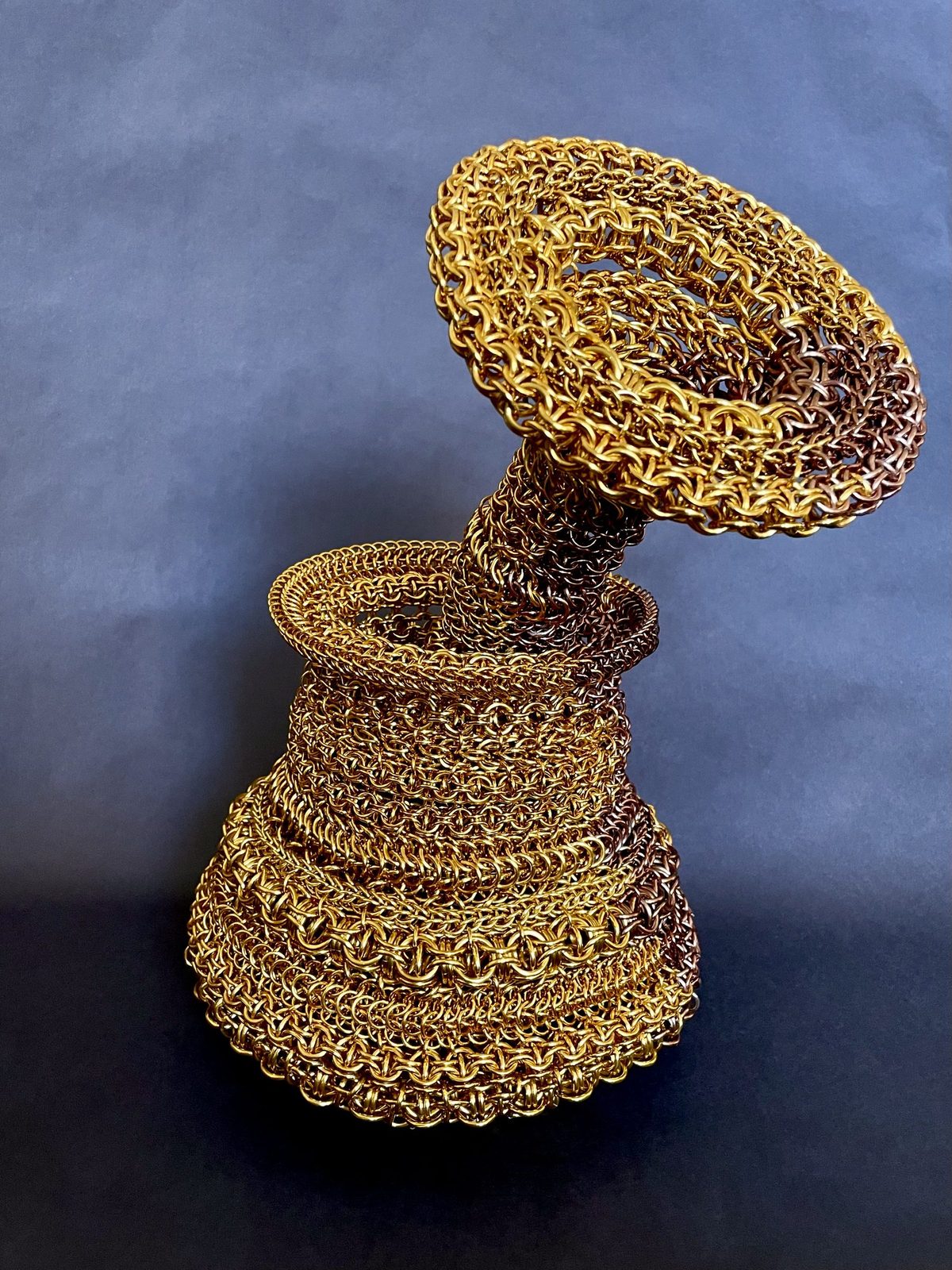
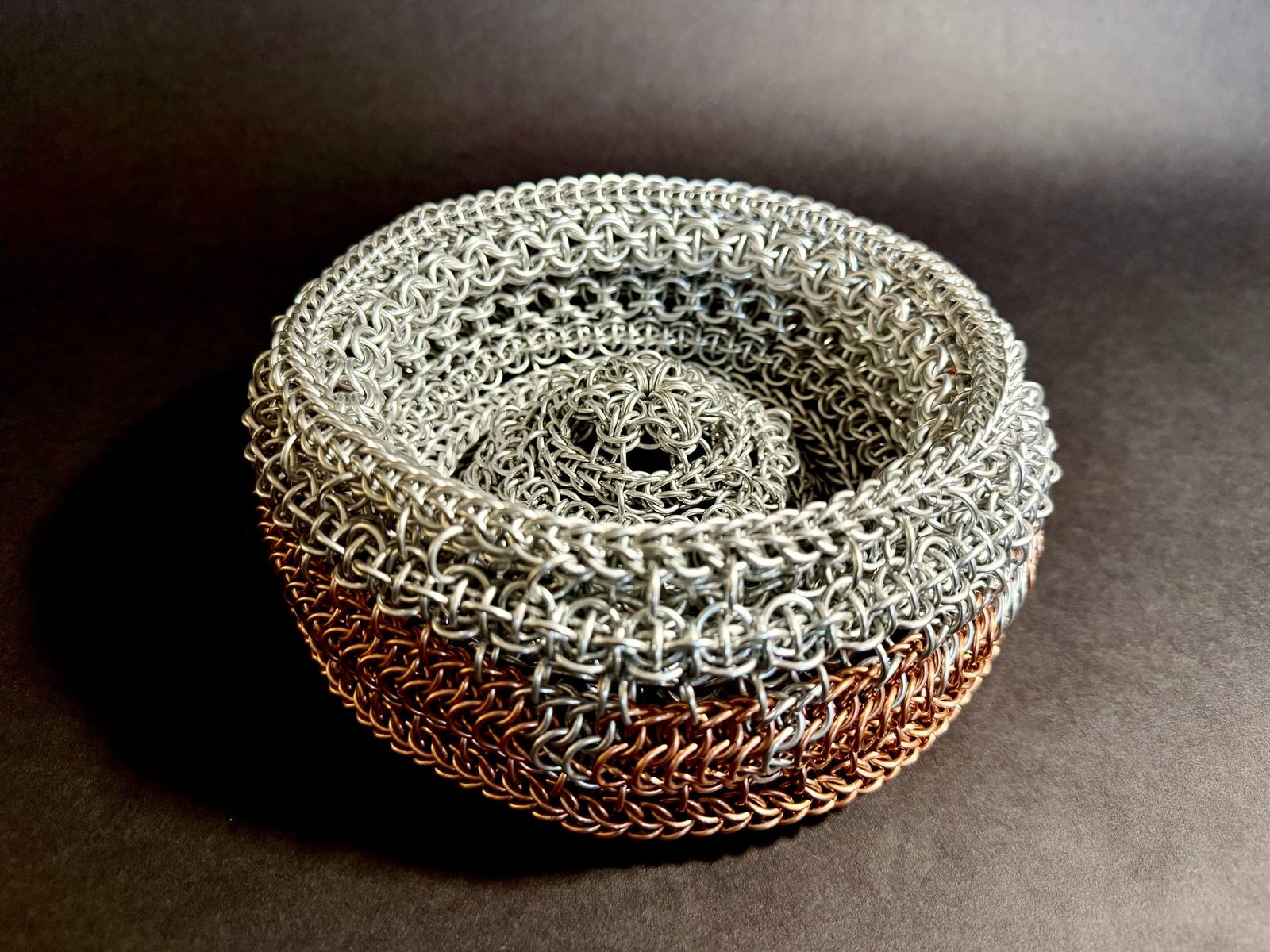
15″ × 11″ × 11″
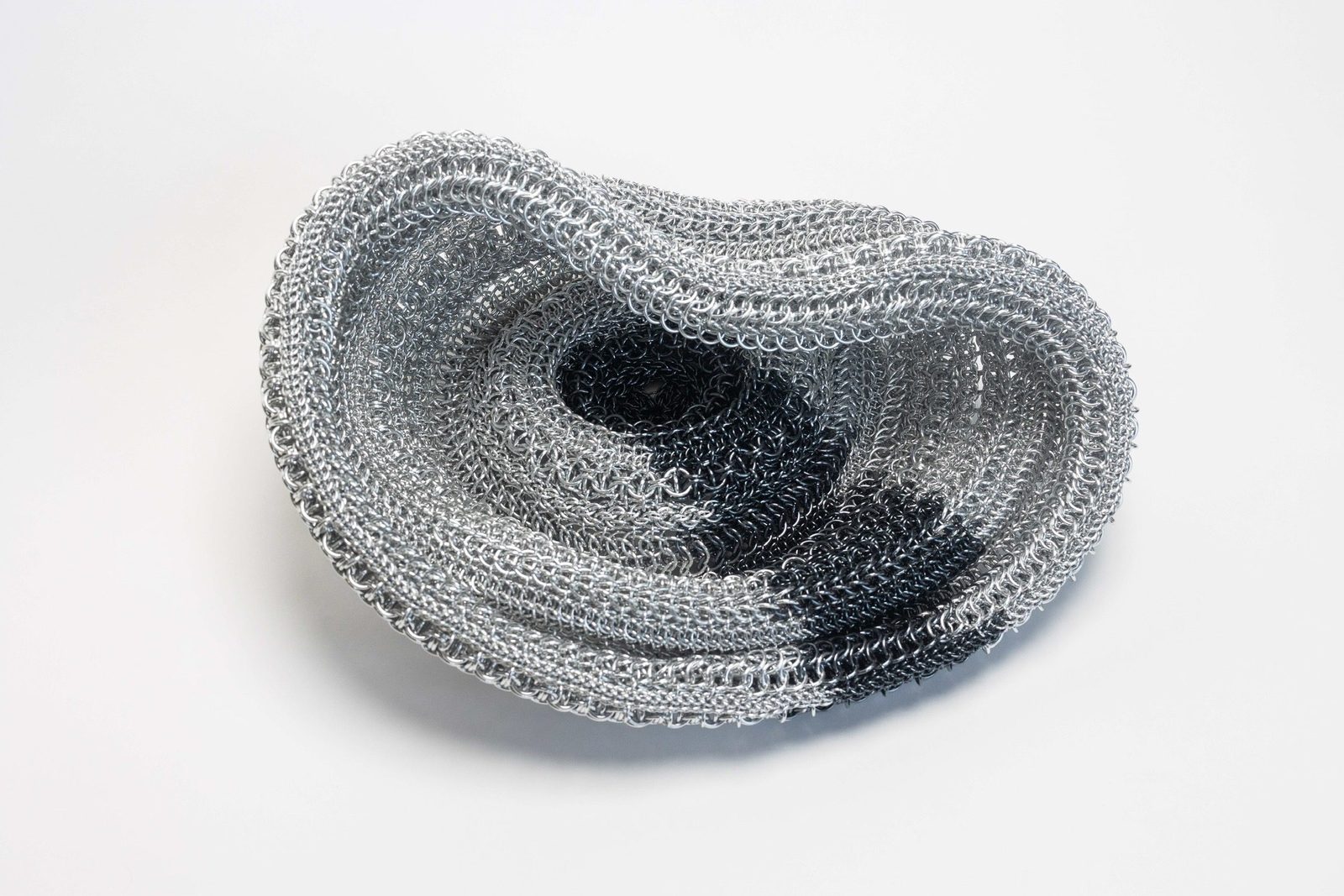
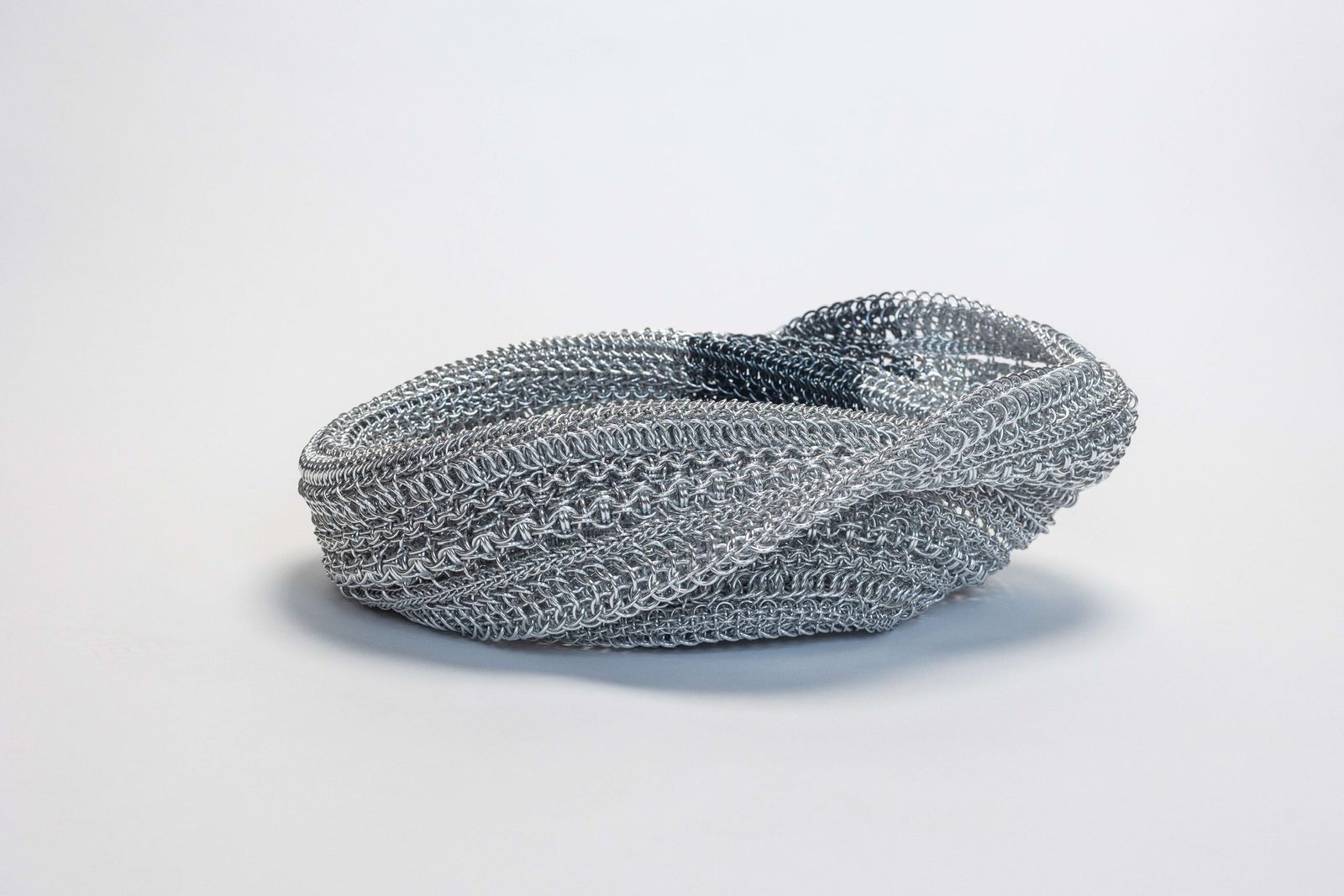
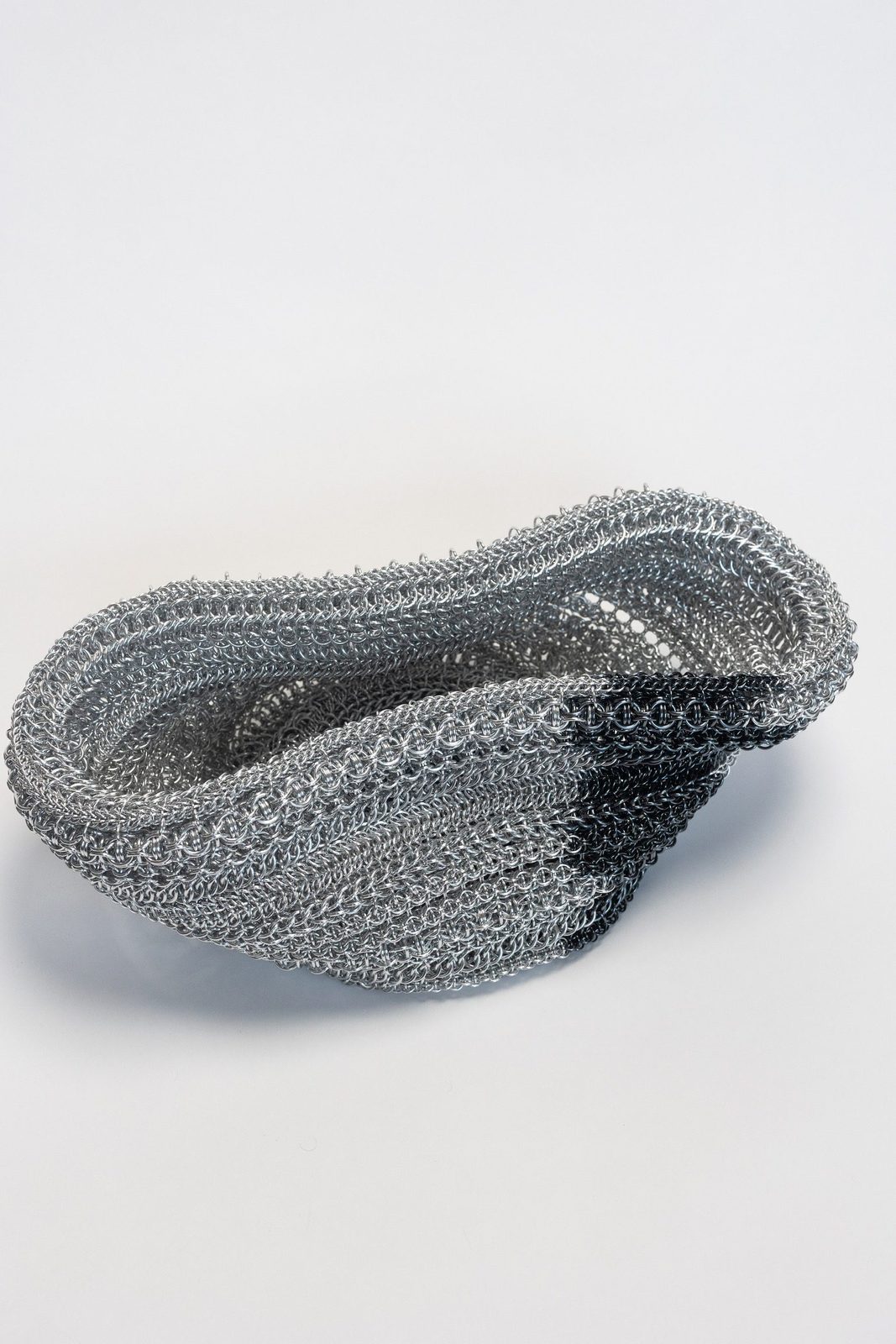
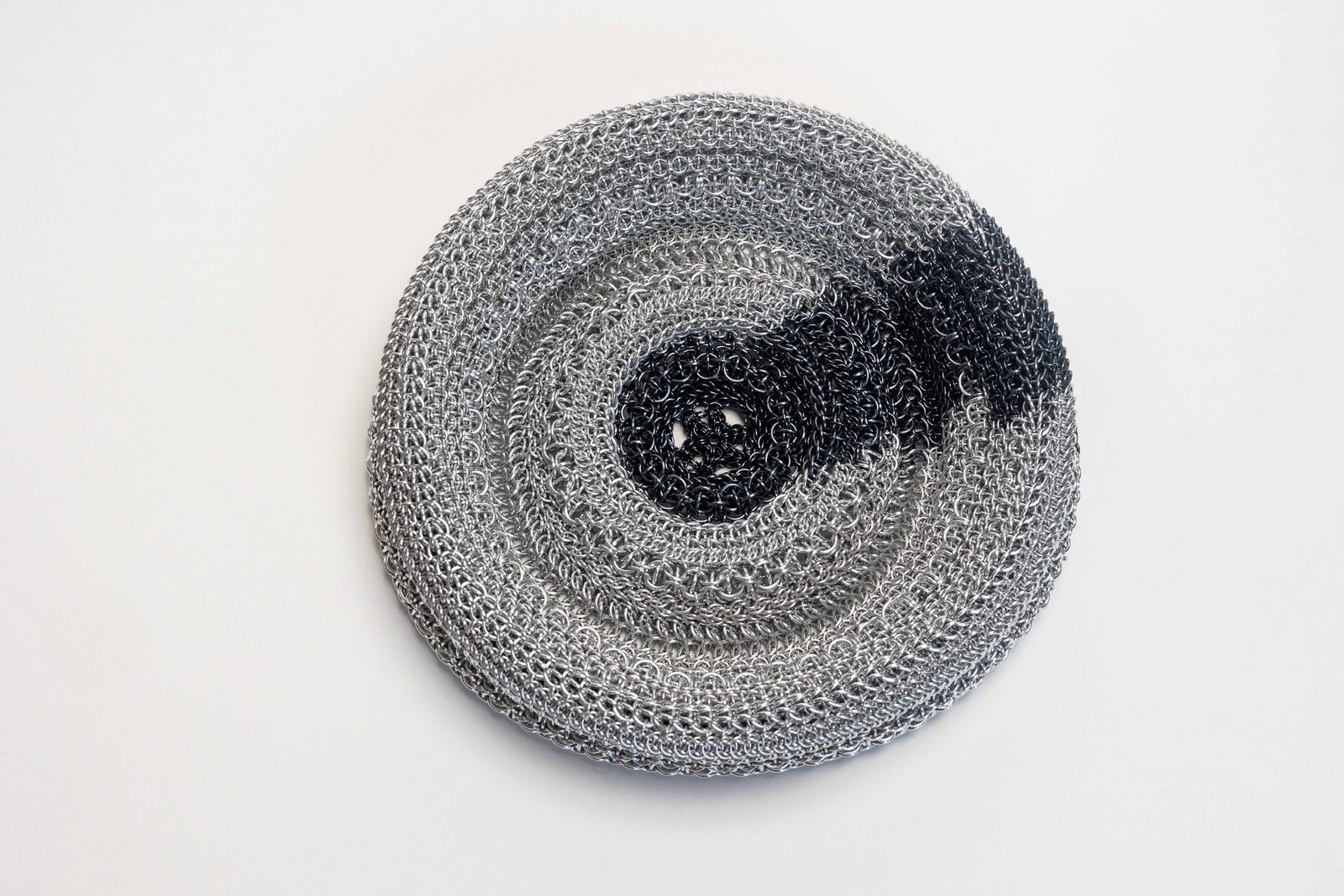
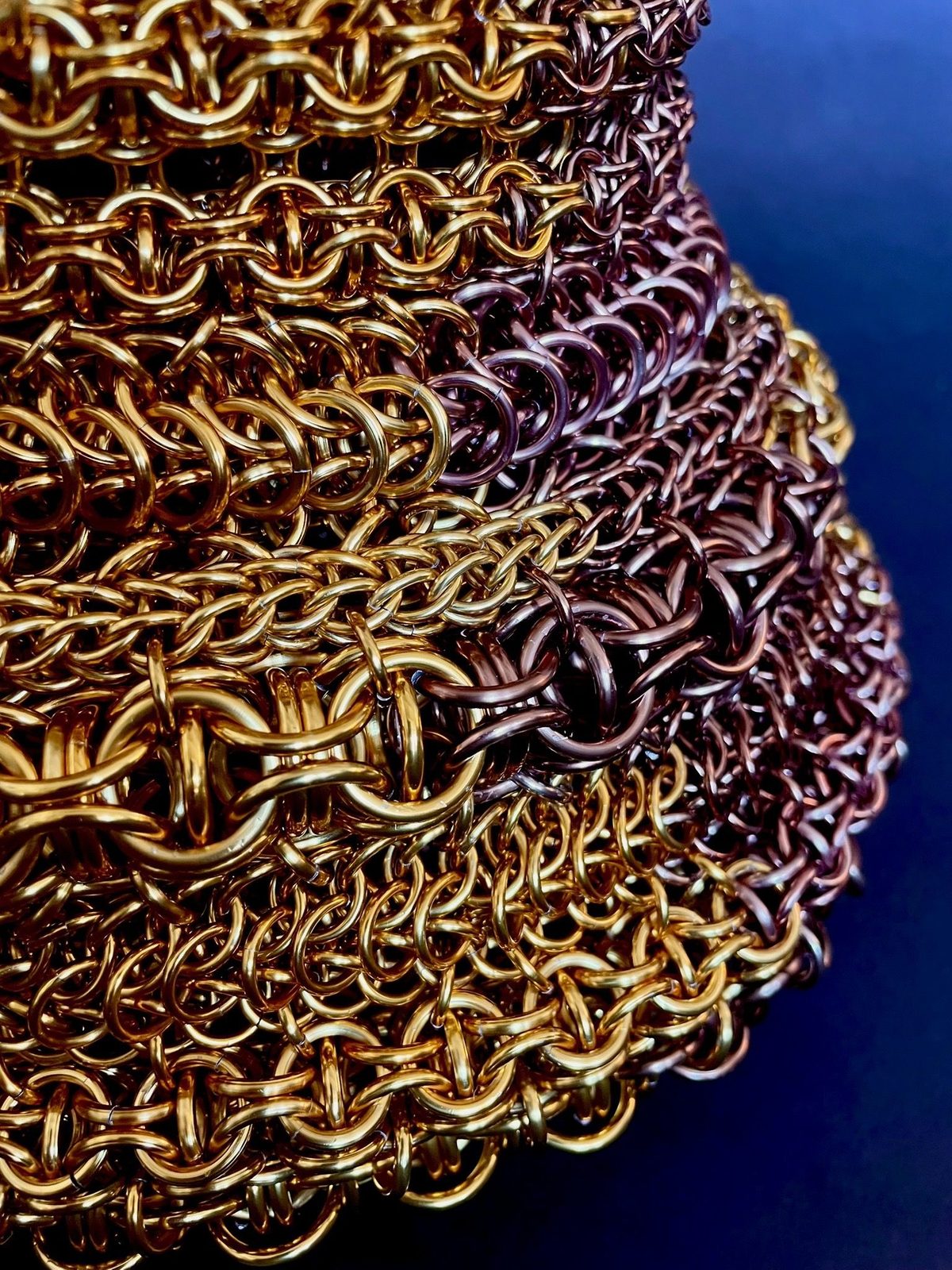
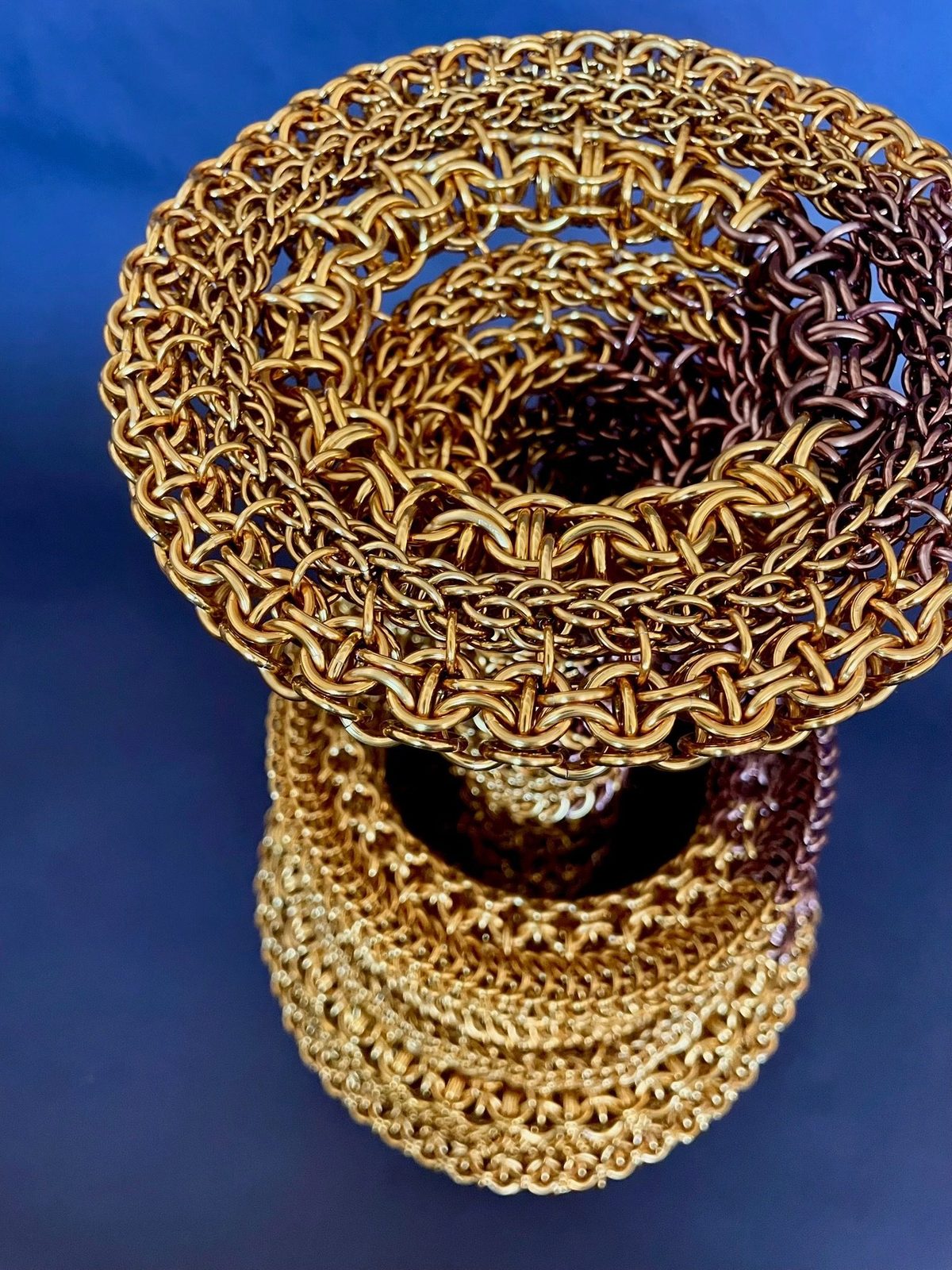
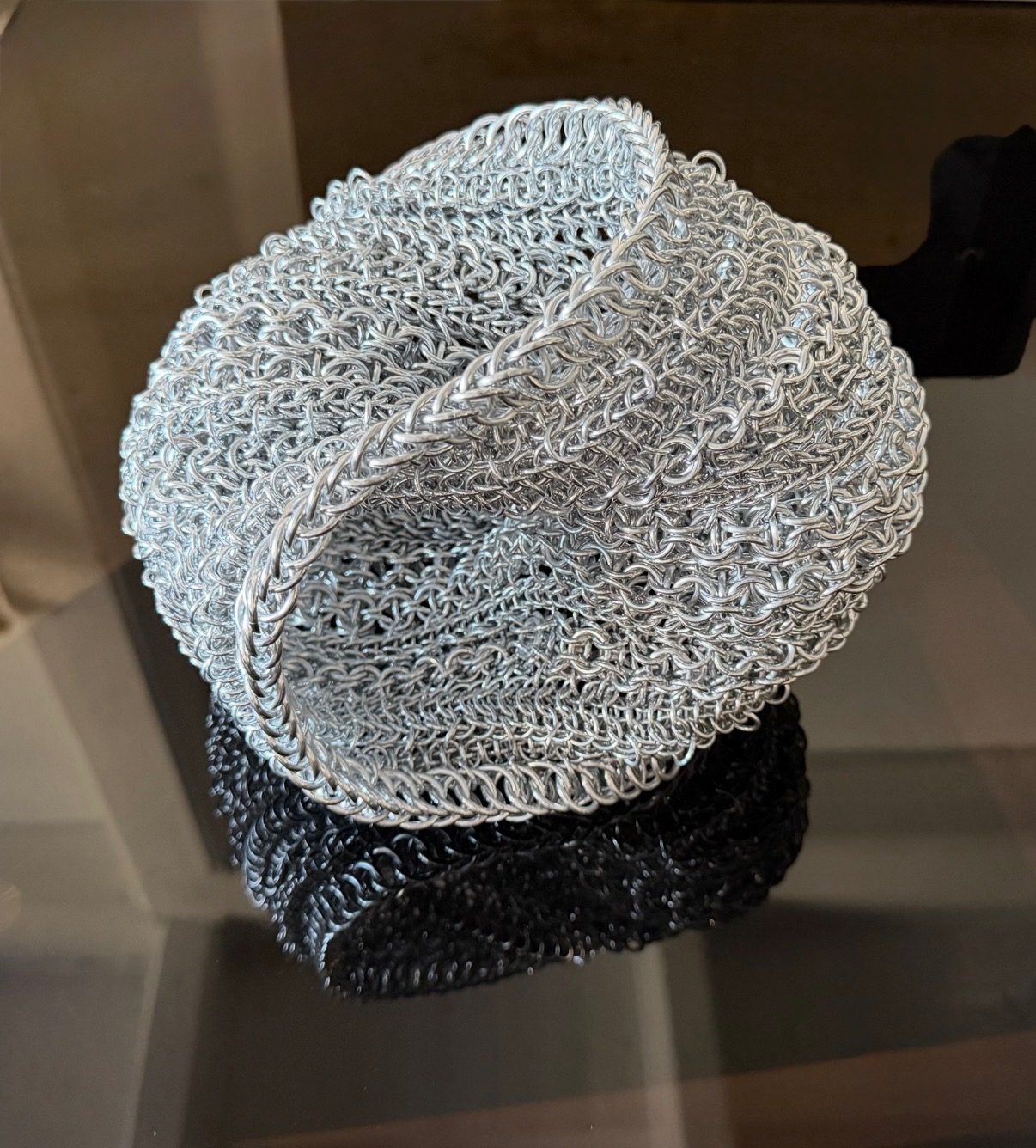
In various contexts, "honeypots" serve as lures: in espionage, maybe a seductive operative; in cybersecurity, a seemingly vulnerable system designed to ensnare intruders. While the piece looks like a functional basket, the bottom of the piece inverts upward through the basket to become the stem/upper mouth. When you look down through the top, you can see straight through the bottom. It invites the viewer to peer within and realize it wasn't what they expected.


6″ × 13.5″ × 16″
Baskets have long been a craft of women and a symbol of the womb. This malleable metal basket rethinks the traditionally male craft of chainmail in a feminine basket form. It represents present-day evolving conversations around expectations of gender and fertility.


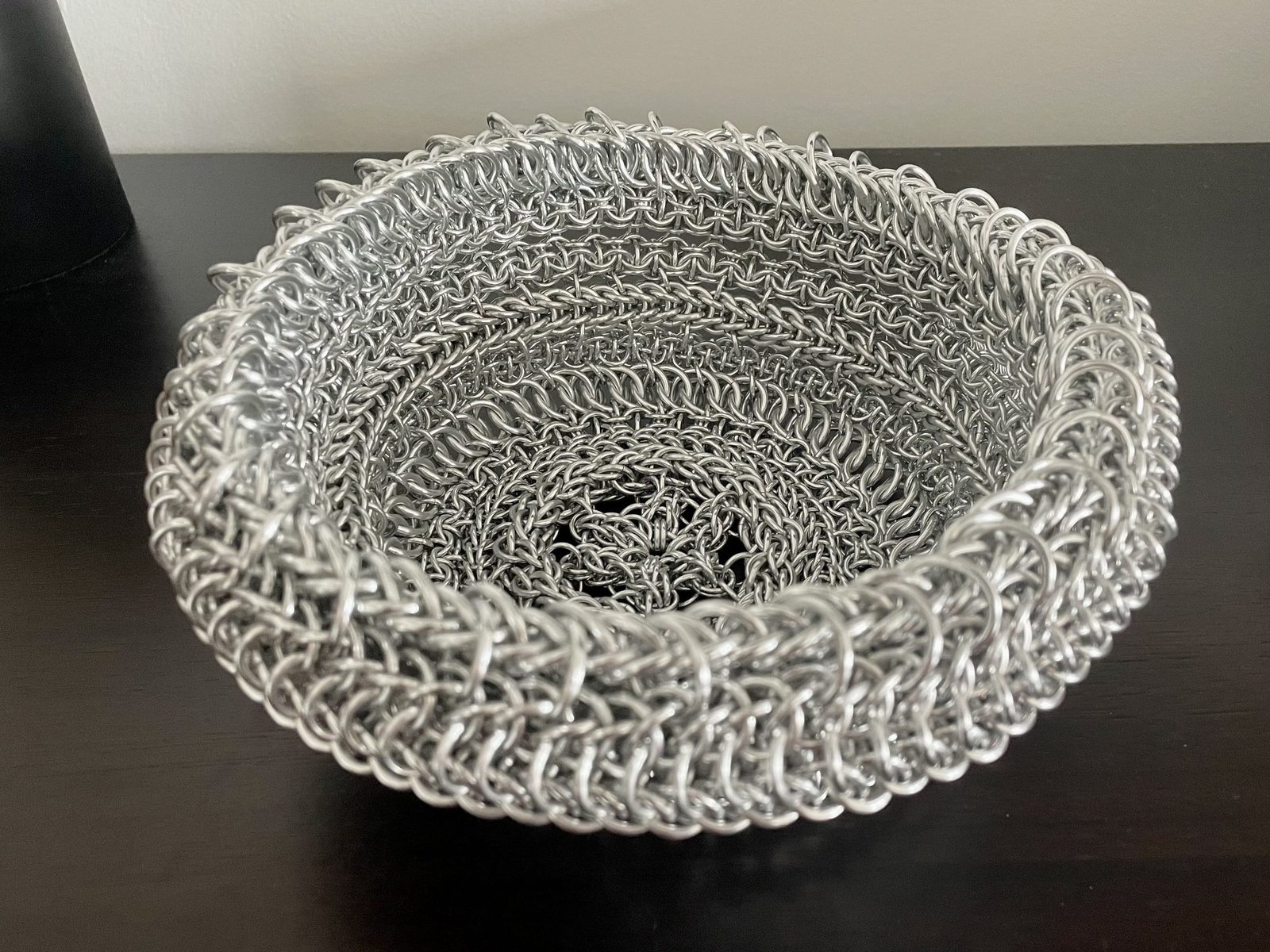
3″ × 8″ × 8″
Jesse Aviv's grandmother is celebrated textile artist Jane Sauer, who pioneered a form of closed basketry. This basket is an homage to Sauer.


The miniature edition of the Fruit Basket series — same obsessive detail at reduced scale. A study in the patience required when the work becomes smaller than the hand.
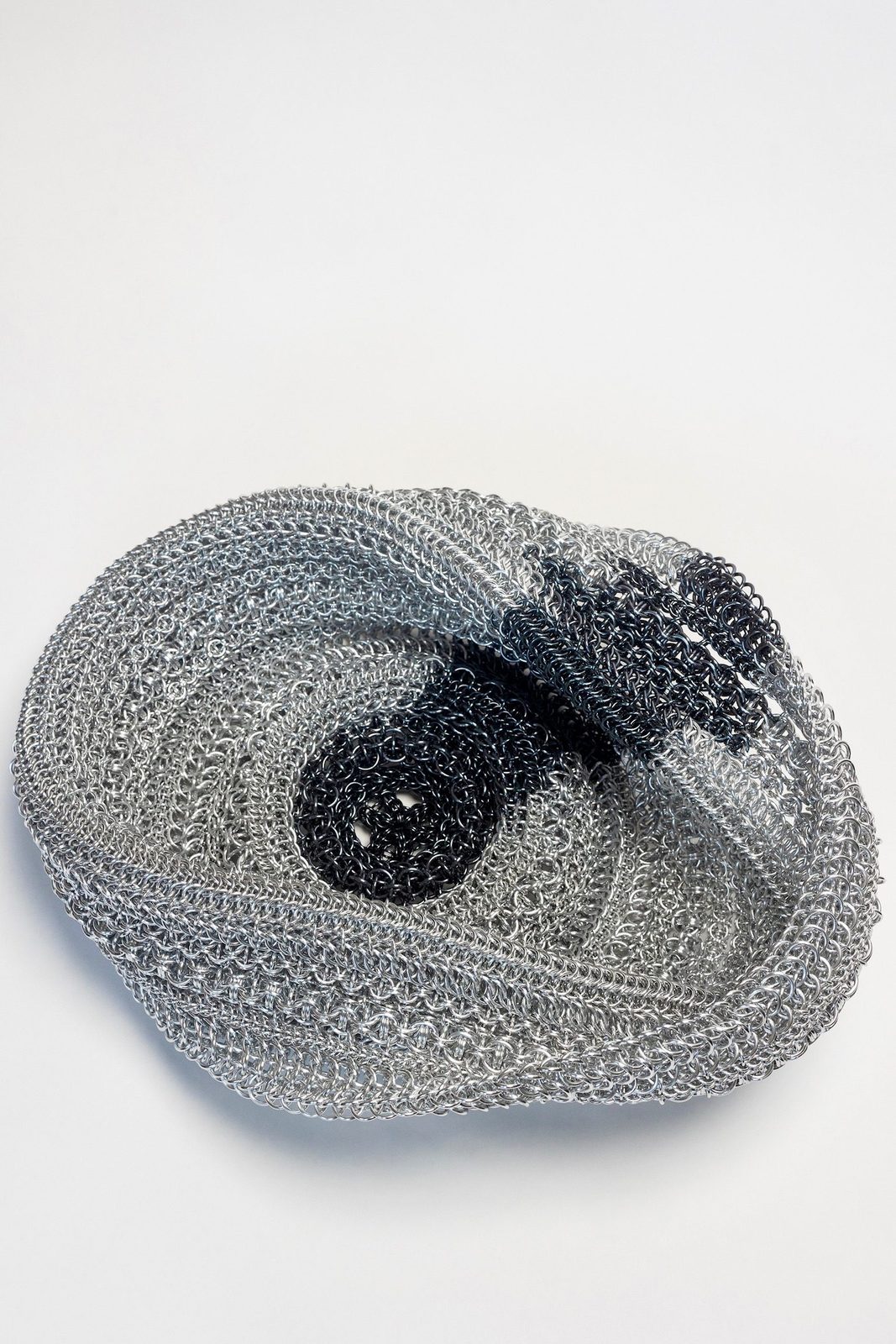
7″ × 7″ × 10″
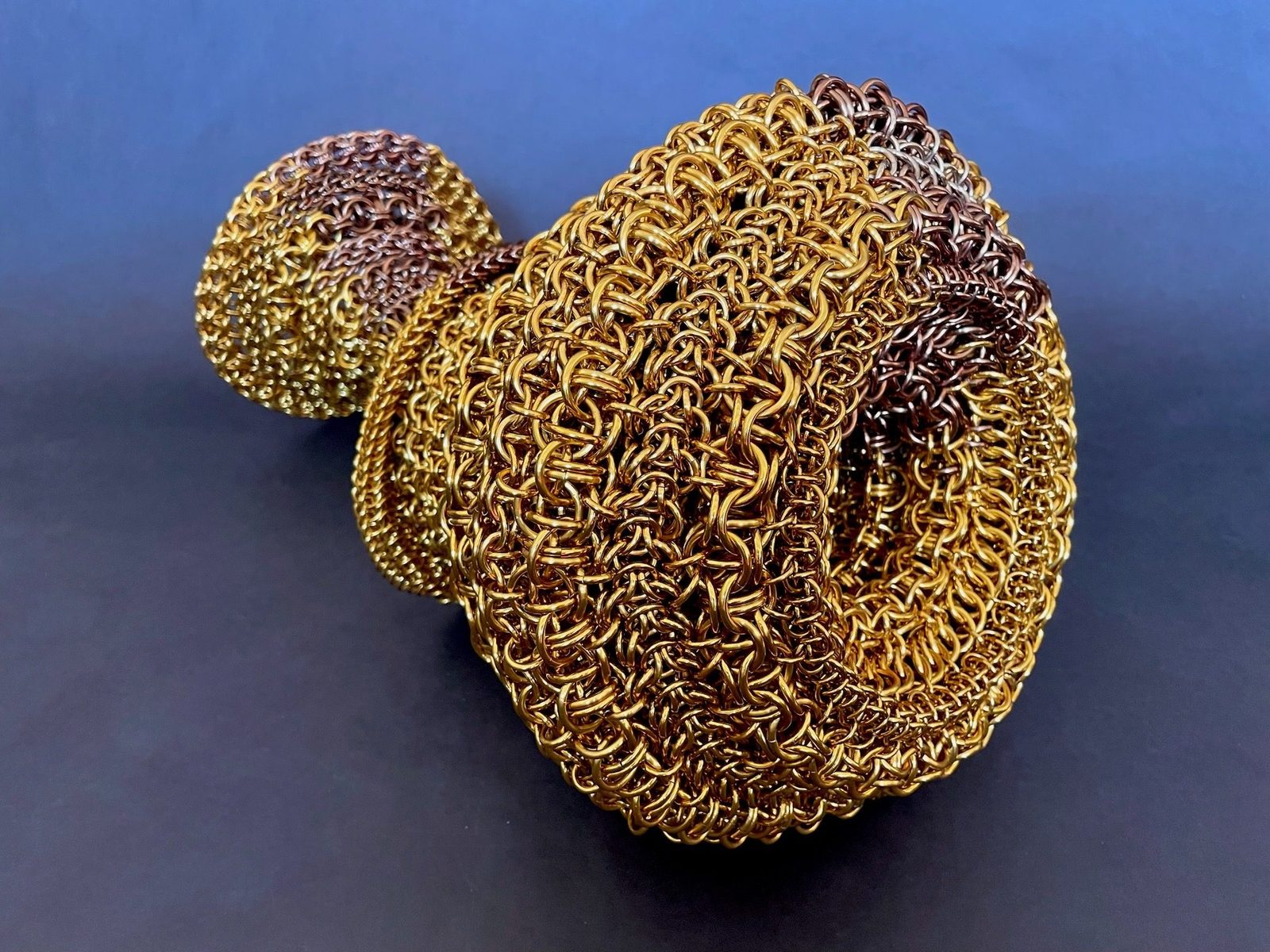
This basket plays on surface and volume, inside and outside.


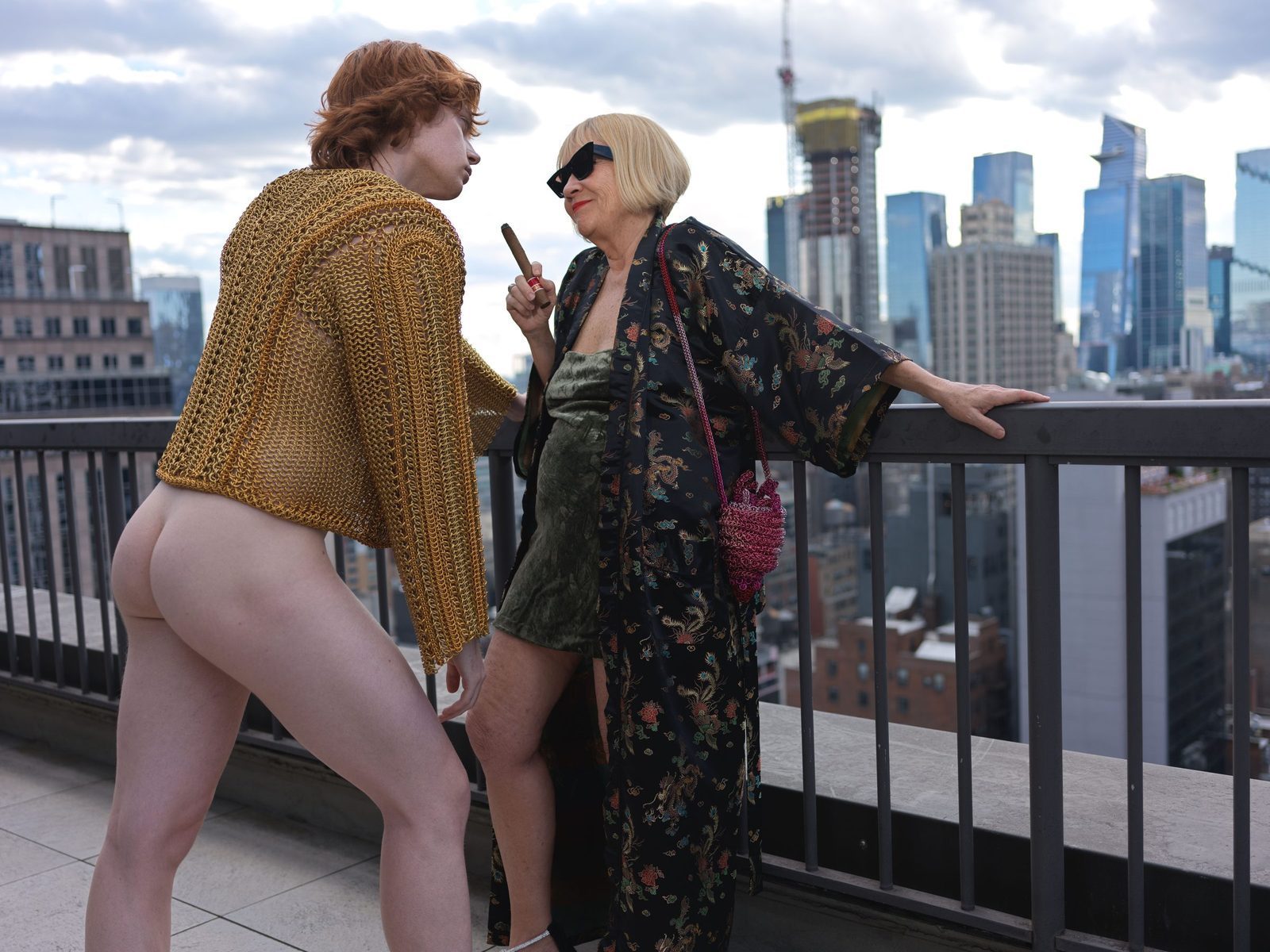
A cropped dress jacket born from two silhouettes: the structured brevity of a bolero and the unhurried drape of a kimono sleeve. The wider sleeve opening lets the arm move with a fluid grace rarely afforded by evening wear, while multiple weaves build dimension across the body of the piece, anchored by our signature Ciphered chainmail for architectural integrity.
What makes this jacket extraordinary lives in its construction. The shoulder is not a separate panel stitched to the body. It is a continuous weave that begins at the base of the jacket, wraps over the shoulder and around the neck, and carries through to the back in one unbroken movement. There is no seam to interrupt the line. The result is a garment that moves as a single, cohesive form. A reverse epaulette shapes itself organically around the shoulder's curve, flowing downward into the sleeve with a naturalism that belies the precision behind it.
Assembled entirely from anodized aluminum jump rings over nearly 200 hours, the Kimbolo carries a remarkable lightness while retaining the flexibility inherent to chainmail's interlocking structure. Nothing like it exists in evening wear.


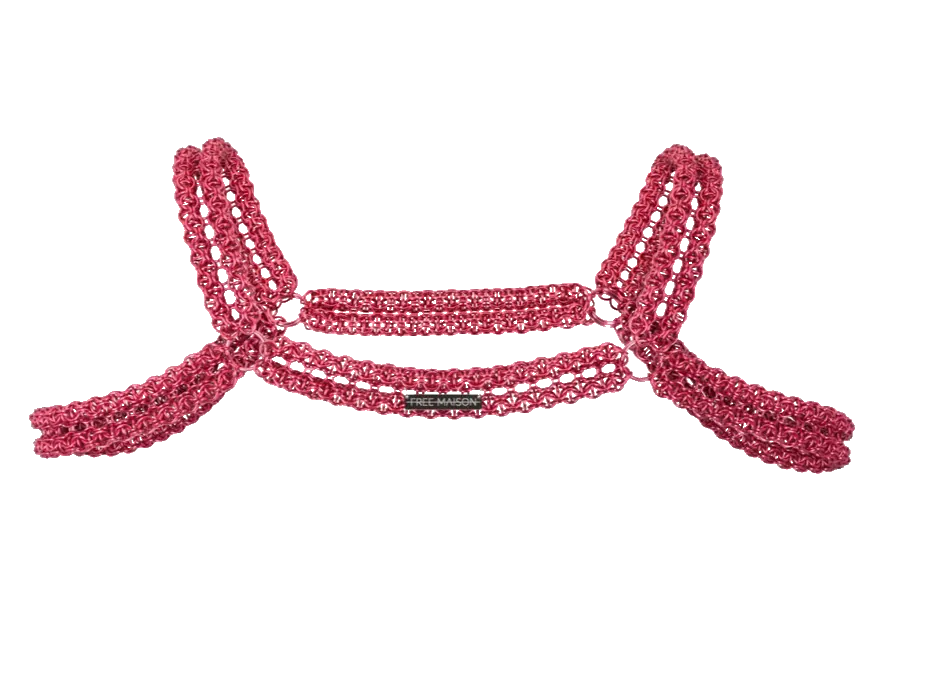
Part of the Core Collection, every Mane is inspired by the ruff of a lion. Corrugated, stacked chains that wrap around the shoulders, chest, and back with the commanding presence of an animal born to lead.
The Devil Red Hanover Mane was designed for the Printemps NYC activation for The Devil Wears Prada 2. The piece was selected by costume designer Molly Rogers to complement a 2006 Oscar de la Renta red gown styled for the Miranda Priestly character. It was displayed in The Red Room at Printemps New York's flagship at 1 Wall Street, among 24 mannequins presenting shoppable looks from the film. The piece was produced in partnership with Molly Rogers and Brian Solis.
In devil red, the Hanover Mane carries a heat and drama that sets it apart from the silver and gold editions — a statement built entirely for a room.


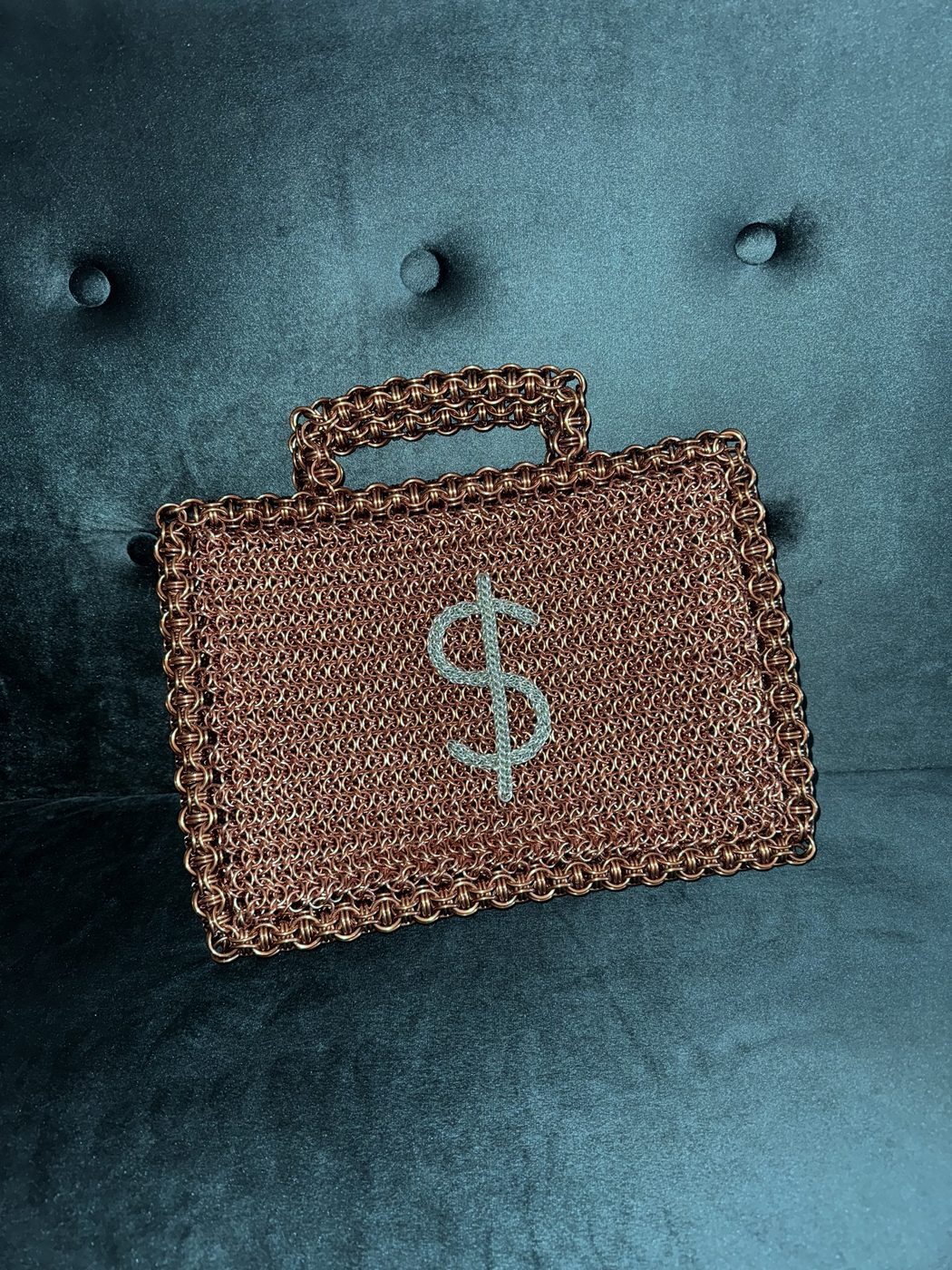
A briefcase made entirely of chainmail, sized to hold a 13-inch laptop — the very instrument through which so much of today's wealth is generated. The bag itself weighs roughly four pounds, about the same as the machine it was designed to carry, and it sits in the hand with a deliberate, grounded heft.
The construction is rigid and architectural, a departure from chainmail's usual softness. A dollar sign rendered in mint green chainmail marks the face of the bag, set against a body woven in old-penny bronze, a tone closer to raw copper with the patina of a coin long in circulation. There is a duality at work here: the symbolic weight of coins paired with the purchasing power of paper currency. Chainmail, once forged purely for defense, is reimagined as something both confrontational and covetable. Your bag can be as offensive as it is protective.
Weighed, balanced, and impossible to ignore.


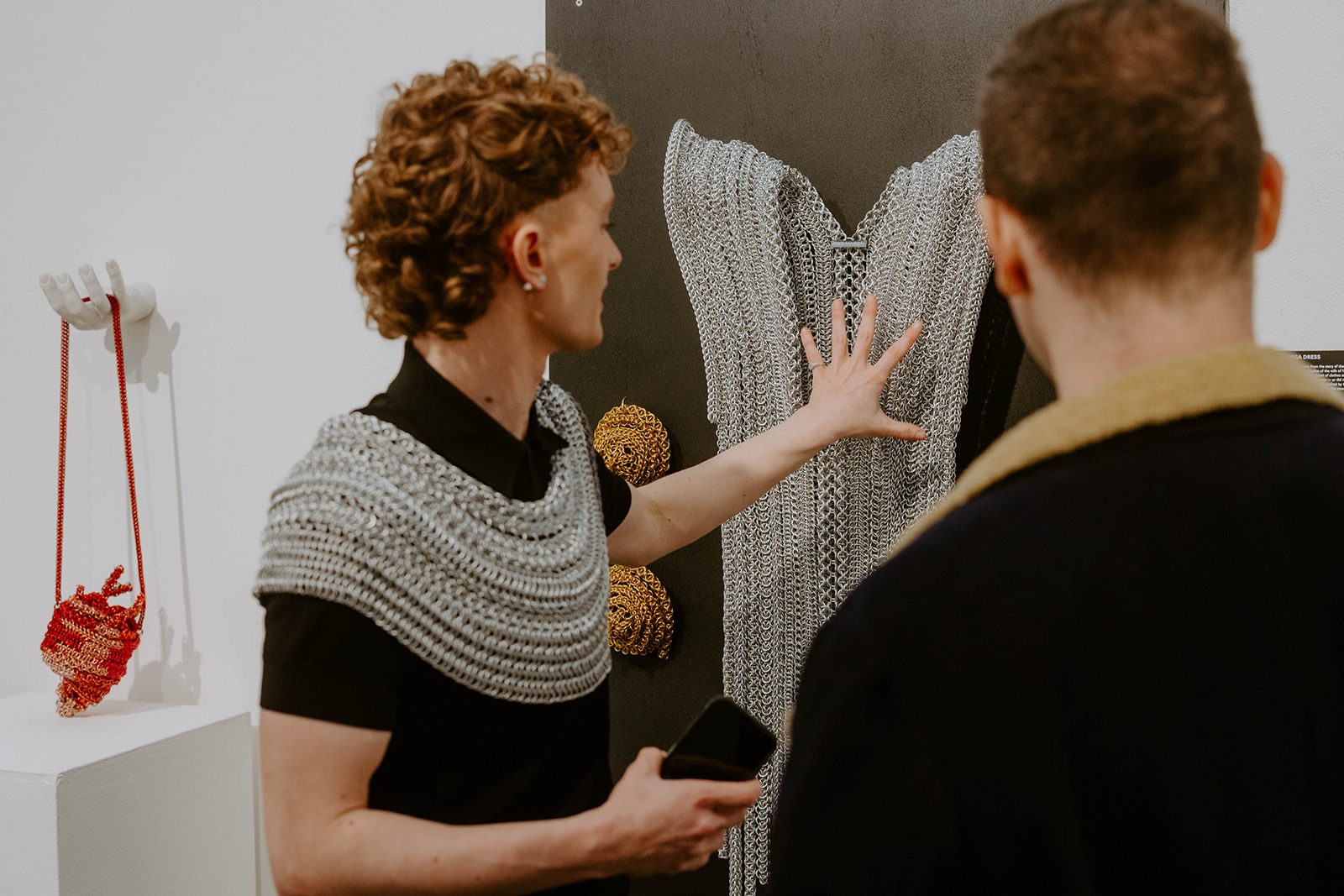
Twelve pounds of aluminum chainmail shaped into a full dress that sits against the body like a suit of armor.
The name comes from the tale of Nabis, tyrant of Sparta, who ruled from 207 to 192 BCE. Nabis had constructed a mechanical automaton in the likeness of his wife, Apega, dressed lavishly with arms outstretched in an invitation to embrace. Those who accepted the gesture were crushed and pierced by iron spikes concealed beneath the figure's garments. The device was used to extract tribute from anyone who refused to pay, turning an image of beauty and welcome into a weapon of absolute authority. Whether the story is historical fact or political mythology passed down through the writings of Polybius, its power endures.
A woman in this dress carries that same energy. Beautiful and formidable in equal measure. The kind of presence that could, if she chose, crush anyone who came too close.


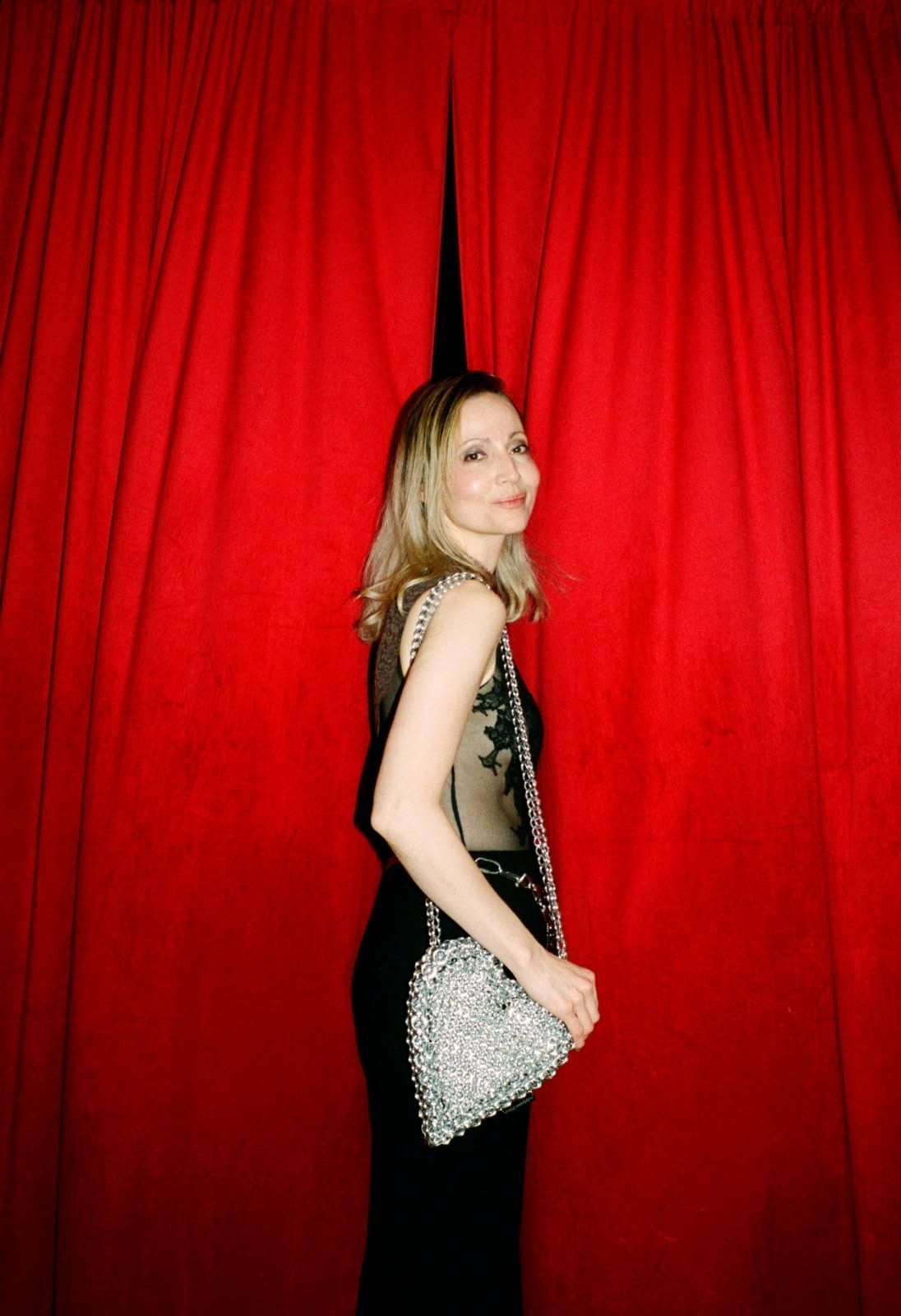
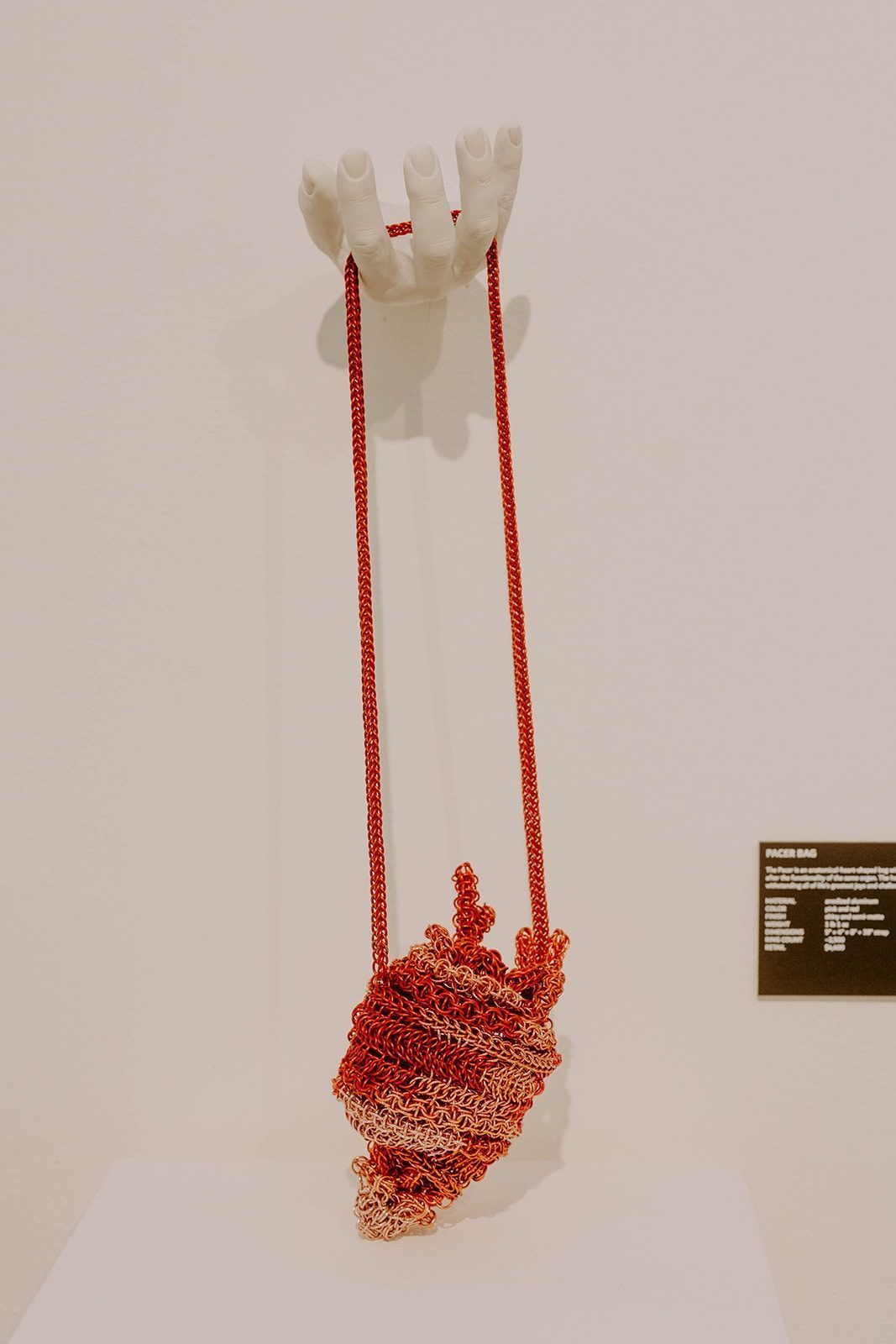
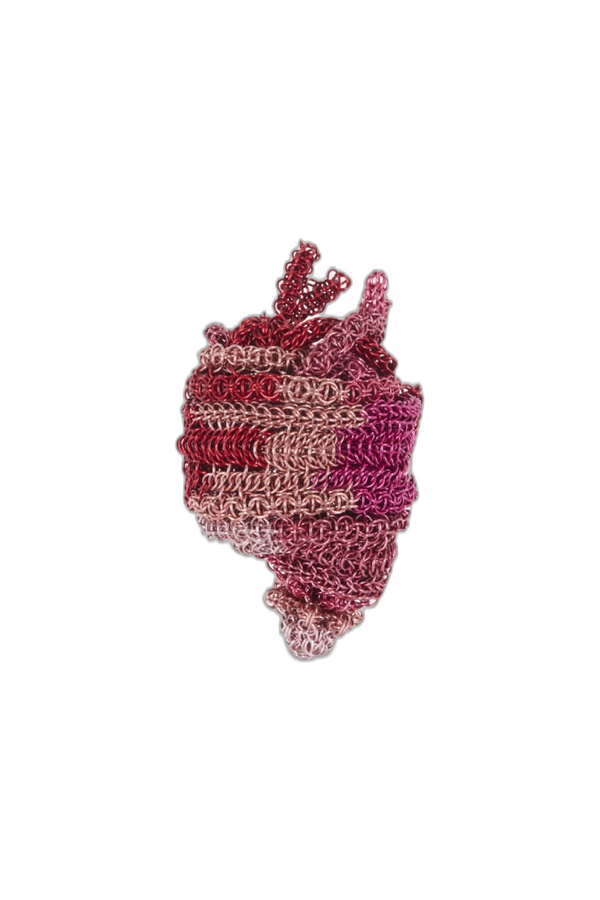
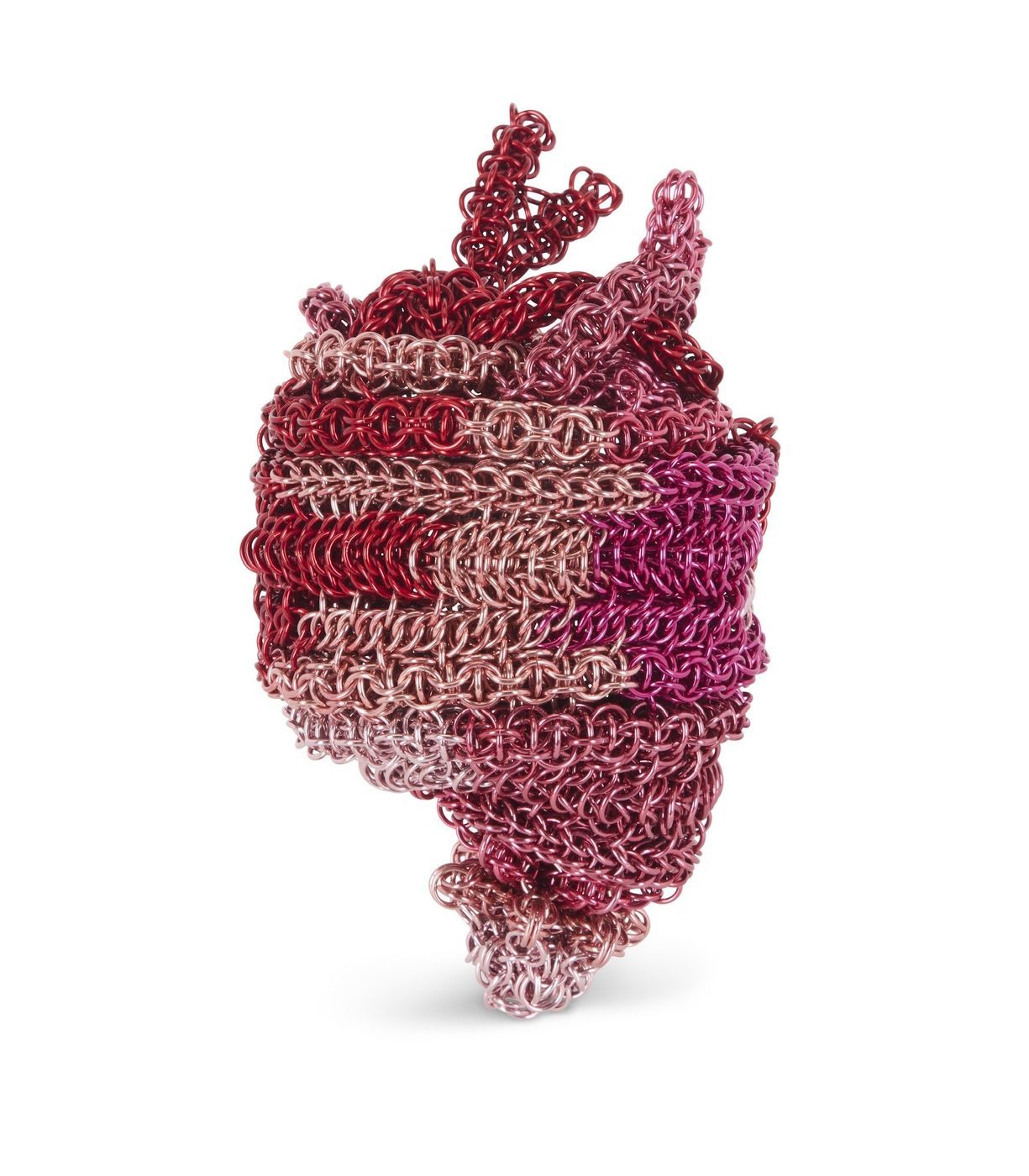
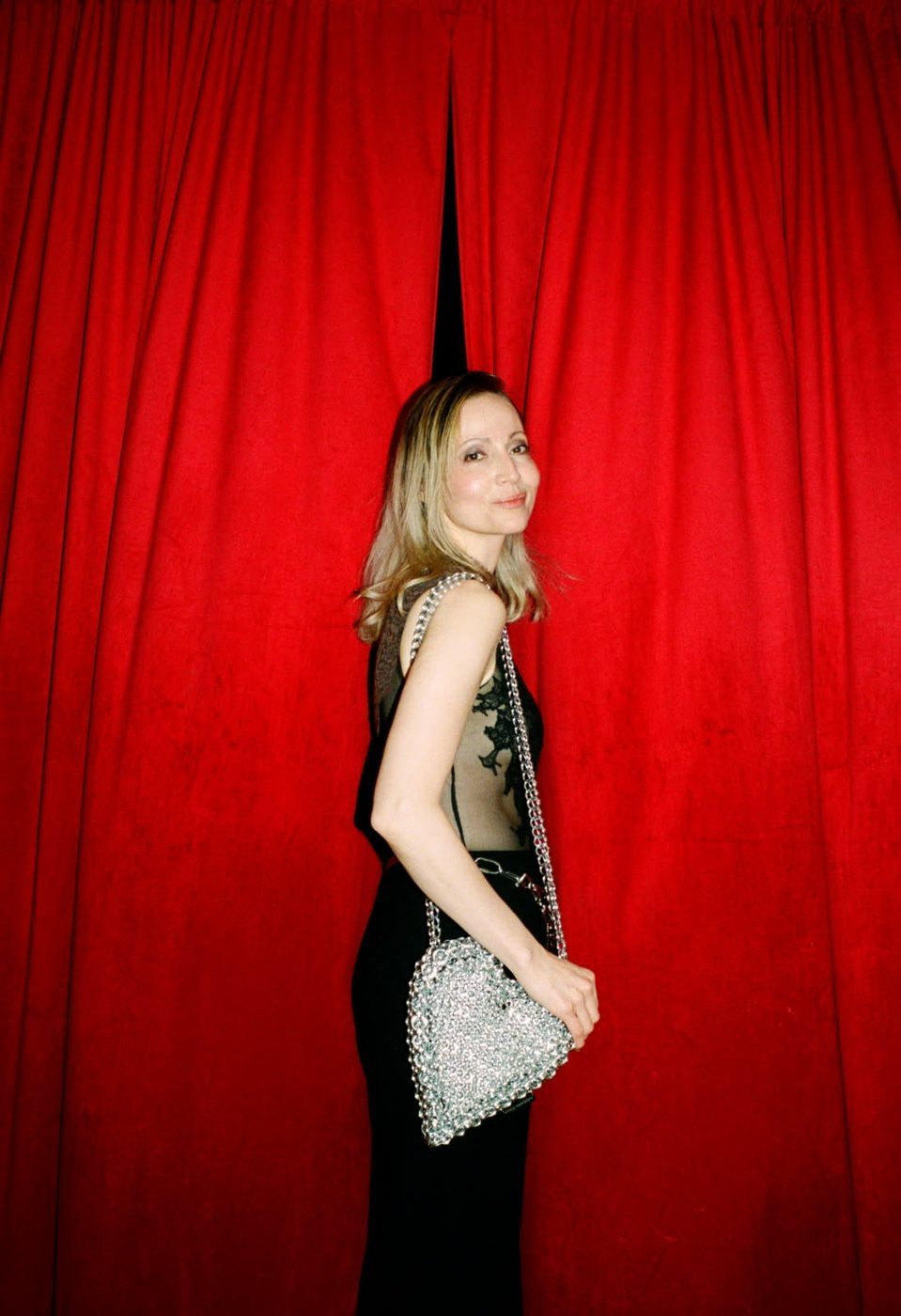
A sculptural chainmail bag shaped in the form of an anatomical heart. The interior is woven like a basket, open to create a functional cavity for carrying your essentials within a form that reads as pure art object.
Multiple chainmail colors are woven together to produce variations in dimension and shadow, deepening the sculptural quality. The name Pacer speaks to the heart's role as the body's rhythm-keeper, the muscle that sets the pace for everything.
Produced in extremely limited numbers, this is chainmail as wearable sculpture. It is not subtle, and it is not meant to be.


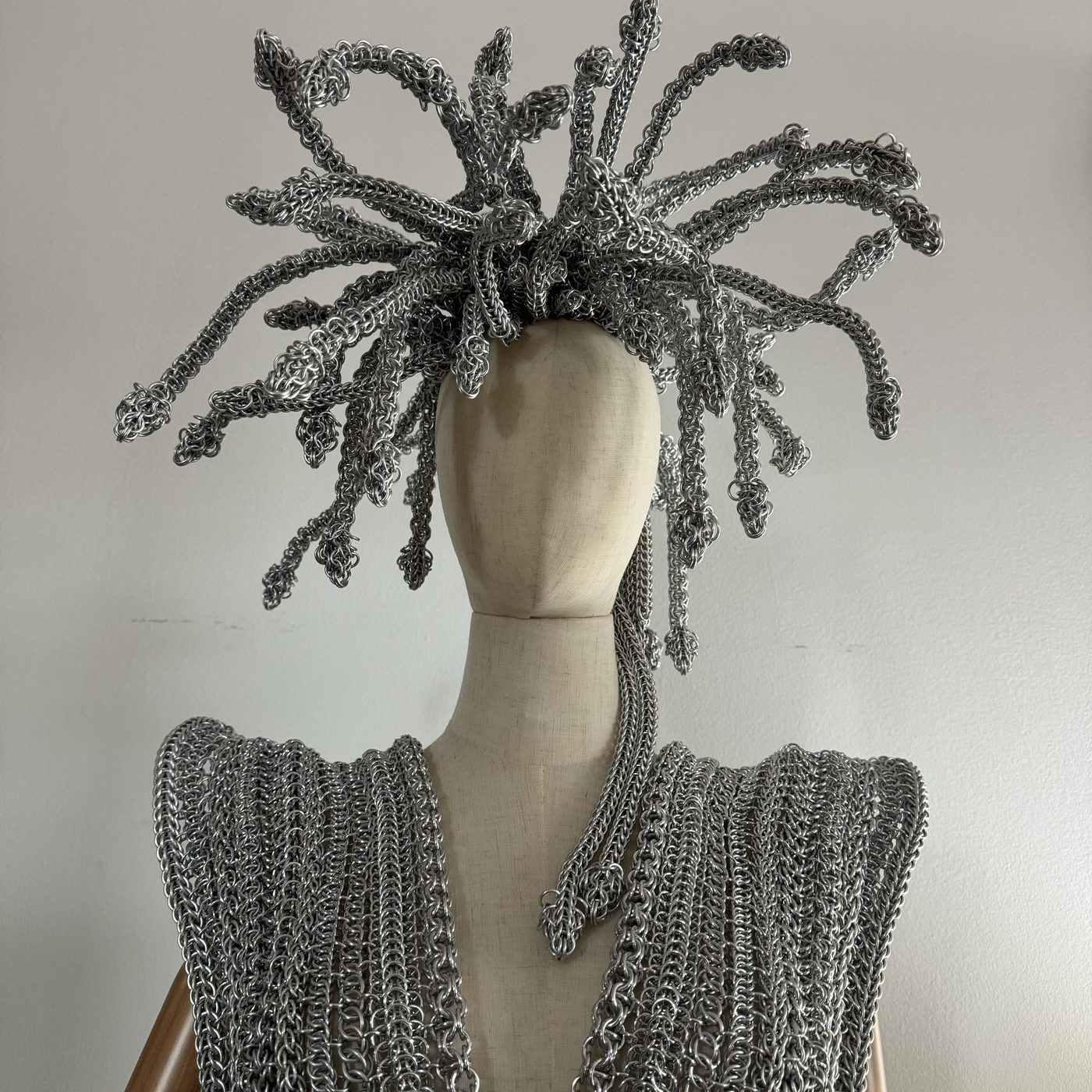
In ancient mythology, Medusa was the creature whose gaze turned her enemies to stone. Petrification as the ultimate defense. This headpiece channels that mythology through chainmail serpents, each one wired with internal structure to create the illusion of living movement atop the head.
Originally created for an attendee of Heidi Klum's legendary Halloween celebration, the piece is a feat of both craft and engineering. Each snake is individually constructed in chainmail, then shaped with wire armature so the serpents appear to writhe and coil with a life of their own. And because of the natural weight distribution of the chainmail wrapping around the base of the skull, the headpiece holds itself in place without a single pin, clip, or adhesive.


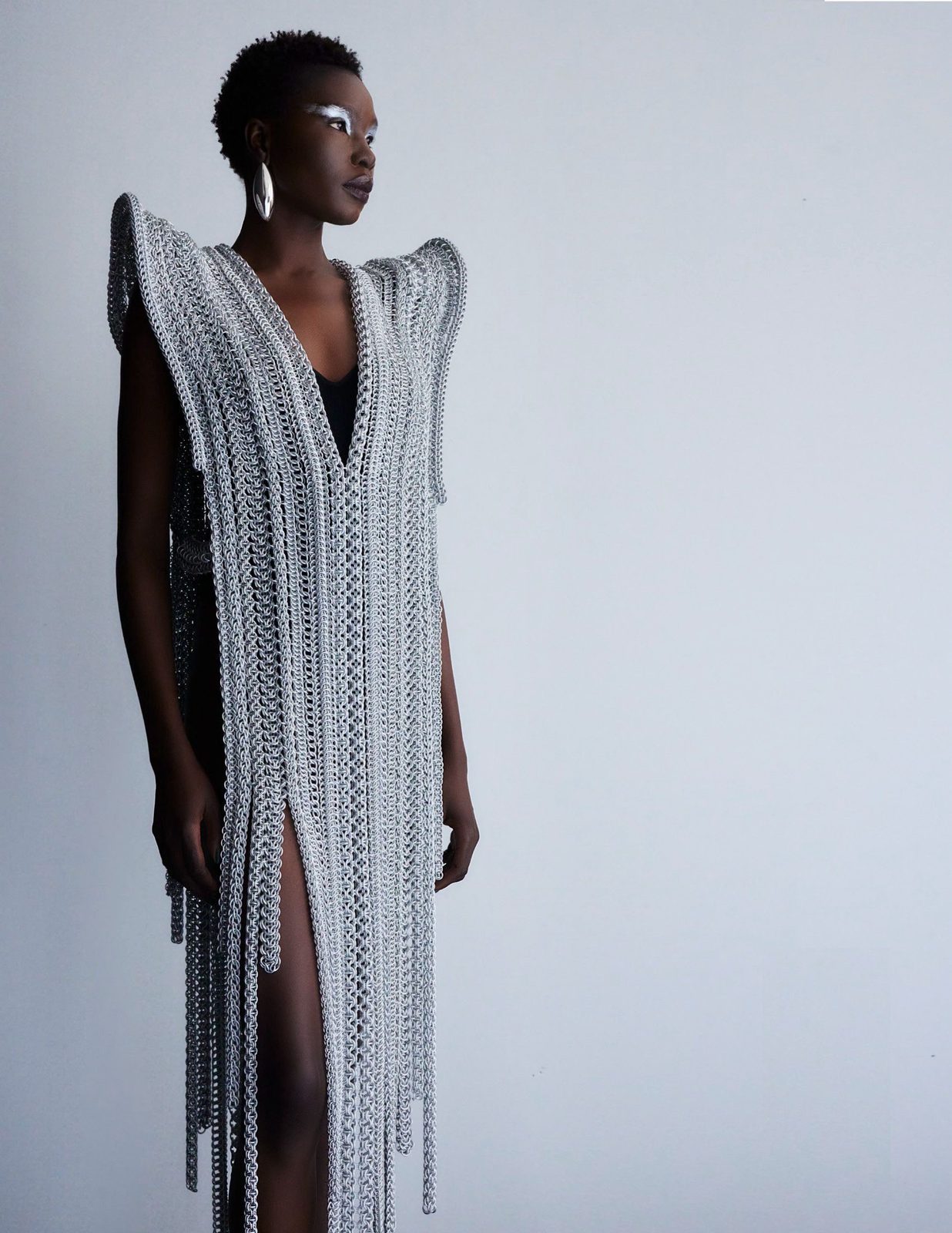
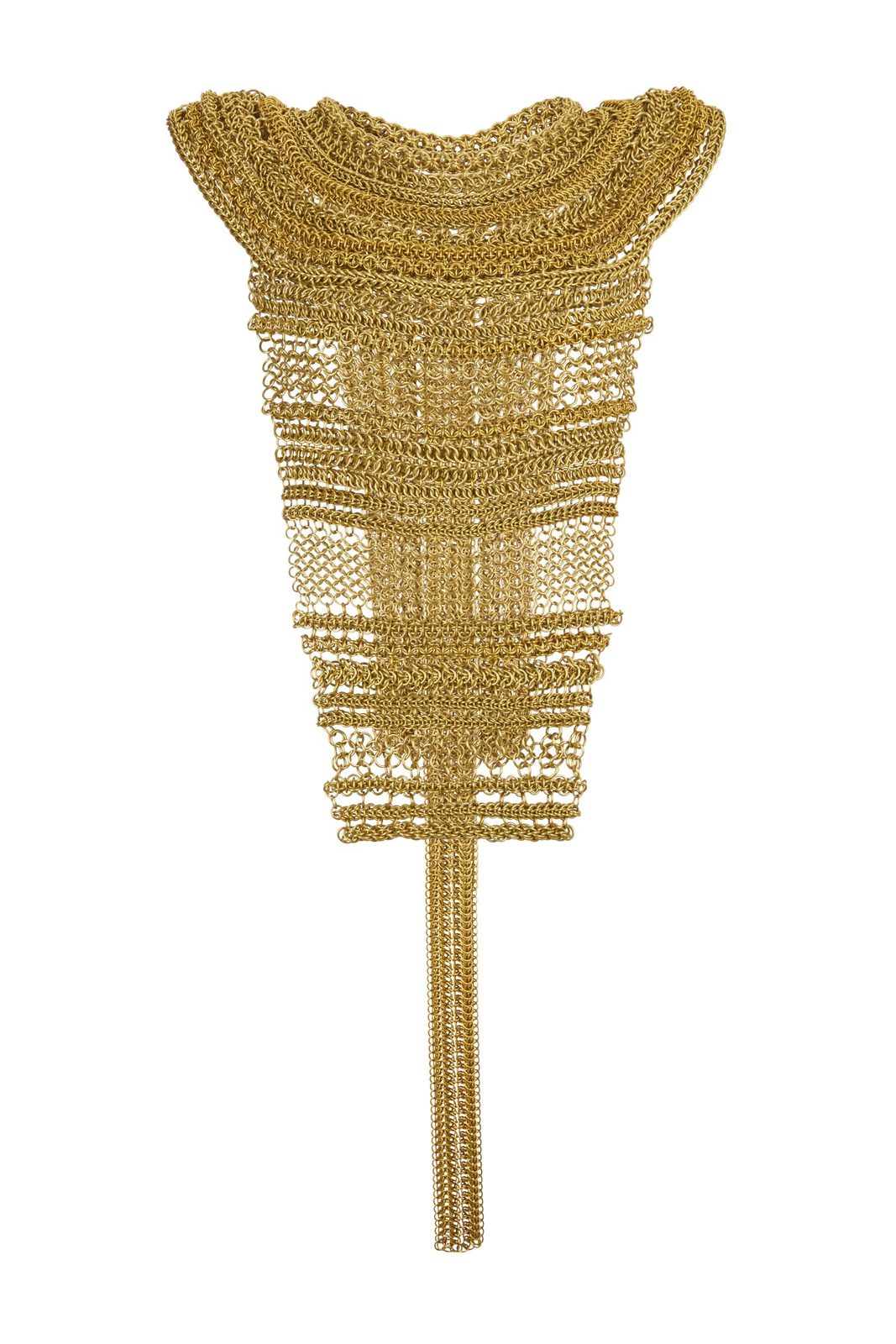
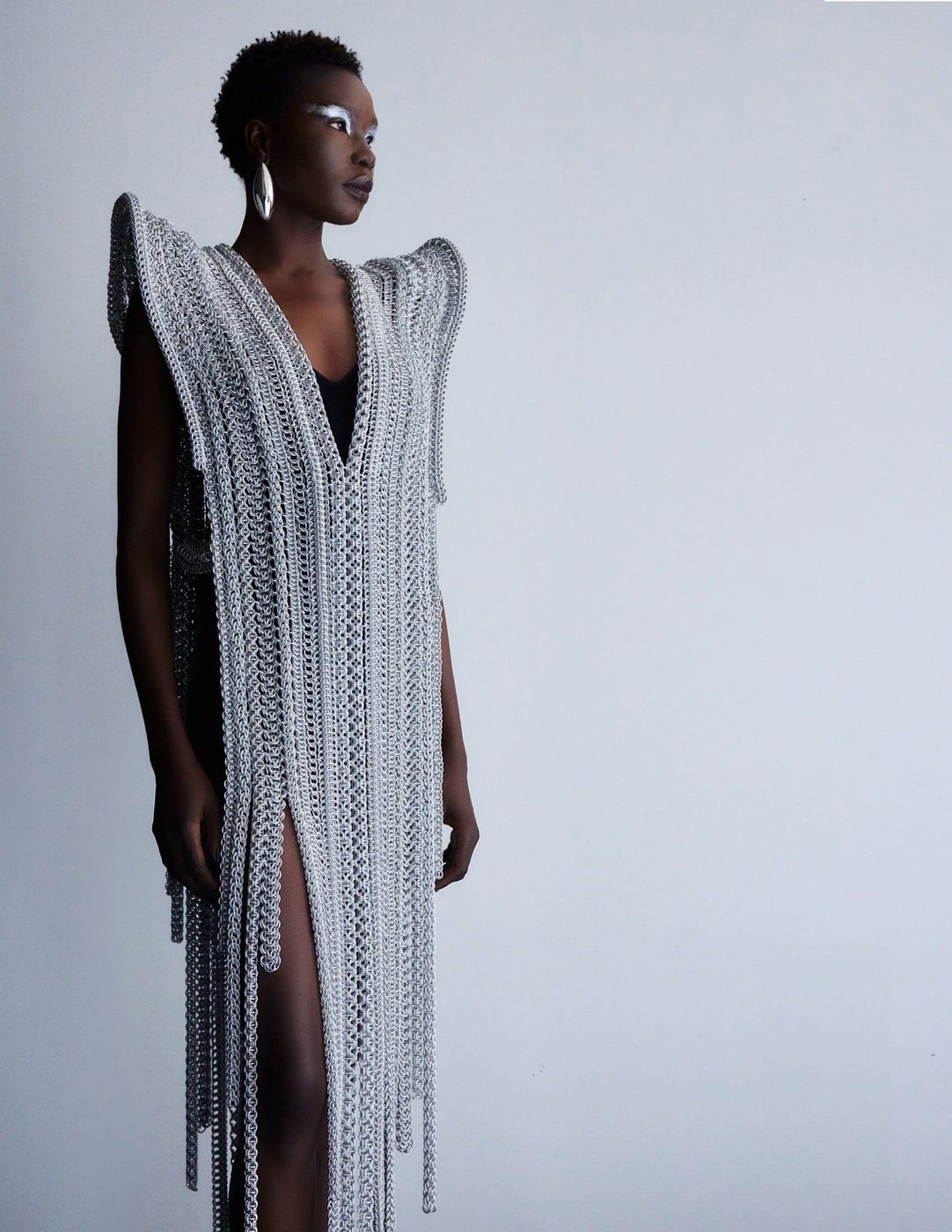
Named for the ancient, powerful program within the Matrix, one of the oldest and most influential entities in that constructed world, this lamé draws equally from the scoring vests worn in competitive fencing, where contact determines the point.
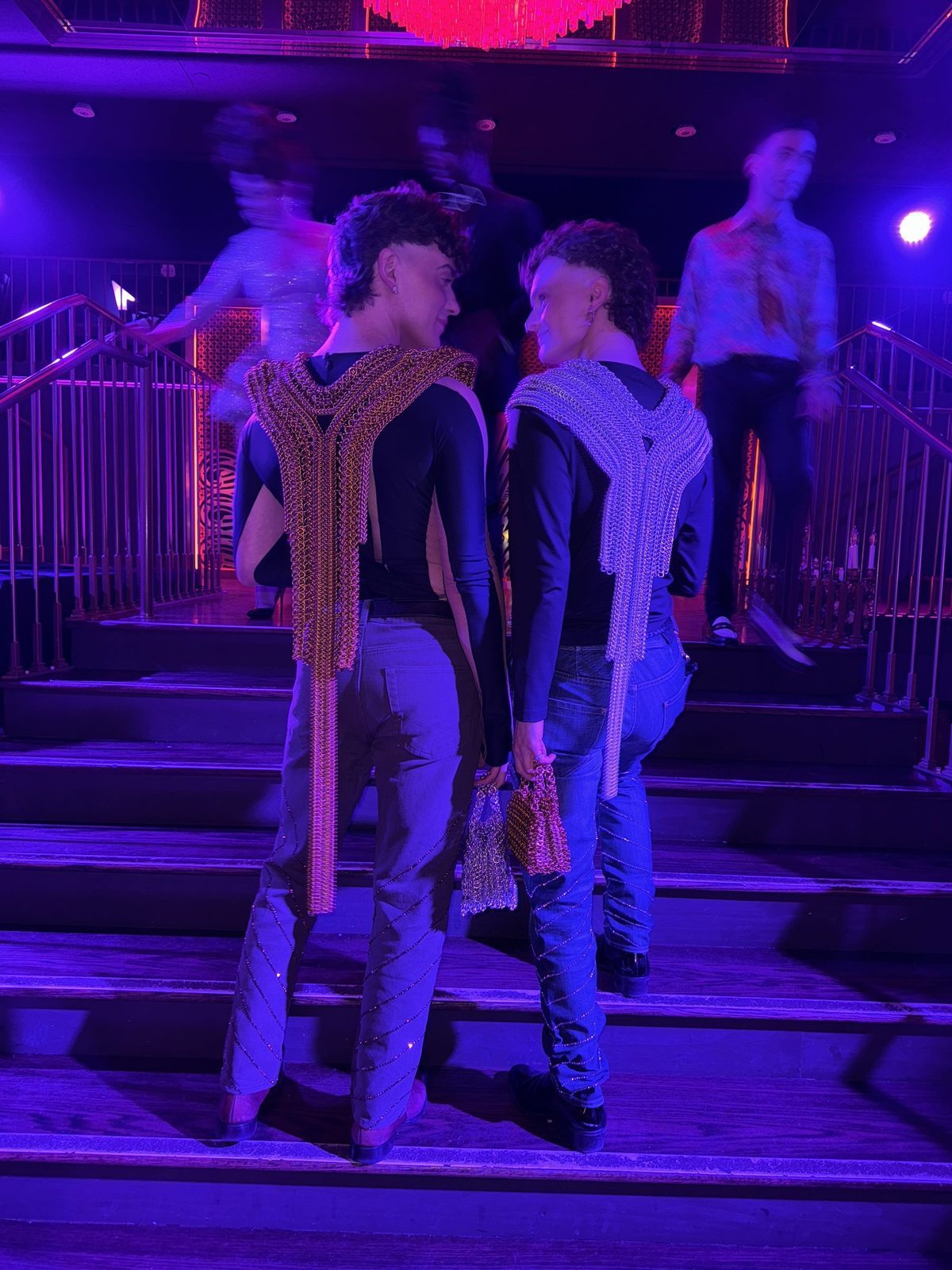
The piece is built with structured shoulders and woven to form a vest across the chest, with a long spine-like tail extending down the back. It is armor distilled into ornament, a garment that carries the posture and authority of something designed for combat while existing entirely in the realm of adornment.
Winner of an International Design Award from Fiber Art Now.


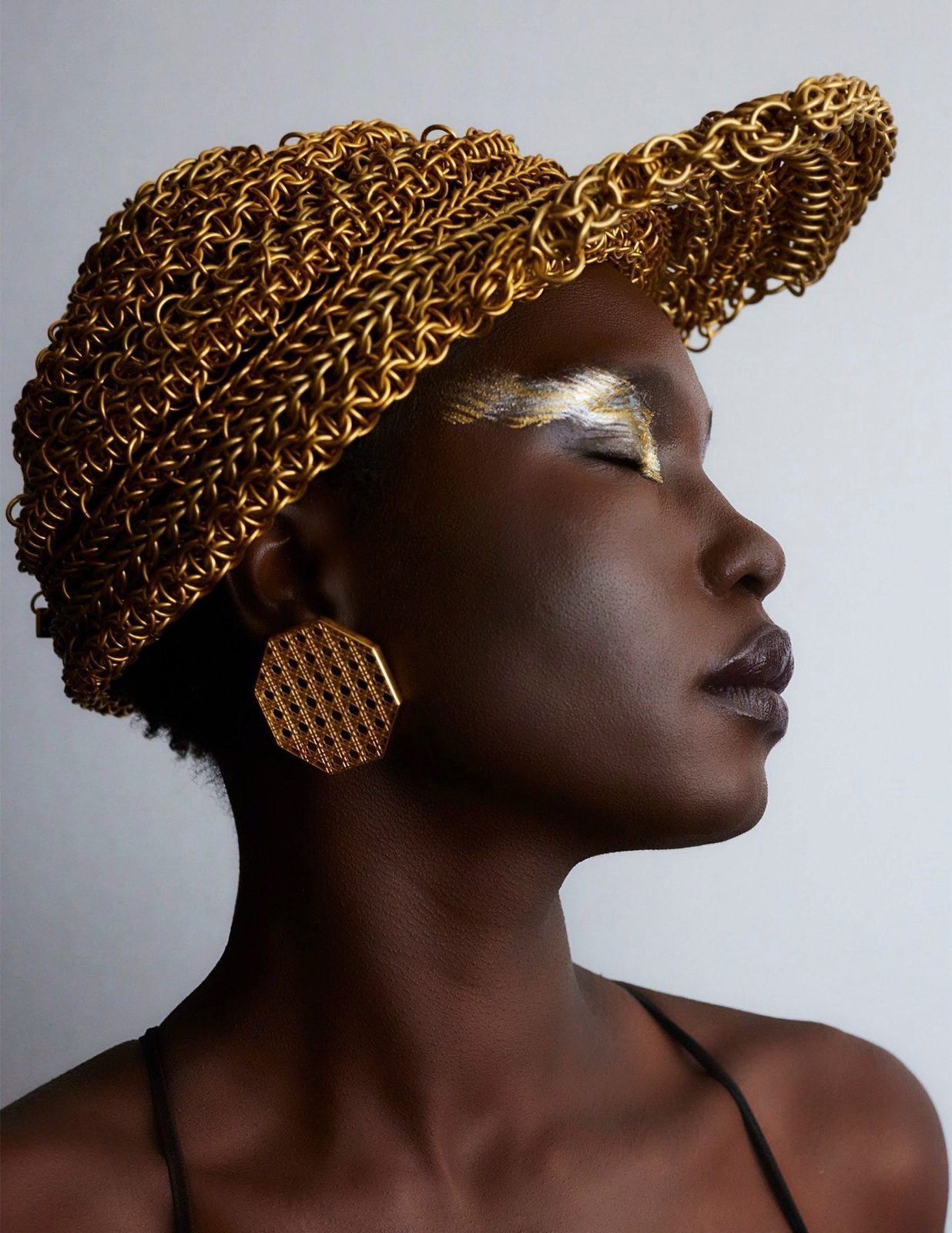
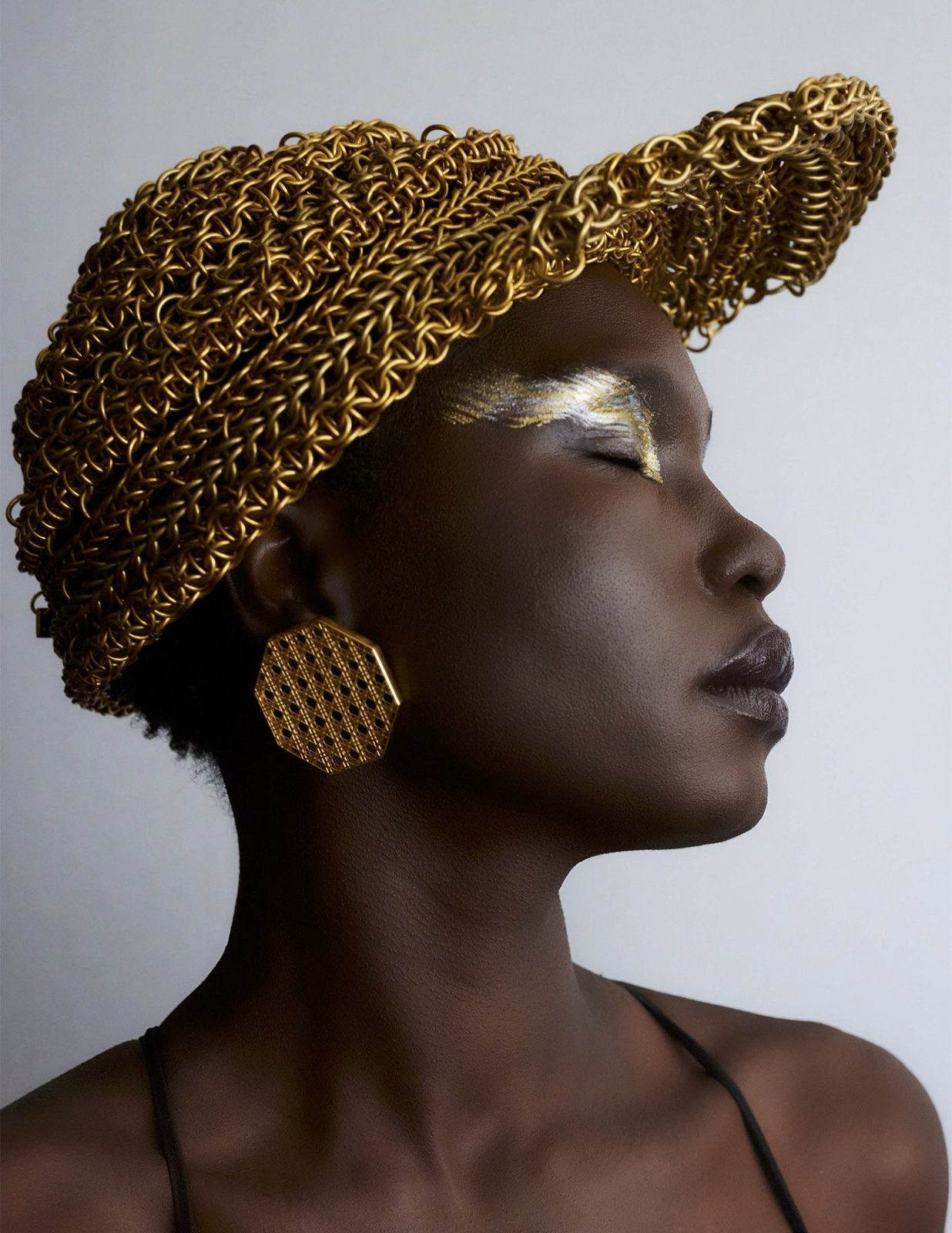
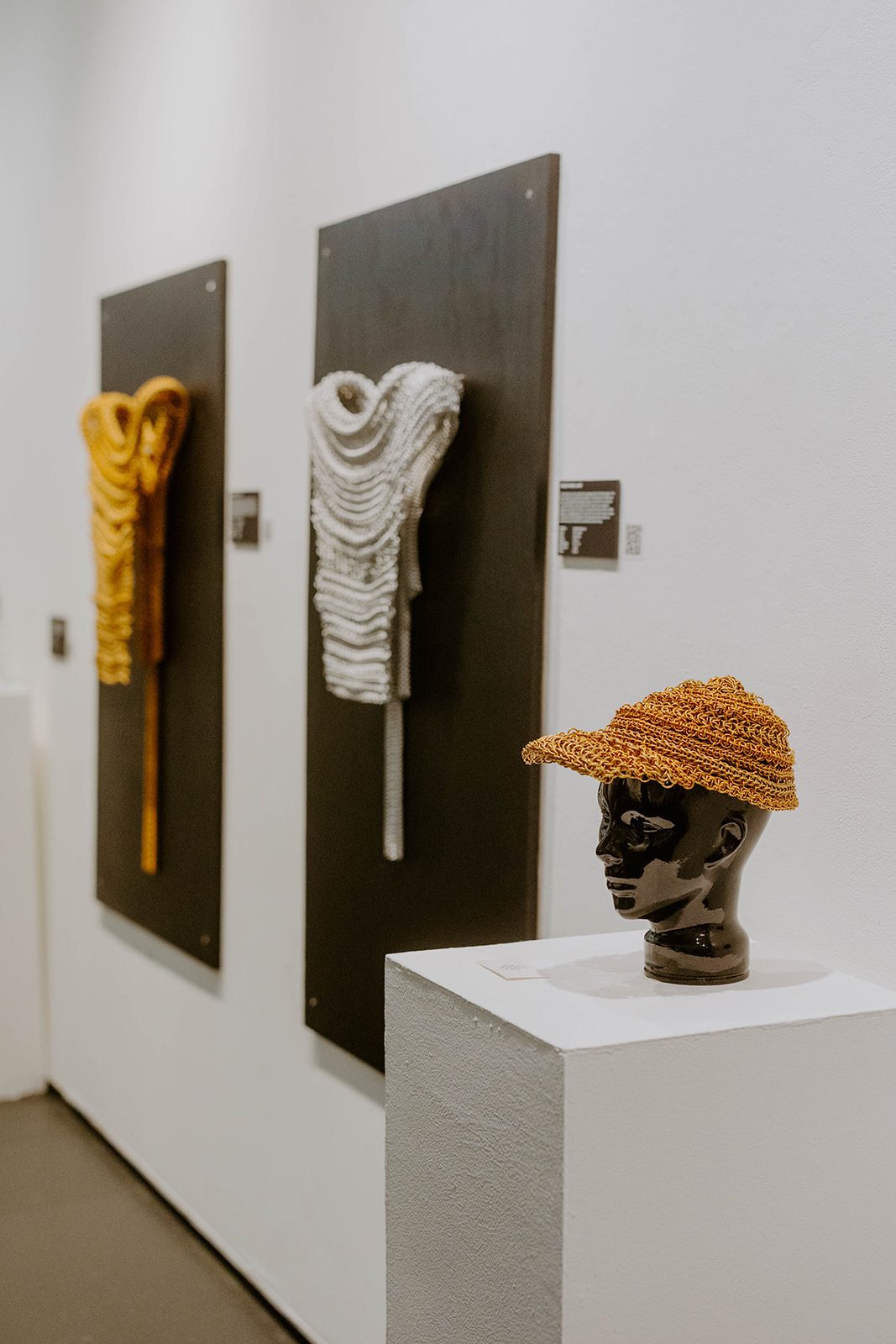
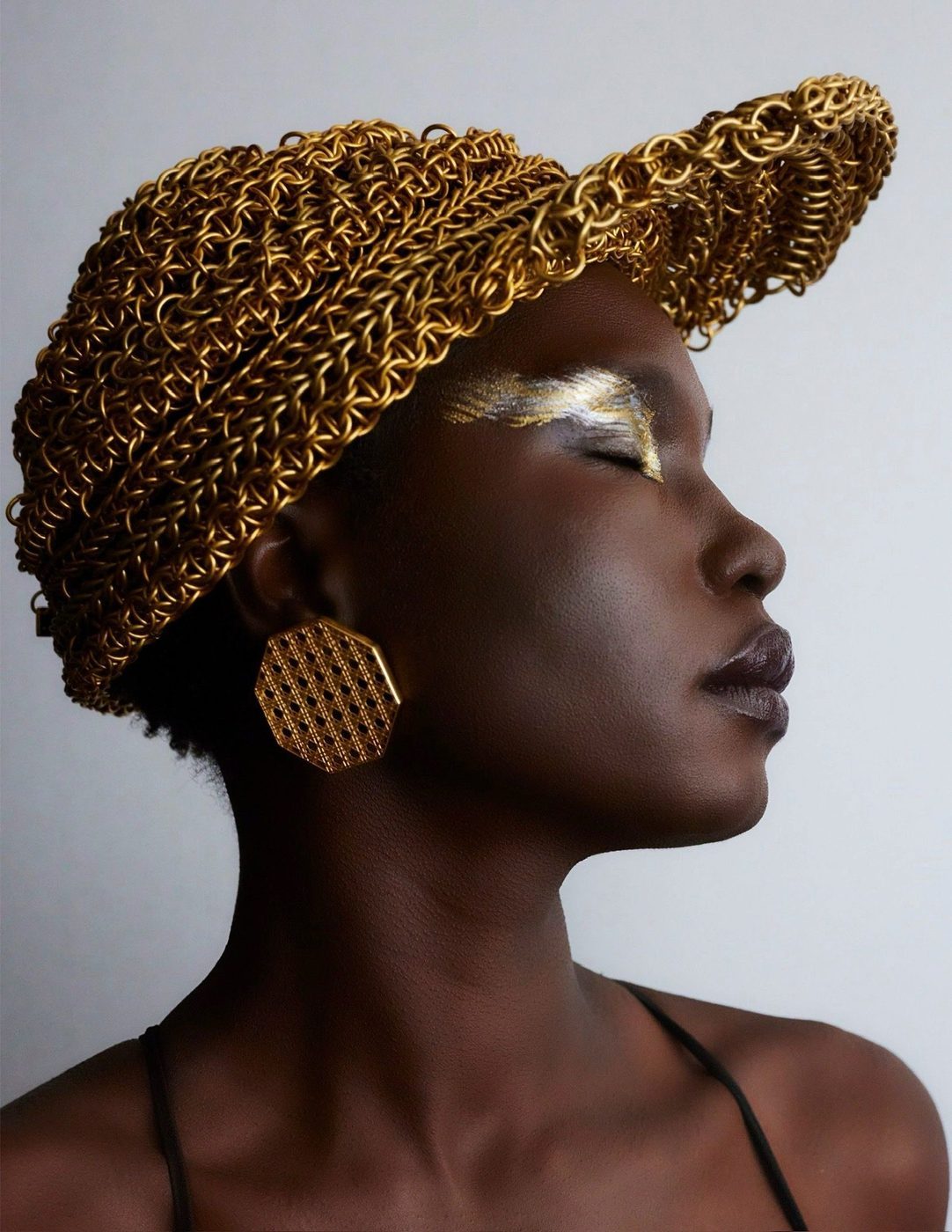
The Kabuto cap takes its name from the helmets worn by samurai in feudal Japan, often wildly ornate yet still engineered to protect the wearer from the edge of a blade. This is that spirit distilled into a chainmail baseball cap: the familiar form of an everyday silhouette, remade in a material that carries centuries of military significance.
Comfortable enough to wear casually, striking enough to stop a room. Every Free Maison hat is named after a different type of military helmet from the ancient world, and the Kabuto is among the most revered.


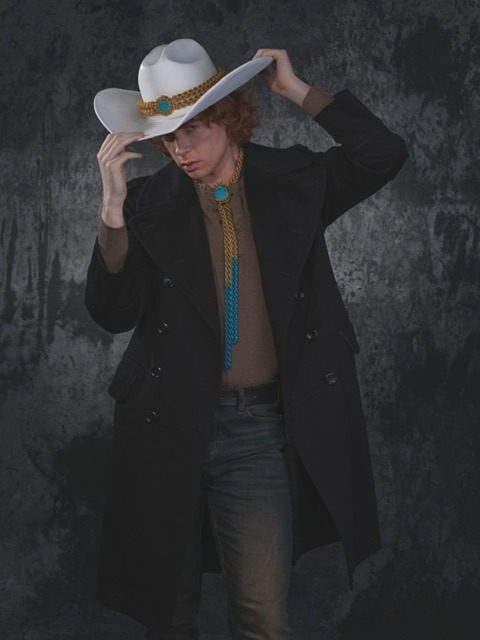
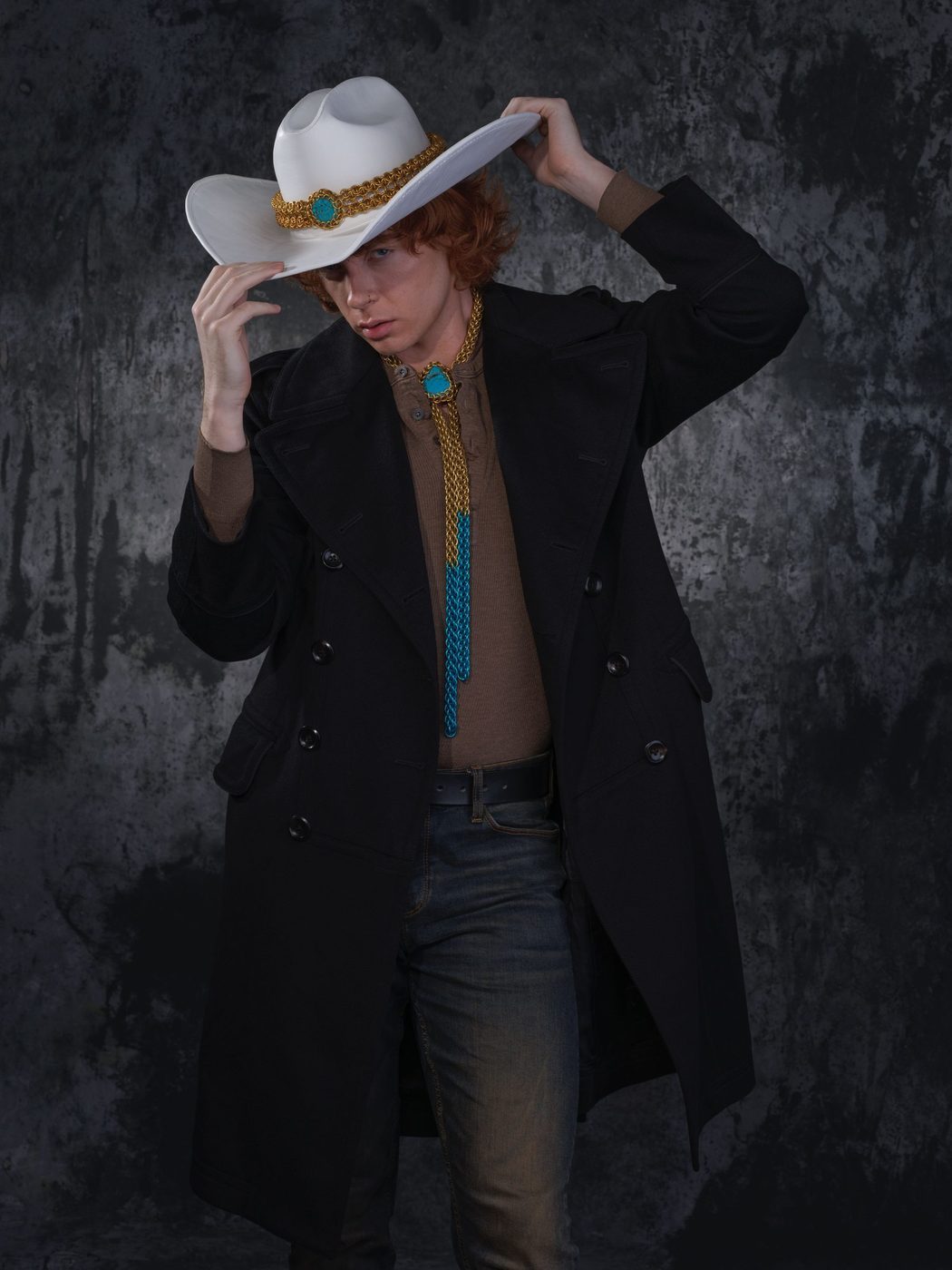
Designer Jesse Aviv grew up in New Mexico, where turquoise is more than a gemstone. It is a language of place, embedded in the landscape and the visual traditions of the American Southwest for centuries.
The bolo tie is woven in gold chainmail with a turquoise stone set at its center, anchoring the piece with the color and weight of the land it references. The tails are detailed with turquoise-colored chainmail to echo the stone above, creating a dialogue between natural material and handcrafted metal that runs the full length of the piece.
The matching hat band was designed to rest comfortably on any cowboy hat silhouette, an addition that transforms the familiar into something singular.


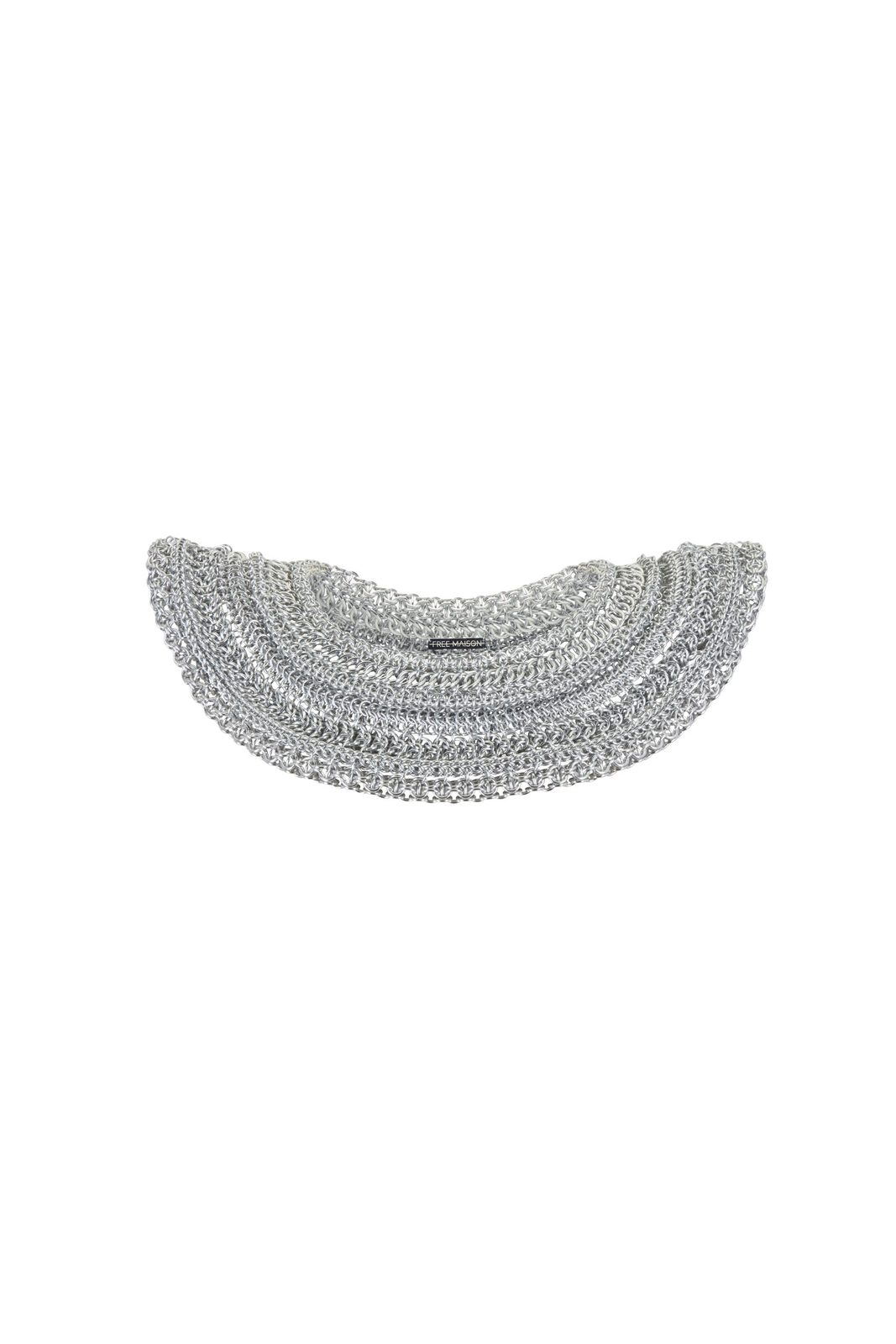
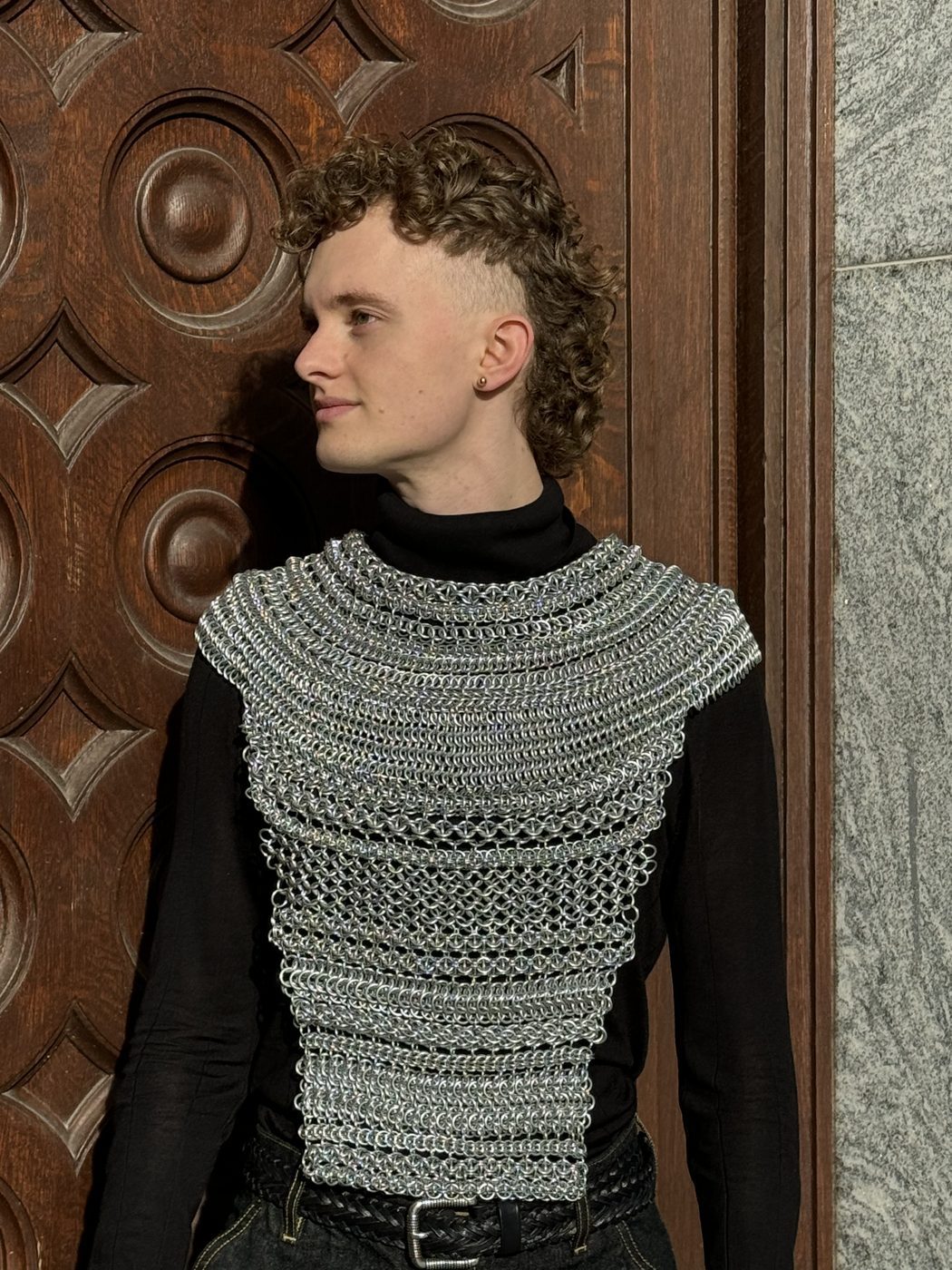
Part of the Core Collection, every Mane is inspired by the ruff of a lion. Corrugated, stacked chains that wrap around the shoulders, chest, and back with the commanding presence of an animal born to lead. Creative Director Tay Dun, a Leo himself, conceived the form as a way to wear authority.
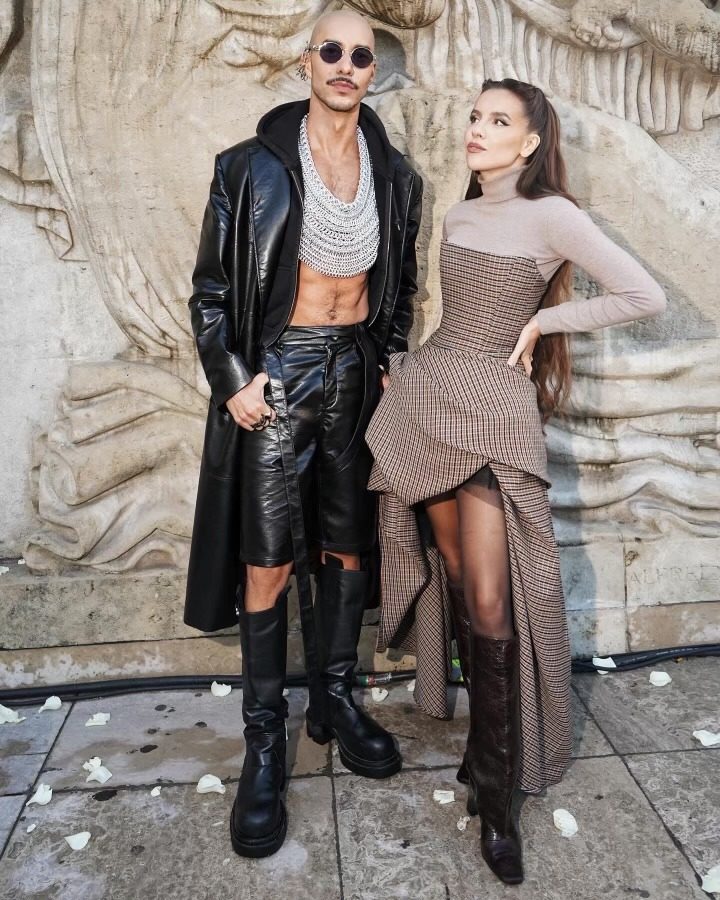
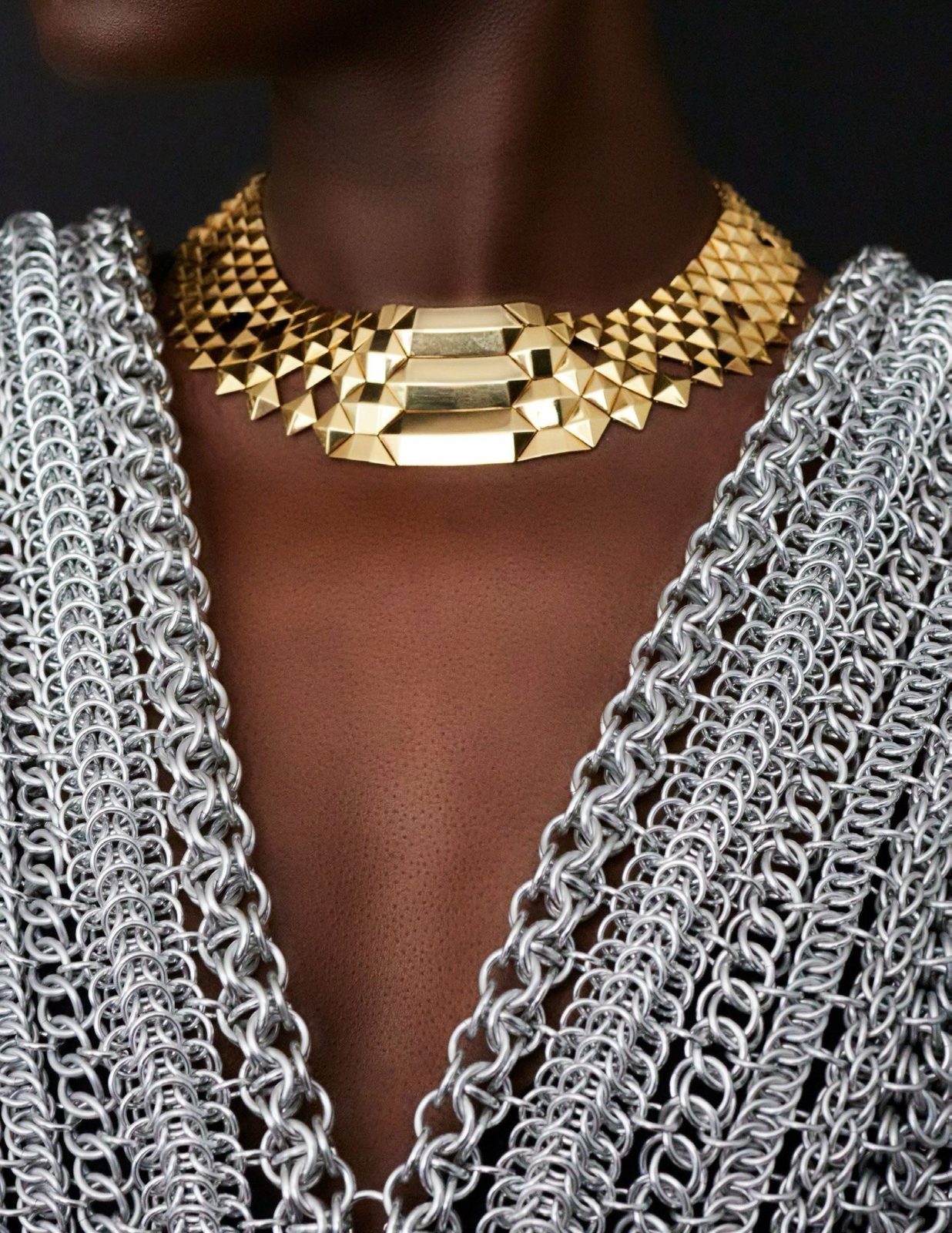
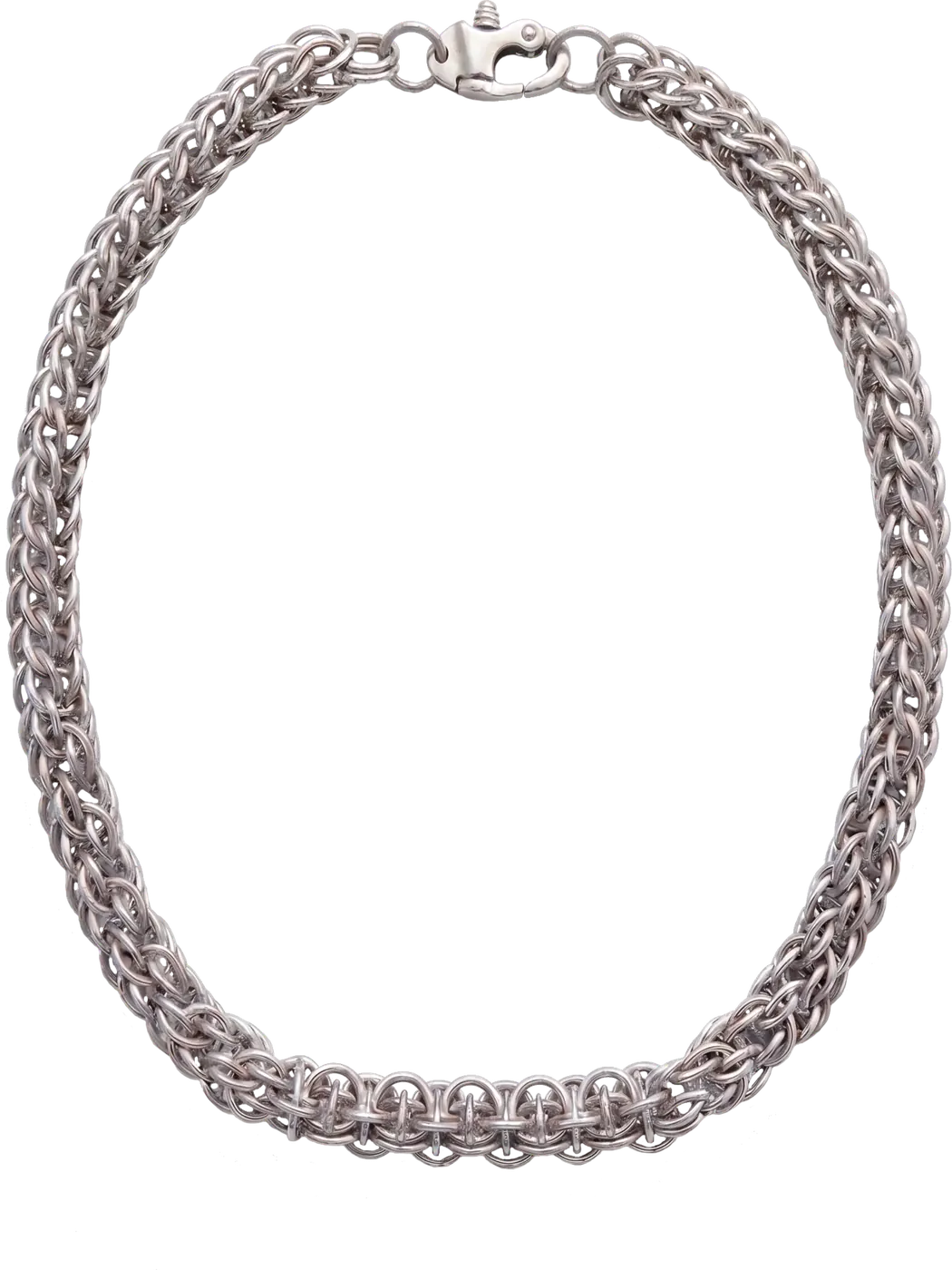
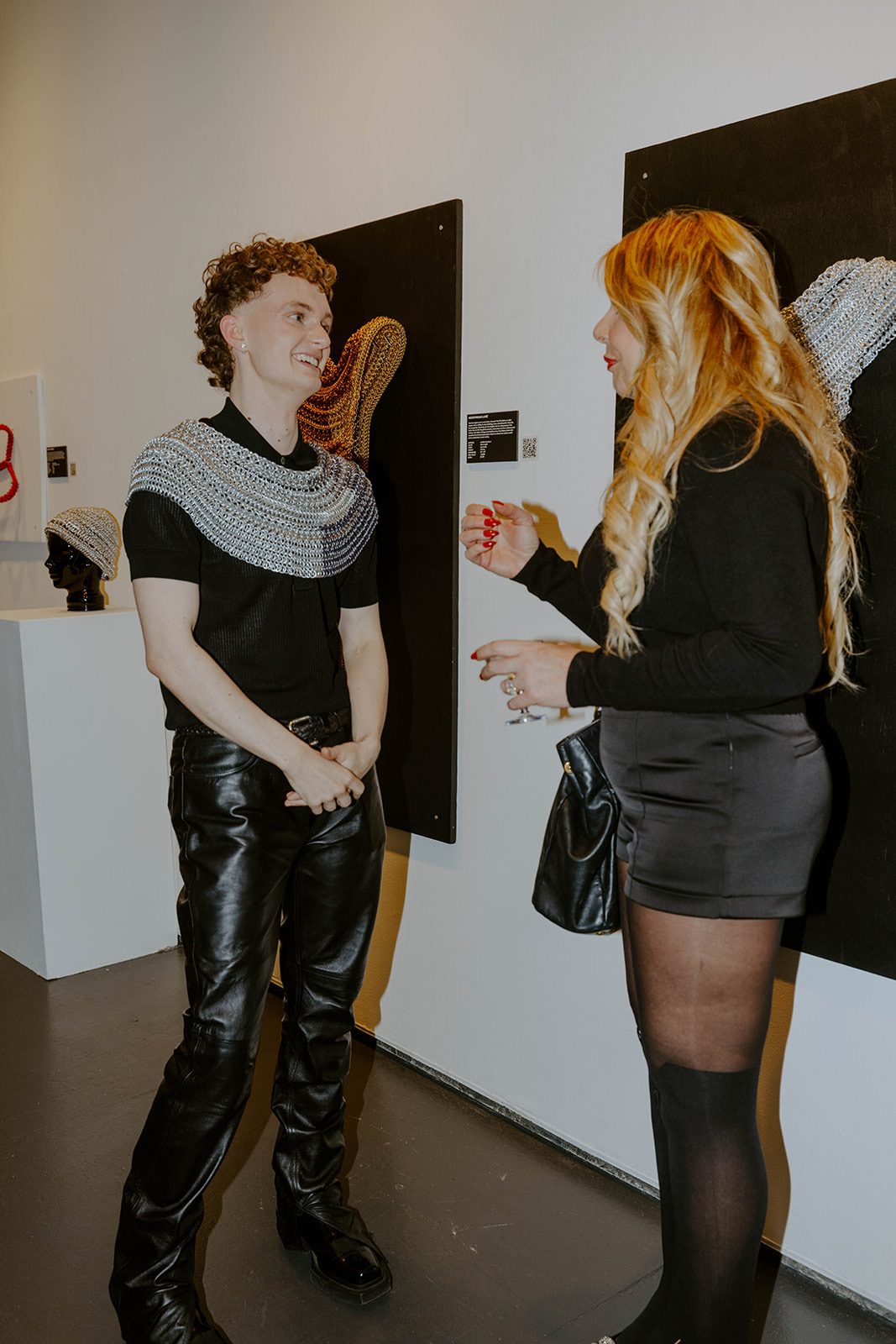
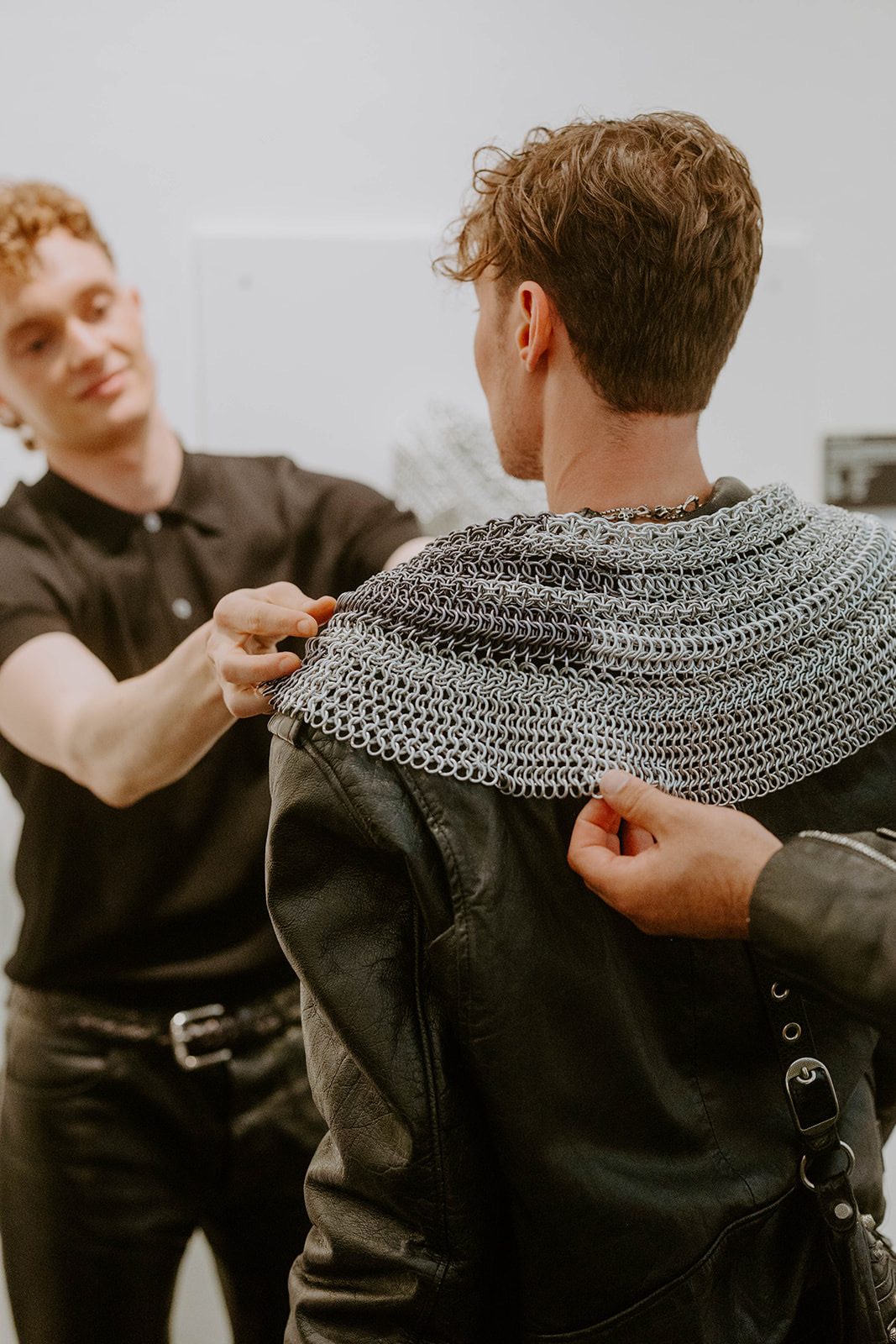
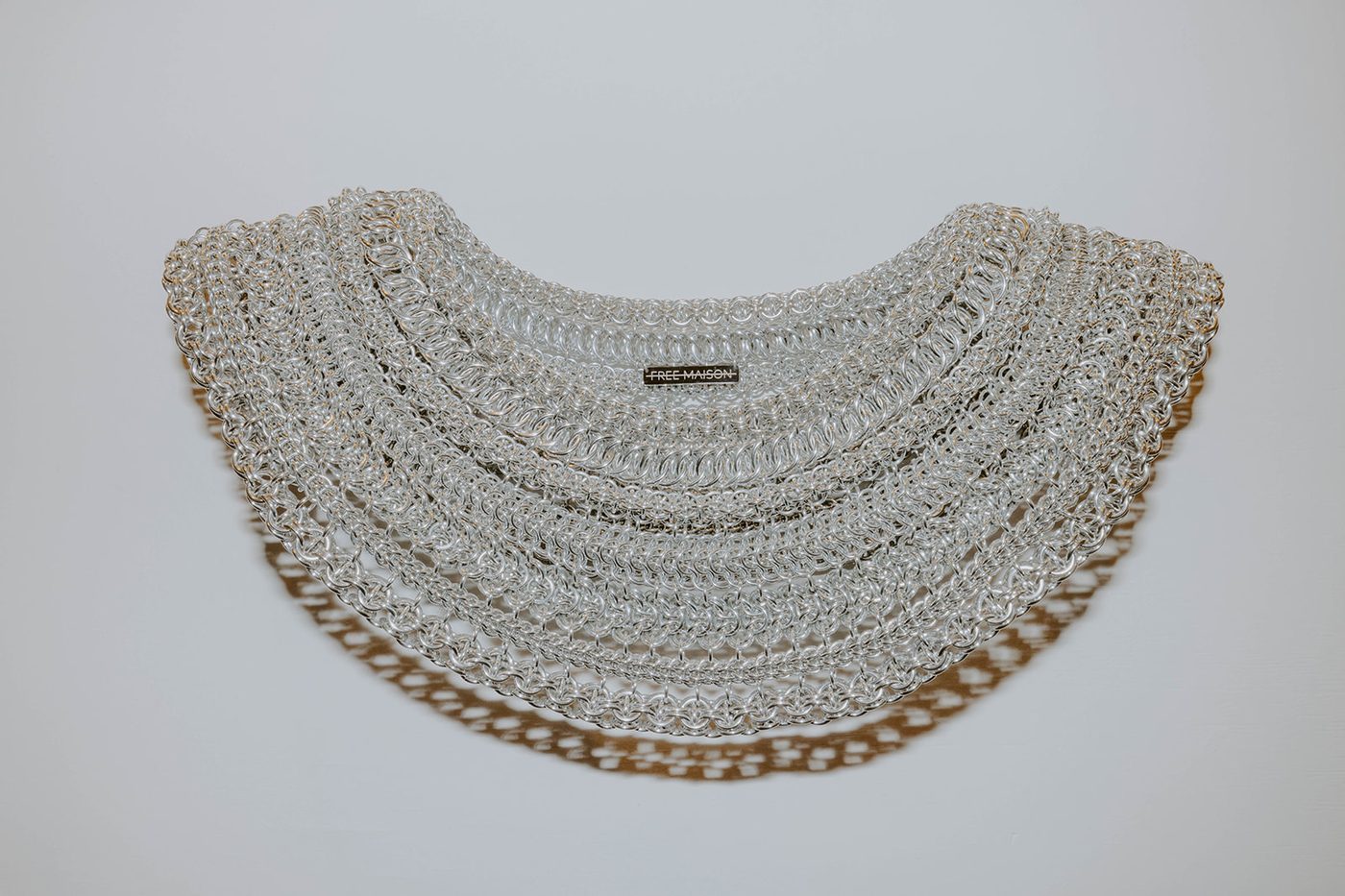
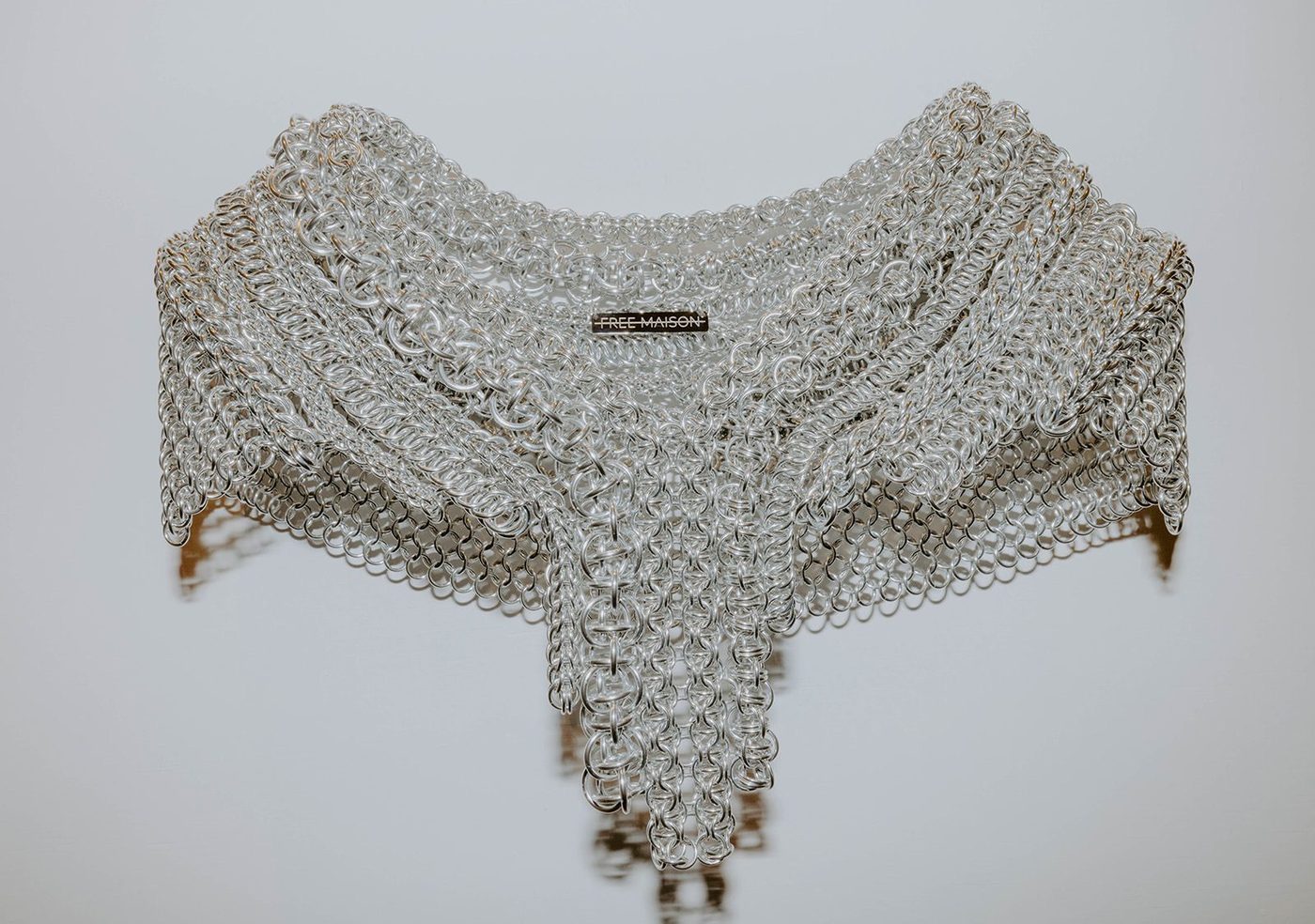
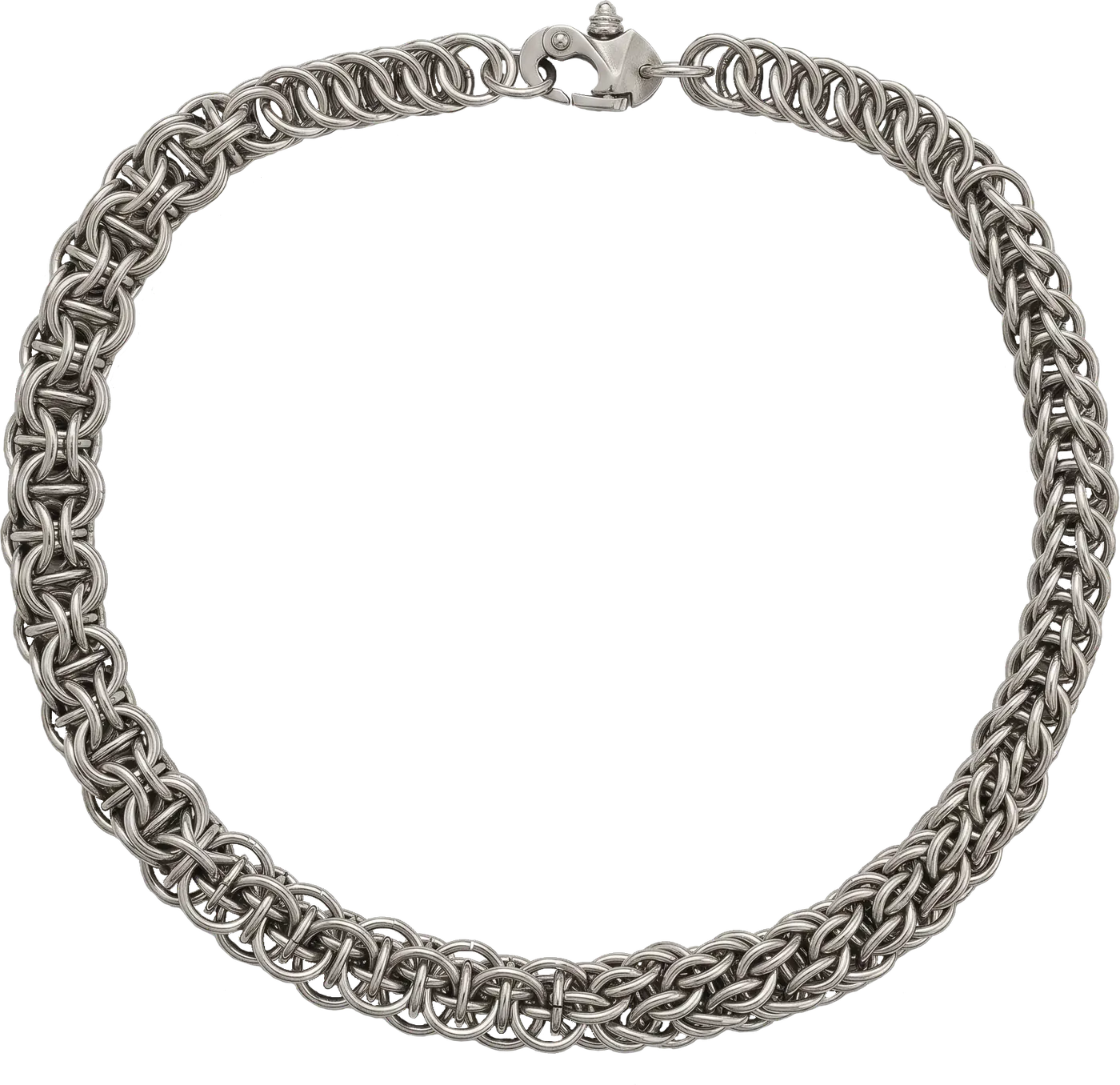
The Hanover Mane is named after the tie knot associated with the House of Hanover, the royal dynasty that ruled Britain for nearly two centuries. The connection is deliberate. This is a necklace elevated into regalia, turning any outfit into something ceremonial. In silver, the Mane carries a cool, lunar quality, catching light across its layered surface with a restrained brilliance.
An ornate way to wear a necklace. A definitive way to enter a room.


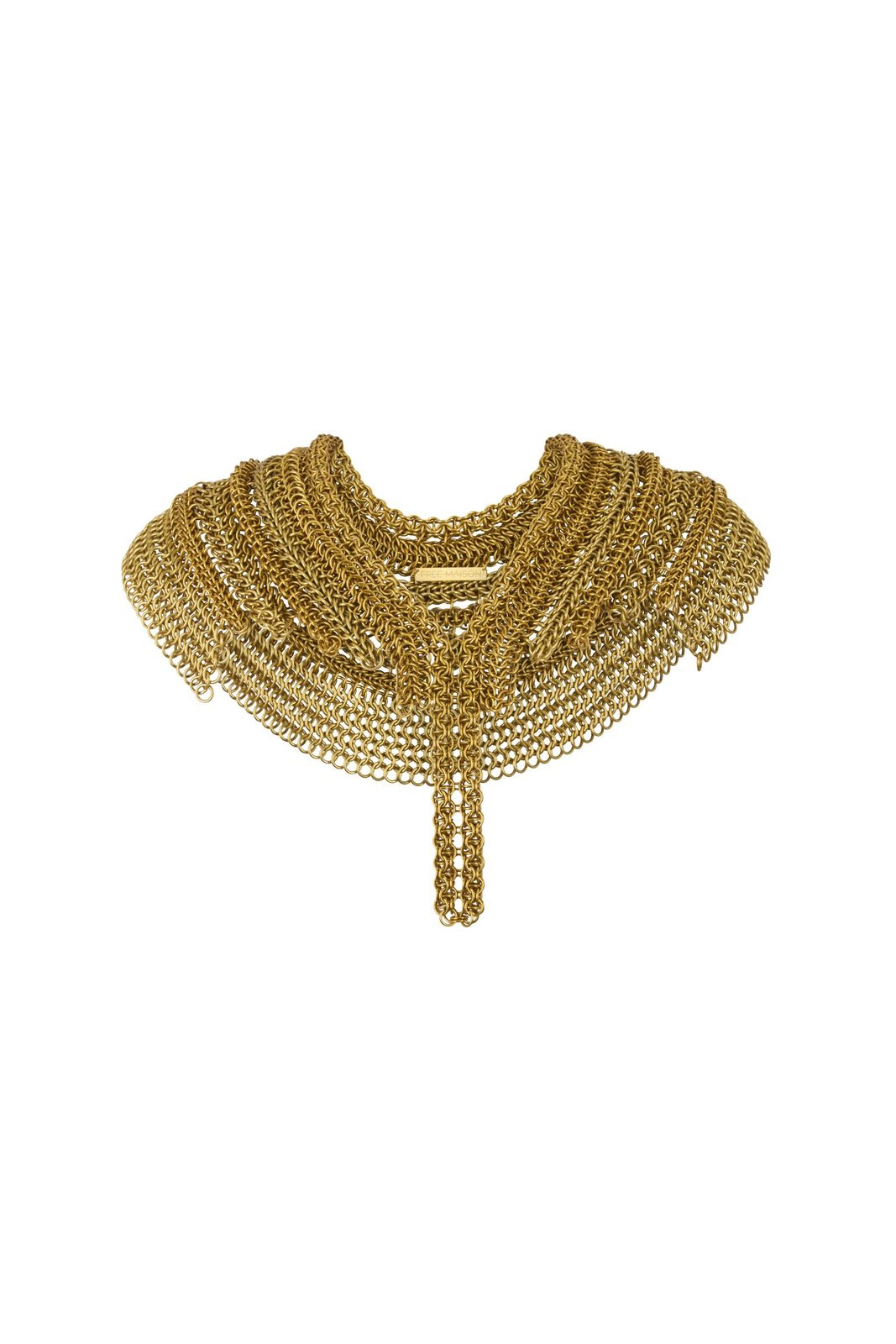
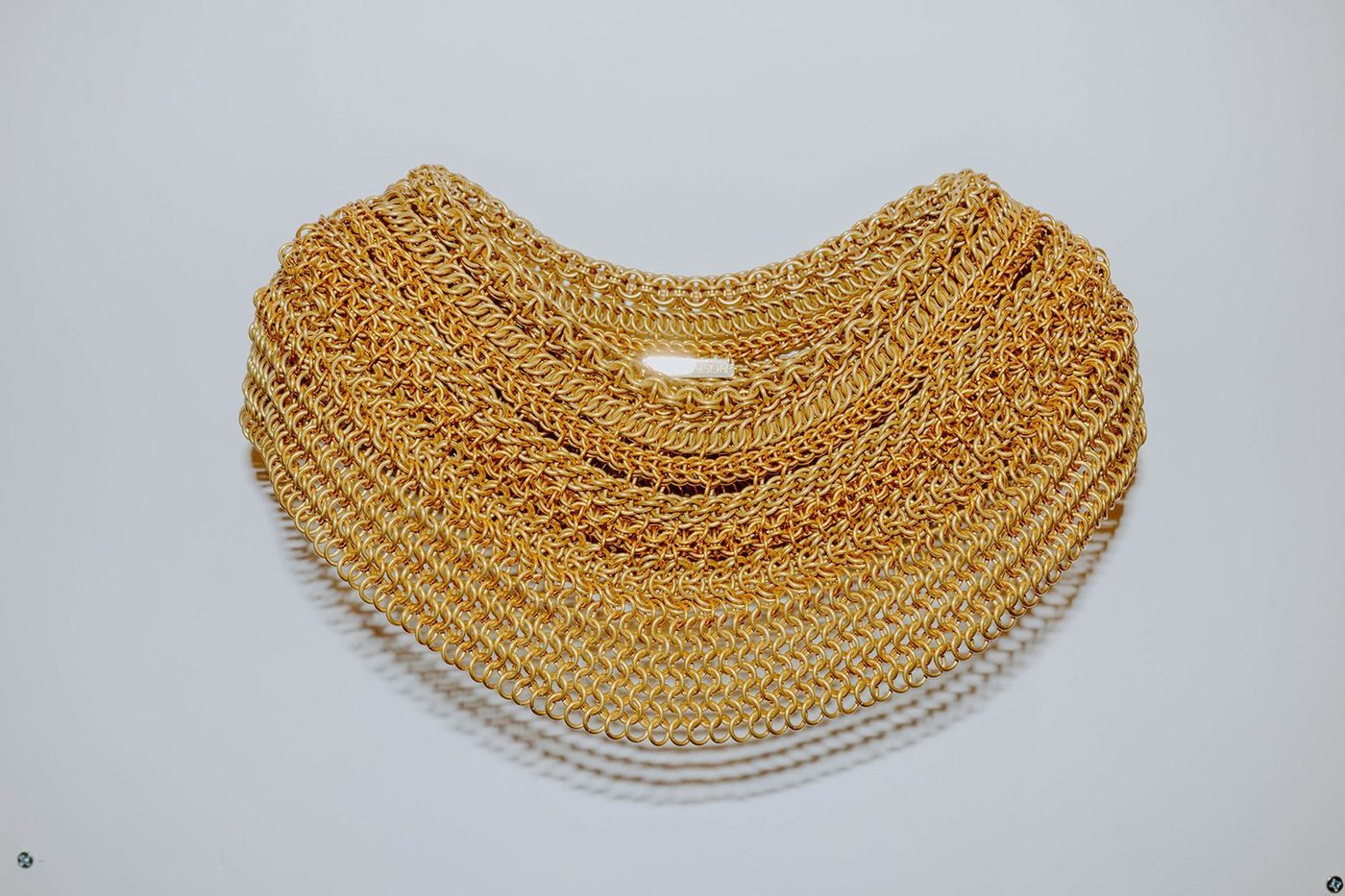
Part of the Core Collection, every Mane is inspired by the ruff of a lion. Corrugated, stacked chains that wrap around the shoulders, chest, and back with the commanding presence of an animal born to lead. Creative Director Tay Dun, a Leo himself, conceived the form as a way to wear authority.
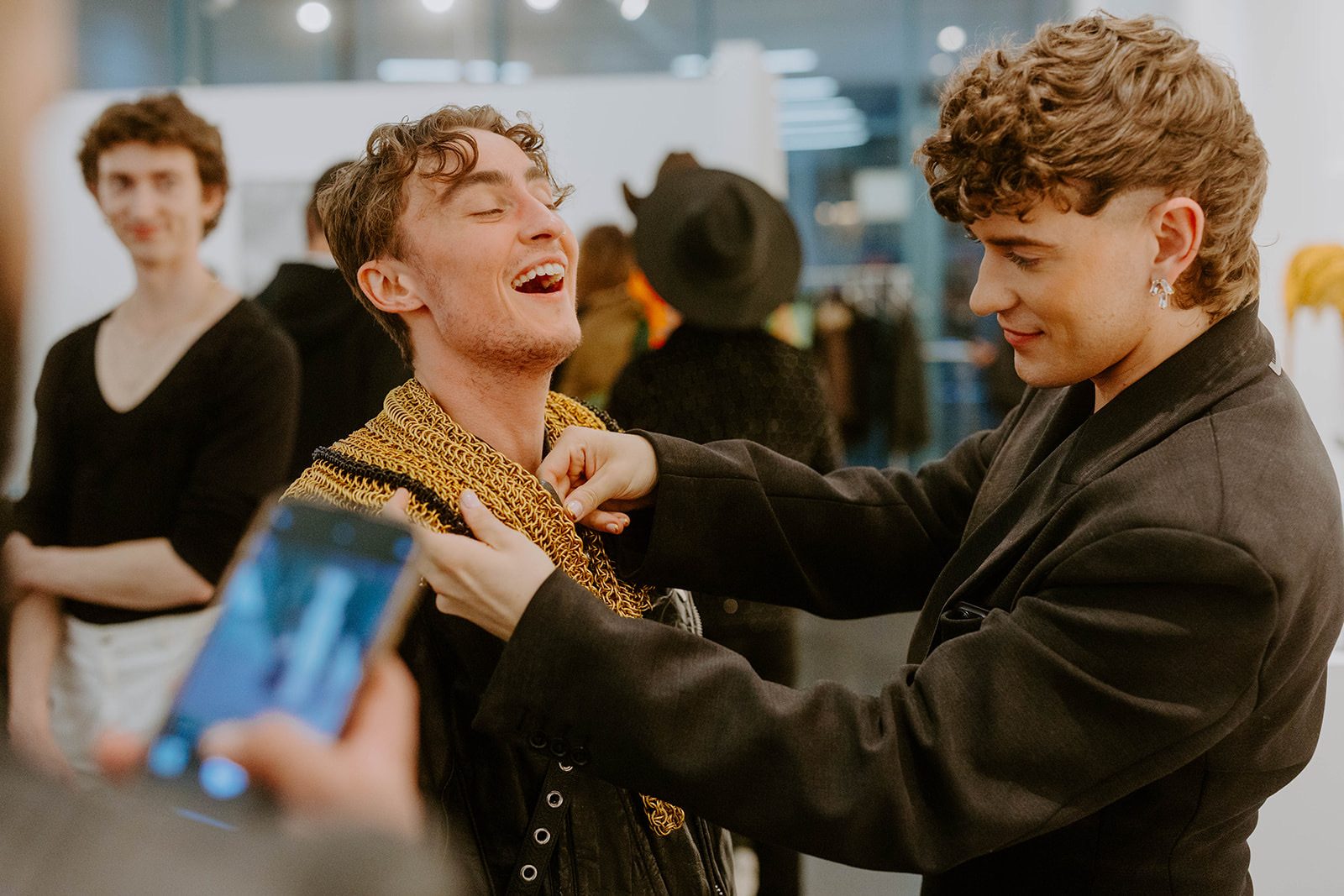
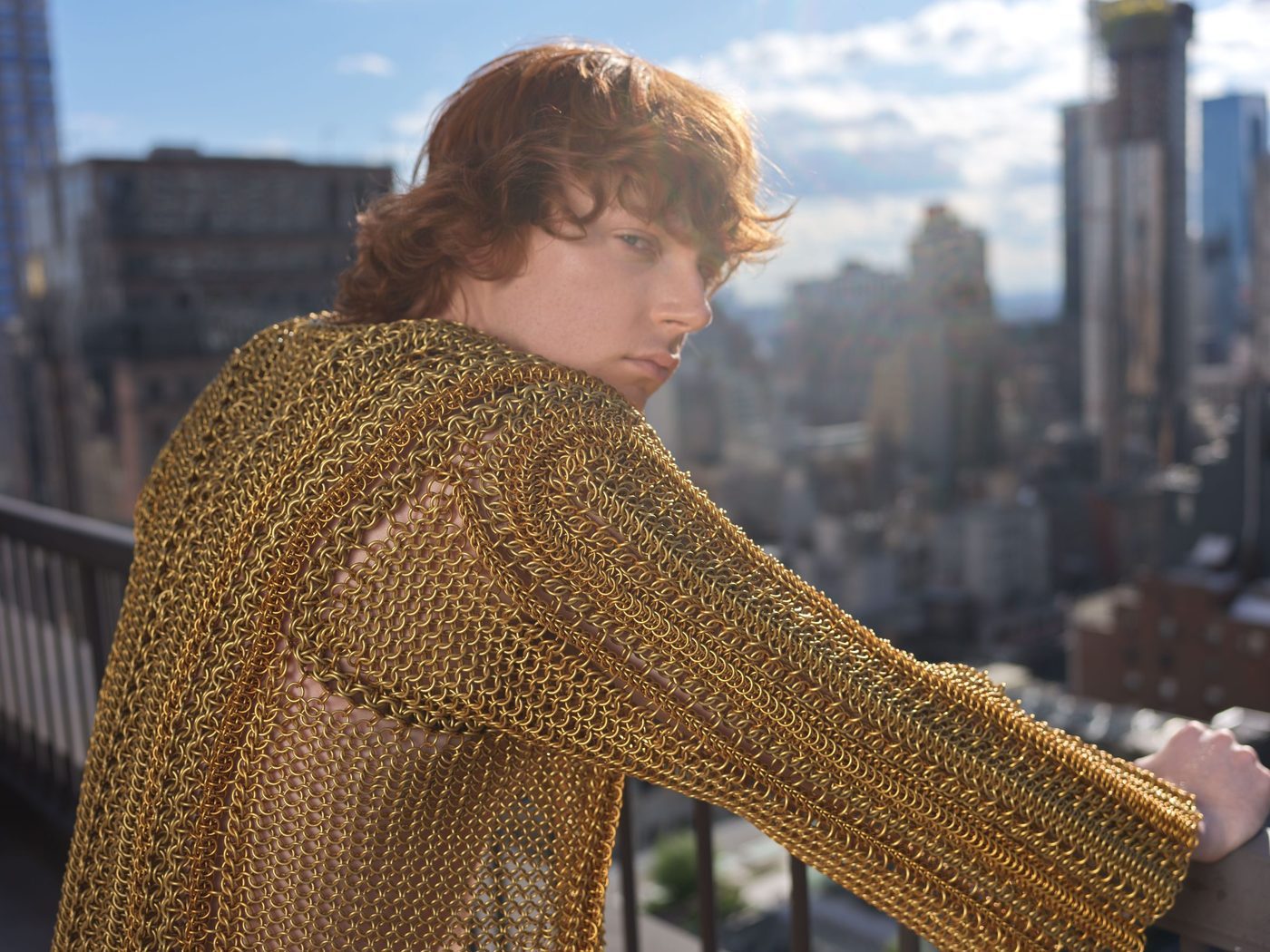
Named after the tie knot associated with the House of Hanover, the royal dynasty that ruled Britain for nearly two centuries, the Gold Hanover carries the warmth and weight of something sovereign. Where the silver edition reads as lunar and cool, the gold is solar. Radiant, and unmistakably regal.
An ornate way to wear a necklace. A definitive way to enter a room.


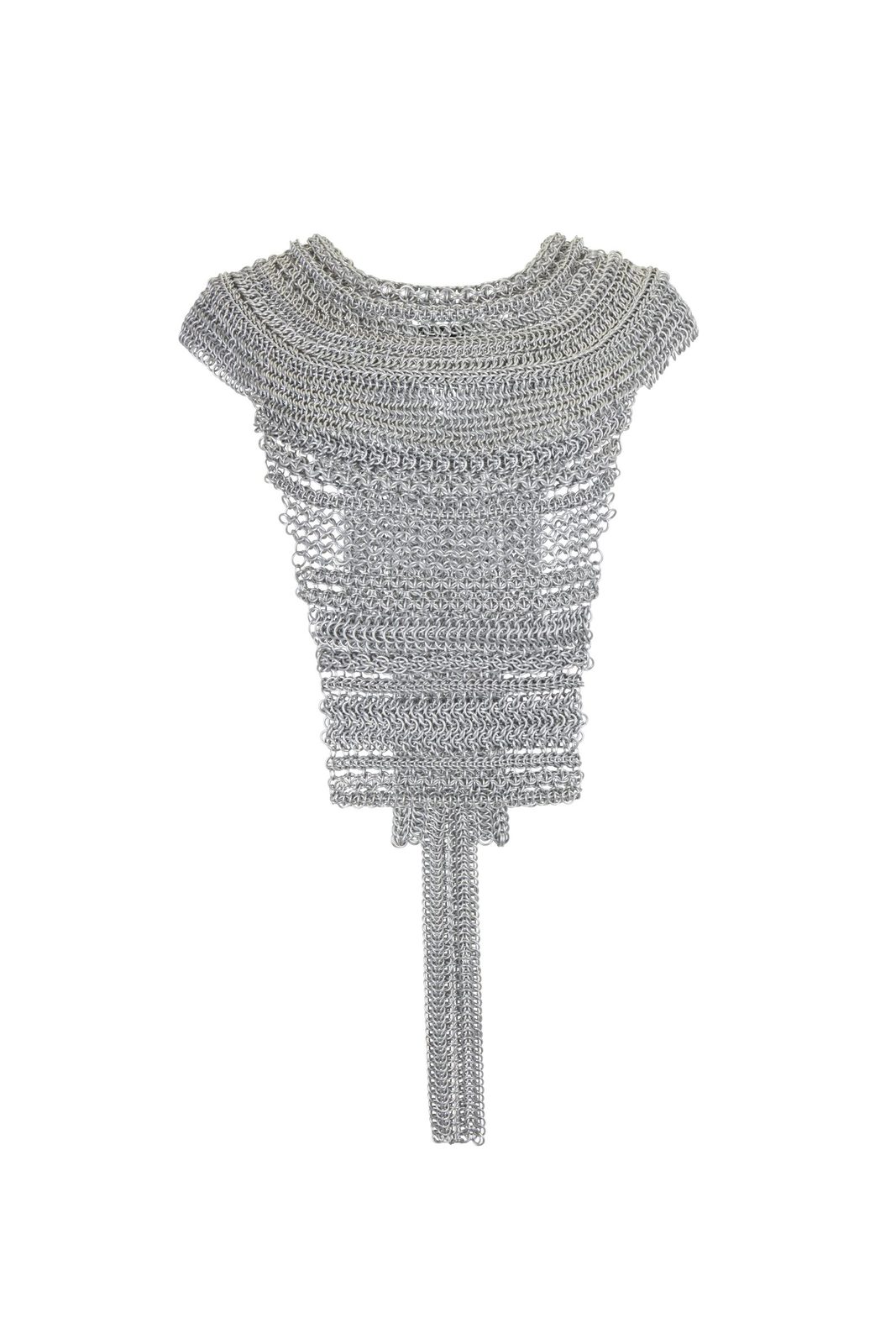
The companion to the Merovingian Lamé. Persephone draws her name from two mythologies at once. In the Matrix, Persephone was the wife of the Merovingian. In ancient Greek mythology, she was the goddess of spring and harvest, abducted by Hades and kept in the underworld for six months of every year. Her absence brought winter; her return brought life. It is the story behind why seasons exist at all.
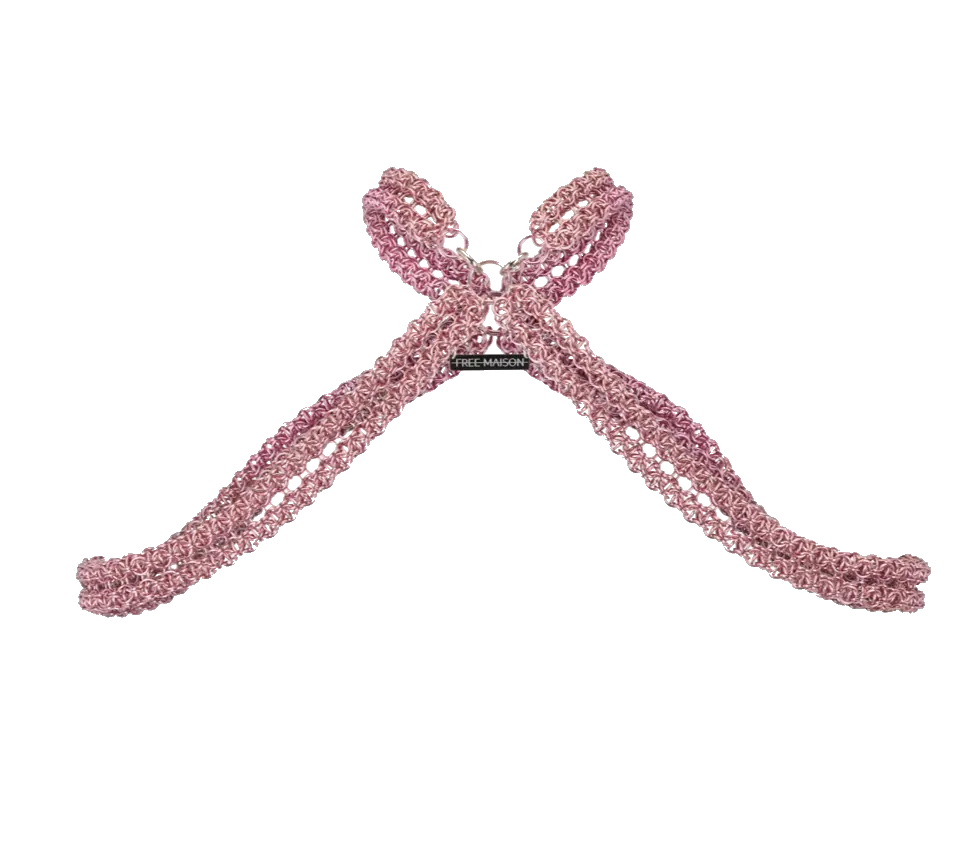
The Persephone Lamé mirrors the Merovingian in its vest construction and spinal tail, but with two key departures: the structured shoulder is removed, allowing the piece to rest like a cap sleeve that falls softly on the shoulder itself, and the tail is shortened for a closer, more contained silhouette. The effect is something lighter and more intimate. No less powerful, but carrying its strength differently.


Another entry in the Mane series, the Novotny is shaped and layered so that the chains form around the chest muscles, emphasizing the upper body with a deliberate, sculptural symmetry. Named after a particular style of tie knot, the Novotny is an exercise in proportion and presence. It sits on the body like it was always meant to be there.


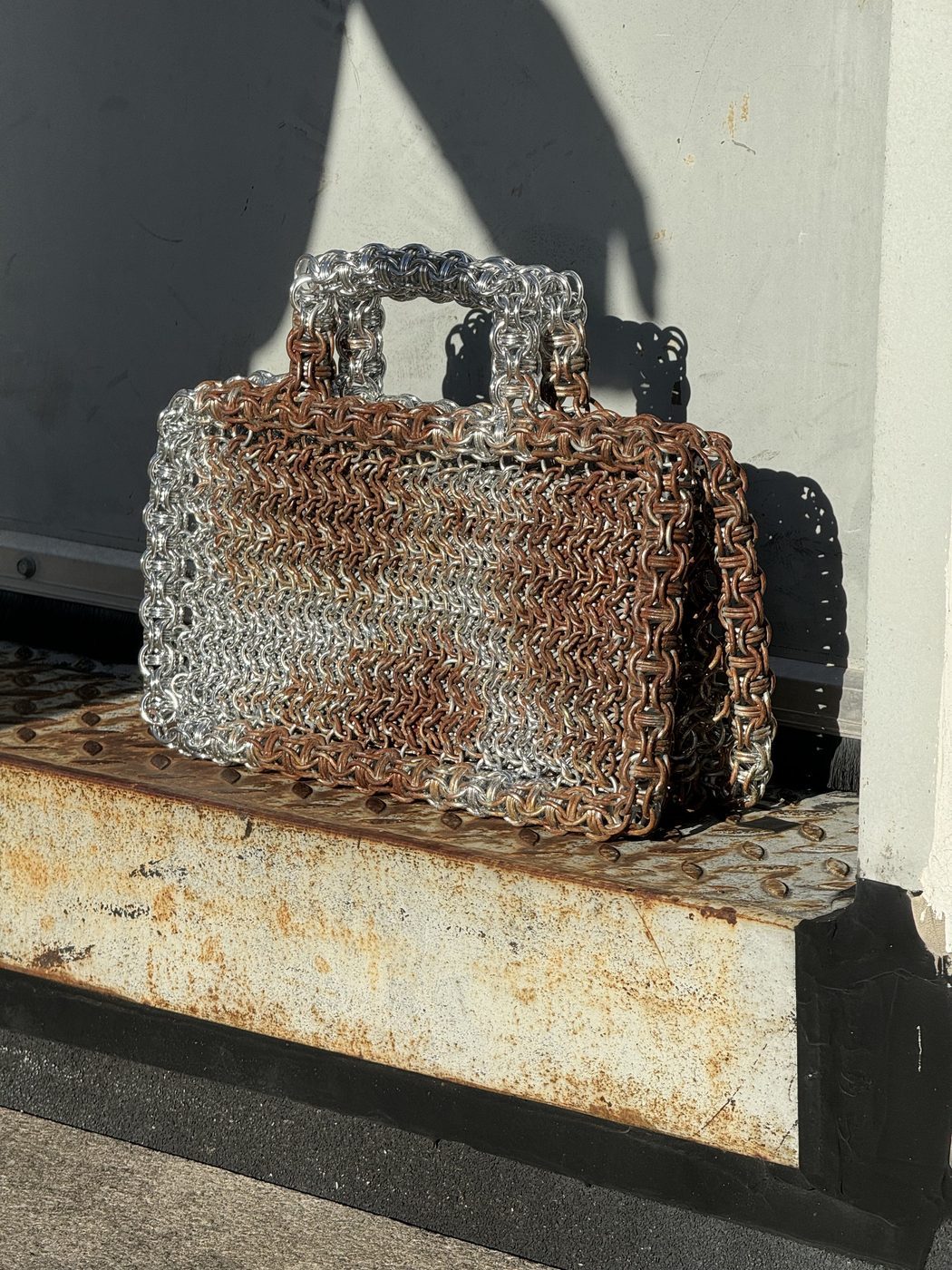
An east-west structured bag with a square handle, designed as an evening piece honoring the Met Gala's Garden of Time theme. What makes this bag unlike anything else is the surface itself.
Jesse Aviv was a chemist before he was a designer, and the Rust Bag is where those two lives converge. Aluminum does not rust, but Jesse applied an iron paint in a dégradé effect across the surface, then treated it with an oxidation solution to produce real, actual rust on the body of the bag. The result is a material dialogue between old metal and new, decay and preservation existing on the same object. It is the Garden of Time theme made physical: the beauty of growth and the inevitability of erosion, held together in your hand.


The first Mane ever made, and the piece that started the entire collection. The Balthus was designed specifically for Creative Director Tay Dun and built around his frame, making it the most personal work in the Free Maison archive.
Where the other Manes are symmetrical, the Balthus is deliberately not. Its asymmetry gives it a restless, living quality, and the weaves Jesse used here were ones he had never attempted before, techniques that existed only in this piece at the time of its creation. The V-neck collar wraps around the shoulders in a way that makes it equally at home over a tailored jacket or a simple white tee. Either way, it transforms whatever it touches into something elevated.
Named after the tie knot invented around 1930 by the Polish-French painter Balthasar Klossowski de Rola, known simply as Balthus. He was an artist as eccentric as he was brilliant, and the knot he created is the largest in existence, wider and bolder than even the Full Windsor. He reportedly devised it out of sheer boredom and rarely wore it himself. The name felt right for the first Mane: oversized in ambition, unapologetically singular, and made by an artist following nothing but instinct.
Like every piece in the Mane series, the Balthus channels the grace and authority of a lion's mane. This one just happened to come first.


A custom heart-shaped crossbody bag made for Francesca Vuillemin, one of New York's most recognized astrologers. The bag is constructed in the style of the Free Maison Heater Bags, with panels that provide full coverage and a surface tension that gives the heart its definitive shape.
A piece made for someone who reads the stars, carried close to the body where it matters most.


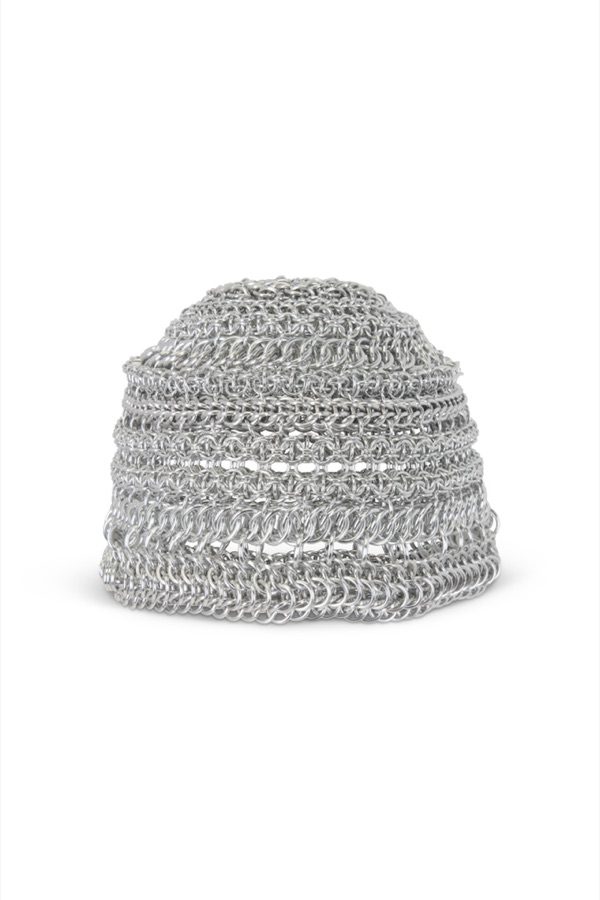
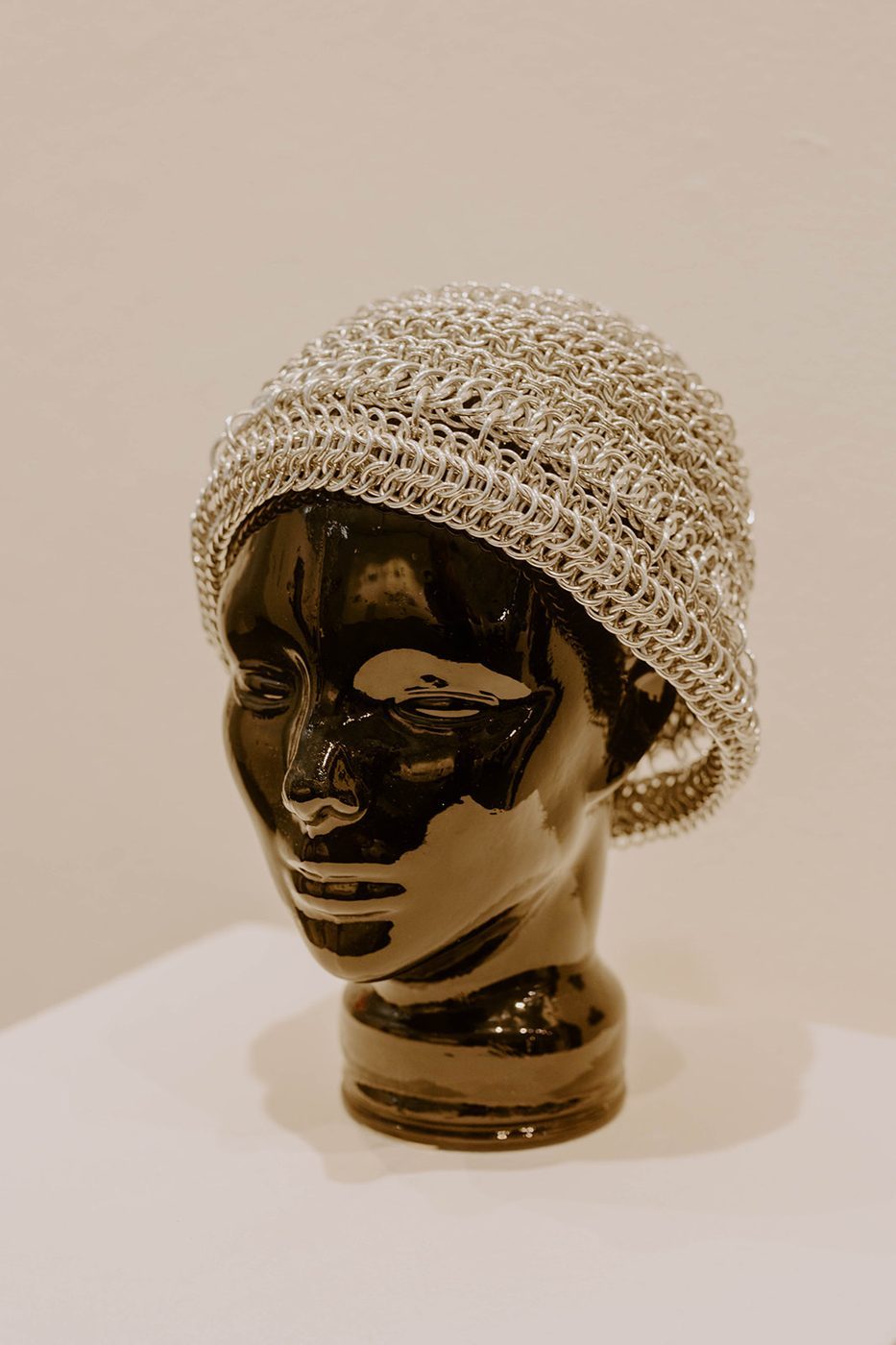
The Morion takes its name from the open-faced Spanish combat helmet that became iconic during the age of exploration. First forged in 16th-century Spain, the morion was worn by conquistadors and infantrymen across Europe and the Americas. Its high crest and sweeping brim were designed to deflect blows from above while keeping the wearer's field of vision clear. It was a helmet built for soldiers who needed to see what was coming.
This chainmail interpretation is shaped as a close-fitting skull cap, covering the crown of the head and wrapping partially over the ears. Like all Free Maison hats, the Morion belongs to a collection named after military helmets from the ancient and early modern world, each one carrying the memory of protection into a new context entirely.


This is where it began. The Ciphered Dress was the first work Jesse Aviv created using the technique that would come to define the brand. A method of interlocking jump rings into woven panels with seamless transitions between each weave, producing a textile surface that reads as continuous fabric rather than assembled metal.
Now presented purely as textile art, the dress stands as the origin point and ongoing inspiration for every Ciphered piece that has followed. It is the proof of concept made permanent.
Everything we make starts exactly like this. Hand-built, ring by ring, uniquely yours. We'll be in touch soon.
— Jesse & Tay
We will get back to you shortly
Questions in the meantime — tay@free.maison
Free Maison · Jersey City · Made by hand
Free Maison LLC ("Free Maison," "we," "us," or "our") operates the website free.maison. This Privacy Policy describes how we collect, use, and share your information when you visit our site, make a purchase, or submit an inquiry. It applies to all visitors globally, including residents of the United States, the European Economic Area (EEA), and the United Kingdom.
Information We Collect
How We Use Your Information
Sharing Your Information
We do not sell, rent, or trade your personal information. We share data only with service providers necessary to operate our business, including Shopify Inc. (e-commerce infrastructure), shipping carriers (UPS, FedEx), Google LLC (analytics), and Meta Platforms Inc. (advertising measurement) — all subject to data processing agreements and confidentiality obligations.
California Residents — CCPA / CPRA Rights
If you are a California resident, you have the following rights under the California Consumer Privacy Act (CCPA) and California Privacy Rights Act (CPRA):
To submit a verifiable consumer request, contact us at tay@free.maison. We will respond within 45 days. You may designate an authorized agent to make a request on your behalf.
EU / EEA / UK Residents — GDPR Rights
If you are located in the EEA or UK, we process your data on the following legal bases: contractual necessity (fulfilling orders), legitimate interests (site security and analytics), and consent (marketing cookies). You have the right to access, rectify, erase, restrict, or object to processing of your data, and the right to data portability. You may also lodge a complaint with your local supervisory authority. To exercise these rights, contact tay@free.maison.
Data Retention
We retain personal data only as long as necessary for the purposes outlined in this policy or as required by law. Order records are retained for a minimum of 7 years for tax and accounting purposes. You may request deletion of non-essential data at any time.
Children's Privacy
Our site is not directed to individuals under the age of 13. We do not knowingly collect personal information from children. If you believe a child has provided us with personal information, contact us immediately.
Changes to This Policy
We may update this Privacy Policy periodically. The "Last updated" date at the top of this section reflects the most recent revision. Continued use of the site after changes constitutes acceptance of the updated policy.
Contact
Free Maison LLC · Jersey City, NJ · tay@free.maison
Our website uses cookies and similar tracking technologies (pixels, web beacons, local storage) to operate the site, analyze traffic, and support advertising. This policy explains what we use, why, and how you can control it.
Types of Cookies We Use
Consent
When you first visit free.maison, a consent banner appears at the bottom of the screen. You may Accept All cookies or Decline Non-Essential cookies. Strictly necessary cookies are always active. Your choice is stored in your browser and will not be asked again unless you clear your cookies or browsing data.
California residents may withdraw consent or request that data collected via cookies not be used for advertising purposes by contacting tay@free.maison.
Third-Party Cookies
Managing Cookies in Your Browser
You can block or delete cookies through your browser settings at any time. Note that blocking essential cookies will prevent checkout from functioning. Browser opt-out guides: Chrome, Safari, Firefox, Edge — search "manage cookies" in each browser's help center.
By accessing or using free.maison, you agree to be bound by these Terms of Service and all applicable laws. If you do not agree, please do not use the site. These terms apply to all visitors, customers, and others who access or use the site.
Products & Pricing
All prices are listed in USD. Free Maison reserves the right to modify pricing at any time without notice. We reserve the right to refuse or cancel any order at our discretion, including cases of pricing errors, suspected fraud, or product unavailability. If an order is cancelled after payment, a full refund will be issued.
Made to Order
Many Free Maison pieces are made to order with a standard lead time of approximately 30 days from order confirmation. Custom and bespoke pieces may require additional consultation and time. Confirmed lead times are communicated at the time of order. Free Maison is not liable for delays caused by circumstances outside our control (carrier delays, material shortages, acts of nature).
Accuracy of Information
We make every effort to display product colors, textures, and dimensions accurately, but we cannot guarantee that your device's display will accurately reflect the physical product. Chainmail is a handmade medium and may exhibit natural variation between pieces.
Intellectual Property
All content on this site — including images, copy, design, product photography, and chainmail patterns — is the exclusive property of Free Maison LLC and protected under U.S. and international copyright law. You may not reproduce, distribute, or create derivative works from any content without express written permission.
User Conduct
You agree not to use this site for any unlawful purpose, to transmit any harmful or disruptive code, or to attempt to gain unauthorized access to any part of the site or its systems.
Disclaimer of Warranties
The site and its contents are provided "as is" without warranties of any kind, either express or implied, including but not limited to implied warranties of merchantability or fitness for a particular purpose.
Limitation of Liability
To the fullest extent permitted by law, Free Maison LLC shall not be liable for any indirect, incidental, special, consequential, or punitive damages arising out of or related to your use of the site or products, even if advised of the possibility of such damages. Our total liability shall not exceed the amount paid for the specific product giving rise to the claim.
Indemnification
You agree to indemnify and hold harmless Free Maison LLC and its officers from any claims, damages, or expenses arising from your use of the site or violation of these terms.
Governing Law & Dispute Resolution
These terms are governed by the laws of the State of New York, without regard to its conflict of law provisions. Any disputes shall be resolved exclusively in the state or federal courts located in New York County, New York. You consent to personal jurisdiction in such courts.
Changes to These Terms
We reserve the right to update these Terms at any time. The updated version will be indicated by the "Last updated" date. Continued use of the site constitutes acceptance of any changes.
All Sales Final — Made to Order
Because all Free Maison pieces are made to order, all sales are final. We do not accept returns or exchanges for change of mind, fit preferences, or ordering errors. Please review sizing guidance carefully before submitting an inquiry or placing an order.
Damaged or Incorrect Items
If your item arrives damaged in transit or materially different from what was ordered, contact us within 7 days of delivery at tay@free.maison with your order number and clear photos of the damage. We will work with you on a repair, replacement, or appropriate resolution. Claims submitted after 7 days may not be eligible.
Custom & Bespoke Orders
All custom and bespoke orders are non-refundable. Production does not begin until a consultation is complete and a deposit is received. The deposit amount and any remaining balance will be confirmed in writing before work commences. Once production has begun, deposits are non-refundable under any circumstances.
Repairs
Free Maison offers repair services for all pieces produced by our studio. Services include ring replacement, structural repairs, patina restoration, and cleaning. Contact us at tay@free.maison to discuss the scope and pricing before shipping any item to us. Return shipping to and from our Jersey City studio is the sole responsibility of the customer. We recommend insured shipping for all repairs.
Consumer Protection — U.S.
Nothing in this policy limits your rights under applicable state consumer protection laws. If you are a California resident, you retain any rights provided by California law that cannot be waived by contract.
Free Maison ships from Jersey City, NJ.
Lead Time
Standard made-to-order pieces ship within 4–6 weeks of order confirmation. Custom pieces may require additional time confirmed at consultation.
Domestic Shipping (United States)
International Shipping
Free Maison currently ships to: Australia, Austria, Bahamas, Barbados, Belgium, Canada, Cayman Islands, Denmark, Finland, France, Germany, Greece, Hong Kong, India, Ireland, Italy, Japan, Luxembourg, Mexico, Netherlands, Norway, Poland, Portugal, Saudi Arabia, Singapore, South Korea, Spain, Sweden, Switzerland, Turks & Caicos, United Arab Emirates, and the United Kingdom.
Shipping rates are calculated at checkout based on destination and carrier (DHL Express, FedEx, or USPS, depending on region), plus a flat $15 international handling fee. Duties, import taxes, and customs fees are calculated and collected automatically at checkout — there is nothing additional to pay on delivery and no customs holds. International orders are not eligible for free shipping regardless of order size. If your country is not listed, contact tay@free.maison to inquire about a custom shipping arrangement.
Lost or Damaged Shipments
All shipments are insured. In the event of loss or damage in transit, contact us immediately and we will initiate a claim with the carrier.
This page serves as the required CCPA/CPRA opt-out notice for California residents.
We do not sell your personal information. We do not sell, rent, or share personal information with third parties for their direct marketing or cross-context behavioral advertising purposes in exchange for monetary or other valuable consideration.
The third-party tools we use — Google Analytics 4 and Meta Pixel — collect certain data about your browsing behavior to help us understand site performance and measure advertising effectiveness. Under a broad reading of CCPA, data sharing with these platforms may qualify as "sharing" personal information for cross-context behavioral advertising. You may opt out of this data sharing at any time.
How to Opt Out
California Residents
Under the CCPA/CPRA, California residents also have the right to know, delete, and correct their personal information. See the California Residents section of our Privacy Policy for details on exercising those rights.
Contact
Free Maison LLC · Jersey City, NJ · tay@free.maison
Hand-woven ring by ring. Handcrafted by a chainmail master with proprietary ciphering technique.
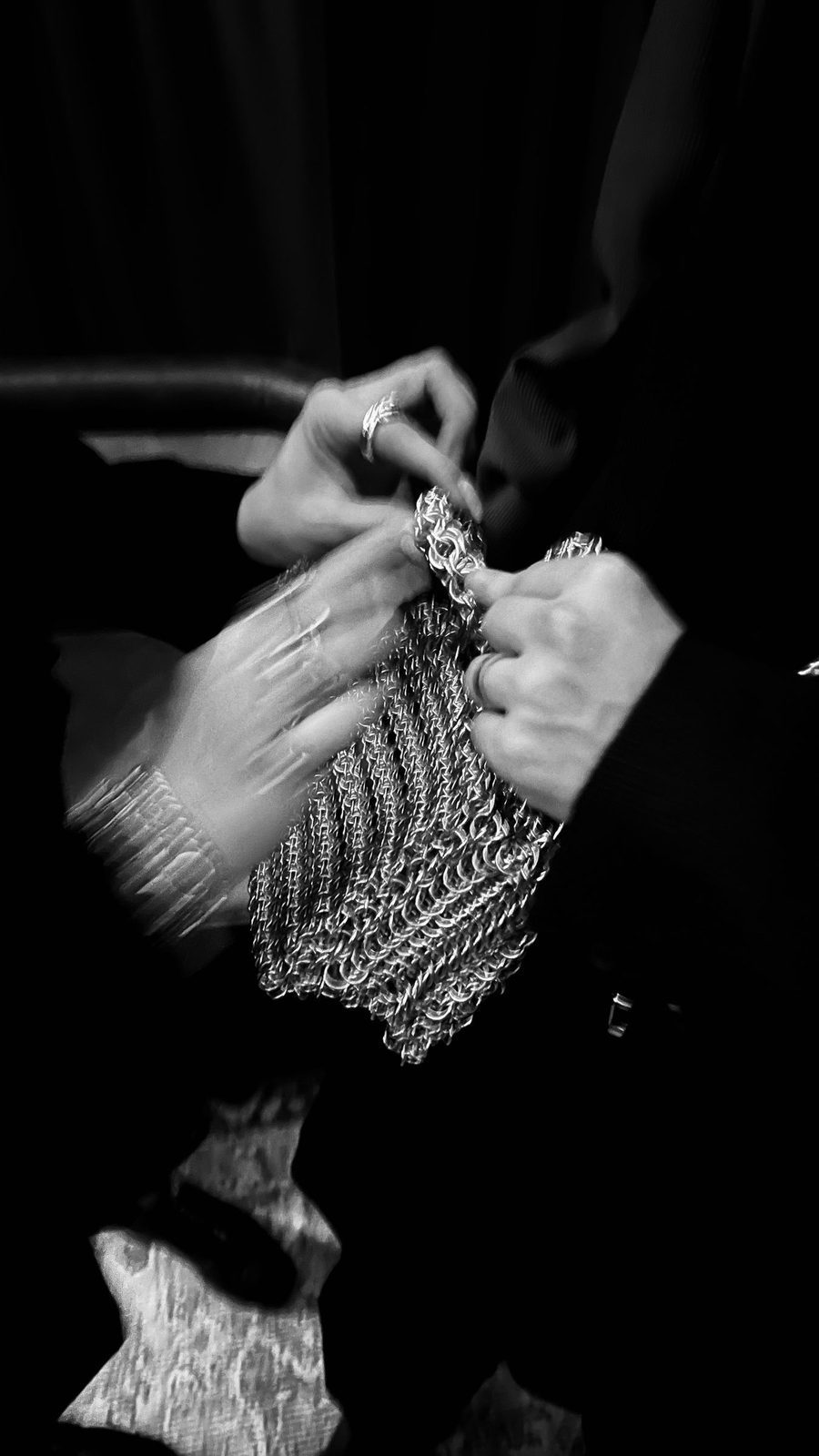
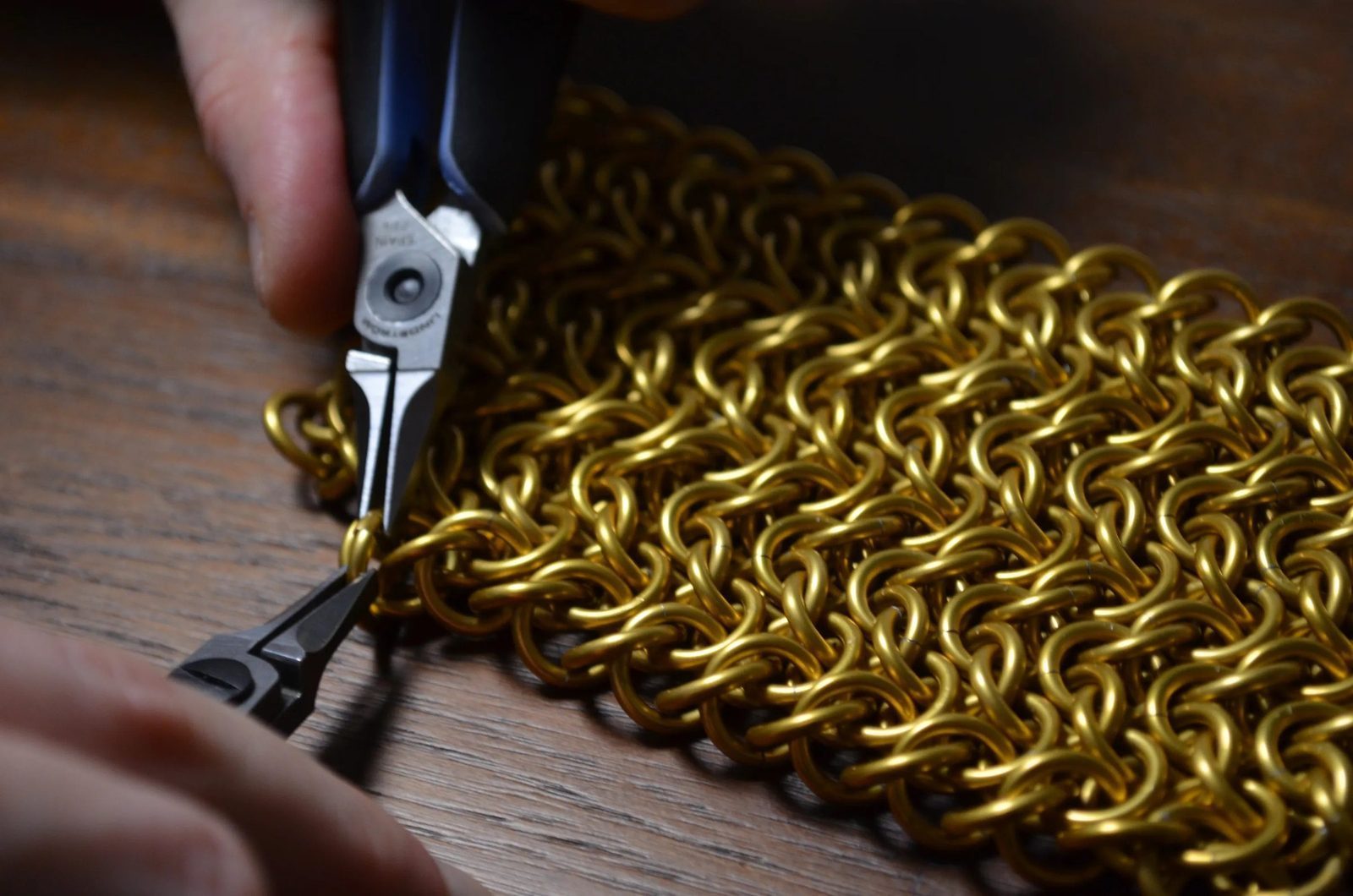
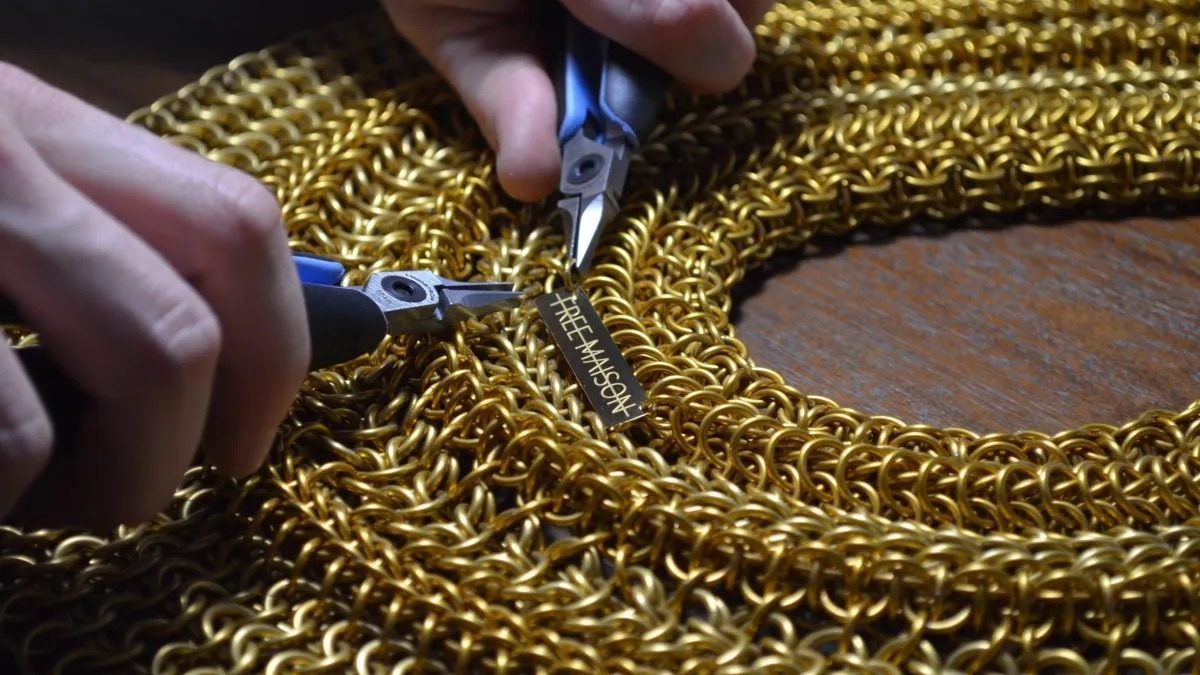
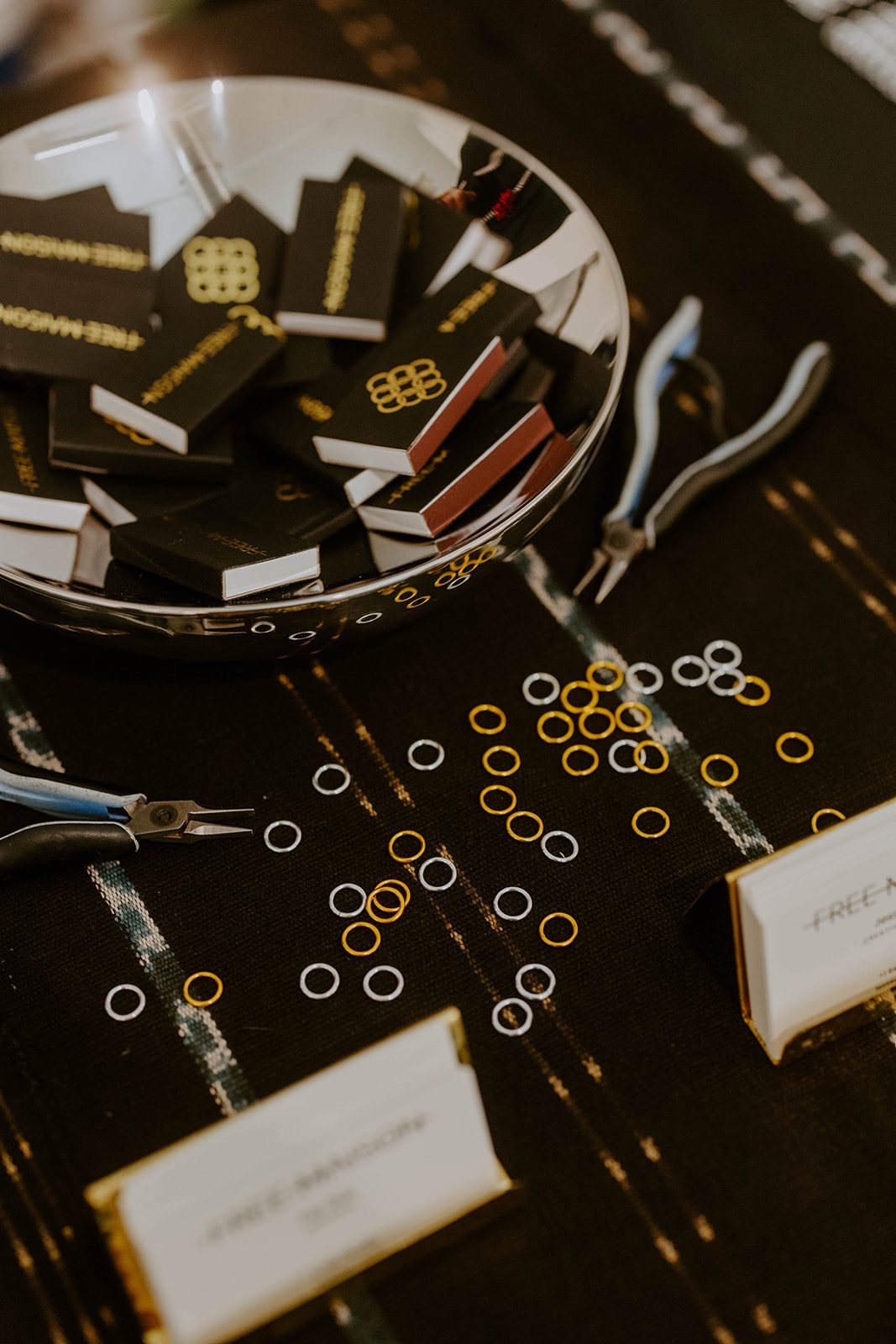
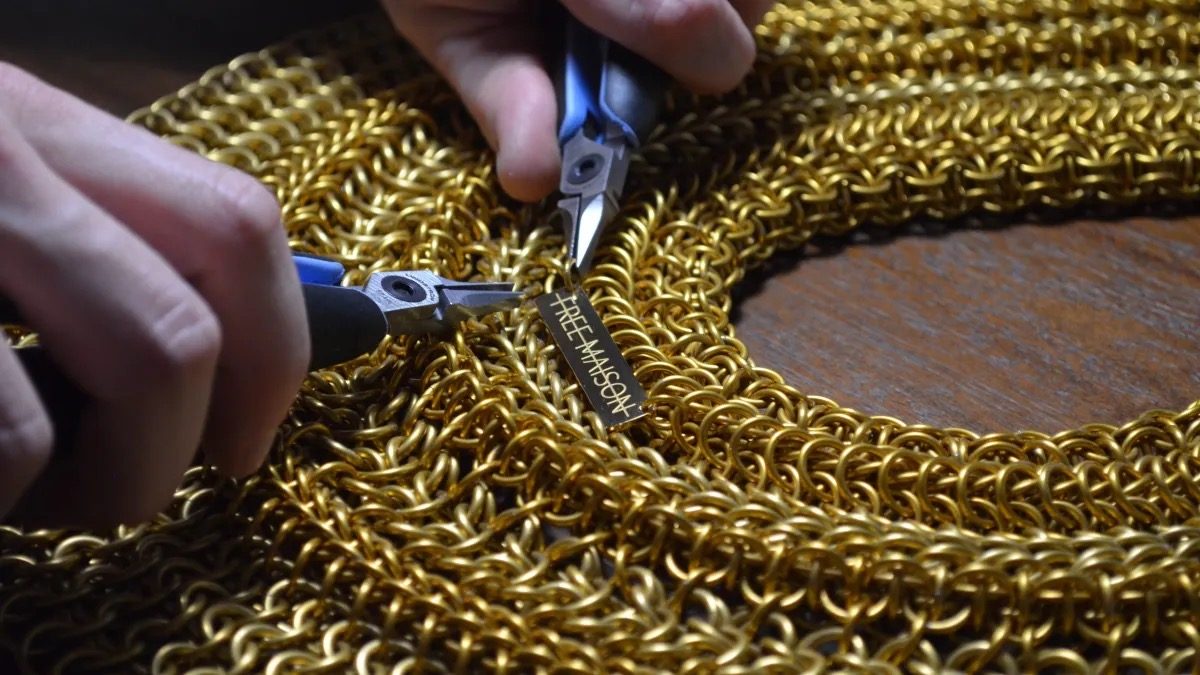
Classical chainmail — or classical maille — refers to the traditional hand-linking technique used for over 2,000 years. Each individual metal ring is opened with two pliers, threaded through adjacent rings in a precise pattern, and closed by hand. This ring-by-ring construction is the defining characteristic of classical maille. It cannot be automated without losing the drape, density, and structural integrity that makes the material distinctive.
The word "classical" distinguishes hand-linked maille from machine-woven metal mesh, stamped sheet metal, laser-cut patterns, or printed metal — all of which are sold as "chainmail" but do not use the ring-linking process. Free Maison uses only classical hand-linked construction.
In the context of Free Maison, couture means made-to-order, made by hand, and made by the house. There is no factory, no production run. Every garment, bag, and art object is assembled ring by ring. Select pieces from the Free Maison collection are available to order directly — garments and fully bespoke couture commissions begin when commissioned.
This is the same definition that governs Parisian haute couture: a single atelier, a named designer, hand assembly, and work made to a specific client's requirement. Free Maison applies this standard to chainmail in Jersey City.
Most products marketed as chainmail today are not made using the classical ring-linking process. Understanding the distinction is essential to understanding what Free Maison makes.
Chainmail has a documented history spanning over 2,000 years — used primarily as battlefield armor from the Roman era through the medieval period. A single hauberk (full-torso armor shirt) required approximately 500 or more hours of hand labor and up to 30,000 individual rings. The craft required specialist knowledge passed through dedicated armorer guilds.
Modern mechanization reduced production time for basic European 4-in-1 weaves, making chainmail accessible for practical applications such as cut-resistant gloves, shark diver suits, and pot scrubbers. But the diversity of weaves, ring gauges, colors, and metals — and the three-dimensional forms that emerge from their combination — still requires ring-by-ring hand assembly that no machine can replicate.
What makes the tradition so alive is that chainmail weaves come from all around the world — from European armor guilds to Japanese and Middle Eastern craft lineages — each with its own structural logic, rhythm, and material behavior. This global diversity of weave patterns is what ultimately inspired the development of Free Maison's ciphering technique. Jesse Aviv, on his journey of becoming a textile artist, spent years working with many different weaves and discovered that some have significantly more structural capacity than others. Certain weaves can be used to create patterns that build form and architecture from within the material itself. The breakthrough was in the combination: two or more weaves — each with different physical properties, worked at varying tensions — woven seamlessly into one another. The result is a material that holds three-dimensional structure and shape with the fluidity of a textile, uniquely possible only in metal.
Free Maison works directly in this tradition. The house was founded in Jersey City in 2024 by Jesse Aviv and Tay Dun to apply classical maille construction to couture fashion and wearable art.
Over 1,000 distinct chainmail weave patterns have been documented in the maille tradition, with artisans continuously developing new constructions. Each weave produces different mechanical and aesthetic properties: some drape softly, some hold rigid form, some create dense opaque surfaces, others produce open lace-like textures.
Free Maison works primarily in European 4-in-1 — the classical armor weave, in which each ring passes through four others — as well as Byzantine, Box chain, and the proprietary ciphered constructions developed by Jesse Aviv. The choice of weave determines how a garment moves, how a bag holds its shape, and how light interacts with the surface.
Despite over 1,000 documented weave patterns in the maille tradition, Free Maison predominantly works with 10 to 15. These specific weaves were selected for their unique structural and architectural properties — their capacity to build form, hold tension, and combine with other weaves to create pieces with dimension and silhouette that no single weave alone can produce.
Jump rings are formed by coiling wire around a mandrel and cutting the coil into individual loops. Each ring is then worked with two pliers — one in each hand — gripped the way hands sit on a steering wheel. The ring is opened with a precise lateral twist (never a pull, which deforms the shape), linked through the correct adjacent rings in the pattern, and closed until the gap is flush. A misaligned or improperly closed ring can compromise the integrity of an entire section.
Premier finishing on every piece is completed by Jesse Aviv and skilled artisans in Jersey City. Collection pieces require between 15 and 220 hours of hand assembly depending on size and complexity. Couture commissions are quoted individually.
Chainmail can be crafted from stainless steel, galvanized steel, niobium, aluminum, titanium, copper, silver, or gold. Each metal produces different weight, flexibility, color, and cost profiles. Free Maison uses anodized aluminum as its primary material — and select pieces are now also available in stainless steel — for three core reasons.
Weight. Anodized aluminum is roughly one-third the weight of steel. A full chainmail garment in steel would be exhausting to wear. In aluminum, a full-length couture gown remains light enough to move in comfortably across an evening.
Color. The anodization process creates a permanent oxide layer on the aluminum surface through electrochemical treatment. The color is not paint, coating, or dye — it is part of the metal itself. It does not chip, peel, fade, or rub off. The range of colors achievable in anodized aluminum — from pale gold to deep rust to electric blue — far exceeds any other chainmail metal.
Durability. Anodized aluminum does not oxidize, tarnish, or rust. Each piece maintains its finish for a lifetime under normal use. Deep scratches may reveal the underlying silver aluminum — repair services are available from the house.
Is Free Maison chainmail heavy to wear?
No. Free Maison uses anodized aluminum, which is approximately one-third the weight of steel. A full-length garment is comfortable to wear for an entire evening. Bags are significantly lighter than equivalent pieces in other metals.
Can Free Maison pieces be repaired?
Yes. Classical hand-linked maille is repairable at the ring level — individual rings can be replaced without affecting the surrounding weave. Free Maison offers repair services for all pieces made by the house. Contact support@free.maison.
How do I care for a Free Maison piece?
Anodized aluminum does not rust, tarnish, or require polishing. Wipe with a soft dry cloth. Avoid prolonged contact with harsh chemicals or abrasives. Store flat or hanging — do not compress under heavy objects, which can deform the ring structure.
Does Free Maison make custom pieces in metals other than aluminum?
Yes. Custom commissions in stainless steel, niobium, copper, silver, and gold are available upon request. Contact tay@free.maison to discuss a custom couture commission.
What is ciphered chainmail?
Ciphering is a proprietary construction technique developed by Free Maison co-founder Jesse Aviv. It connects multiple weave patterns with differing physical properties at varying tensions, allowing three-dimensional structure and form to emerge from the logic of the weave itself — without external armatures or frames. It is the defining technical signature of the house.
A signature technique developed by Jesse Aviv.
Creative Director Jesse Aviv developed Free Maison's signature style: ciphered chainmail. The technique is characterized by connecting varying chainmail weaves into structured, three-dimensional metal textiles.
Over a thousand chainmail weaves exist — many with geographic names like European 4-in-1, Japanese 6-in-1, and Full Persian 6-in-1, or aesthetic descriptors like dragonback and sweetpea. Each weave produces its own surface texture, density, and drape.
The ciphering technique binds different weaves at specific angles and tensions to create desired forms and textures. Where one weave ends and another begins, the transition itself becomes a design element — a seam that is structural and visual at once.
This approach allows Free Maison to engineer three-dimensional shapes — a bag that holds its form, a harness that follows the body, a cap with a defined silhouette — all from raw metal rings, without stitching, glue, or internal frames.
Each Free Maison piece is built ring by ring, with Jesse Aviv assembling every finished object. The ciphering process requires not only weave knowledge but spatial reasoning — understanding how tension and direction will translate across thousands of individual connections.
Collection pieces require between 15 and 220 hours to complete, depending on the complexity of the design and the number of weave transitions involved.
We strive to make pieces that will last a lifetime.
If your Free Maison piece has become damaged or is not up to your standards, we would like to make it right. Every piece is built to last — and we stand behind the quality of our craft.
Small repairs are offered at no cost. Significant repairs are charged at $20 per hour. Send images of the damage to support@free.maison for a cost estimate before sending your piece.
Free pickup and drop-off is available in the NYC and Jersey City areas. Outside these zones, the customer covers shipping to the workshop — Free Maison covers return shipping.
If a sizing error was ours, or if the adjustment is simple, resizing is free. Otherwise, resizing costs depend on the difficulty of the adjustment and require proof of purchase. Contact support@free.maison with a description and photos for a quote.
All sales are final. Cancellations or refunds are not available. Exchanges or store credit may be considered within 10 days of delivery at the company's discretion.
Items must be unworn, undamaged, and returned with original tags and packaging intact. Returned items are inspected upon receipt. Processing takes up to 5 business days. Original shipping fees are non-refundable.
Everything you need to know about Free Maison, our chainmail couture house, and how we work.
What is Free Maison?
Free Maison is a classical chainmail couture house founded in 2024 by Jesse Aviv and Tay Dun, based in Jersey City, New Jersey. The house creates hand-woven chainmail handbags, garments, harnesses, jewelry, and wearable art objects — assembled ring by ring from individual metal jump rings using classical maille construction techniques. Free Maison operates free from traditional social media and produces all pieces by hand.
Is Free Maison affiliated with Freemasonry or any Masonic organization?
No. Free Maison has no affiliation with, association with, or endorsement of Freemasonry, Masonic organizations, or any fraternal order. Free Maison is an independent chainmail couture fashion house founded in 2024 by Jesse Aviv and Tay Dun, based in Jersey City, New Jersey. The similarity in name is coincidental. Free Maison specializes in classical hand-woven chainmail garments, handbags, jewelry, and wearable art objects, and has no connection to Freemasonry or Masonic lodges of any kind.
Who founded Free Maison?
Free Maison was founded in 2024 by Jesse Aviv and Tay Dun. Jesse Aviv is a chainmail artist and the house's lead maker, who pioneered Free Maison's proprietary ciphering technique after years of study as a textile artist. He holds a chemistry degree from Emory University on a Woodruff scholarship and left a career in biotech to pursue chainmail full-time. Tay Dun is the co-founder and Creative Director, responsible for the brand's identity, strategy, and creative direction.
What makes Free Maison unique?
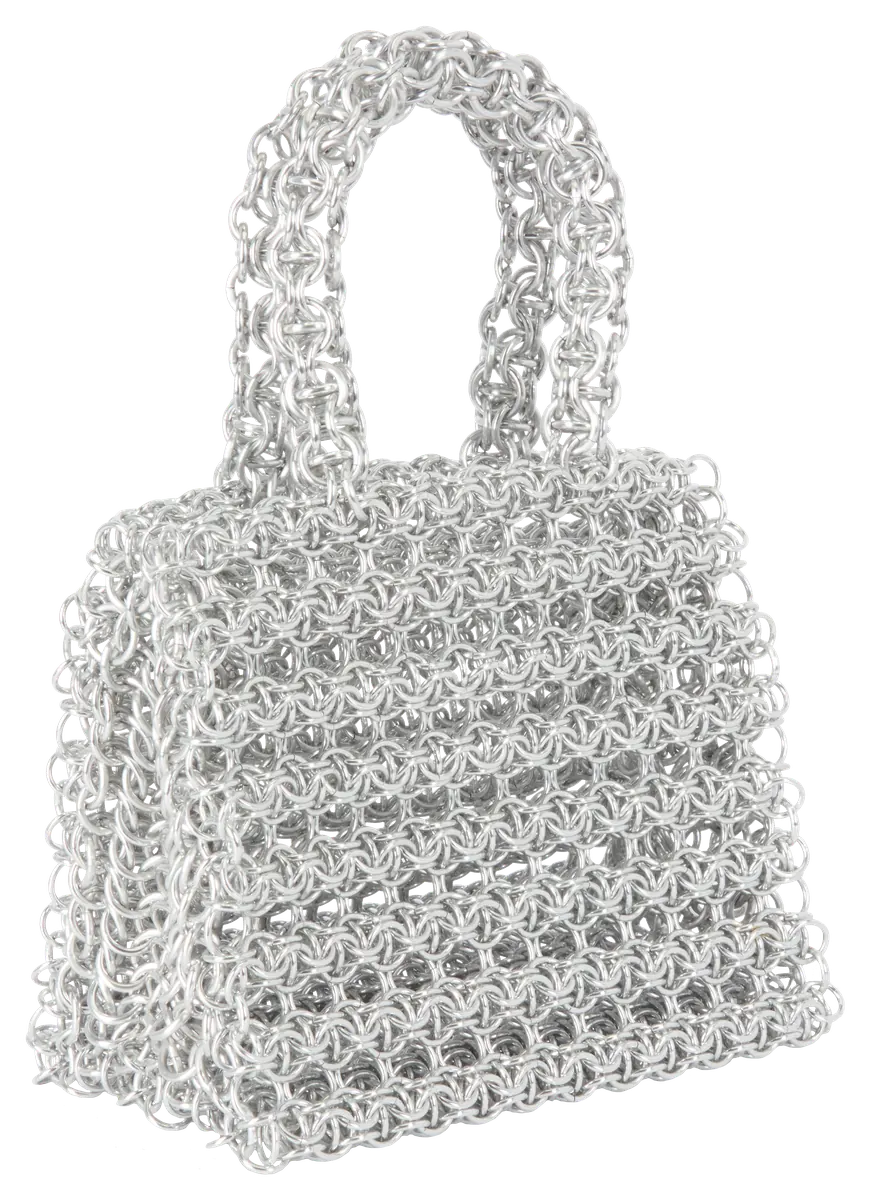
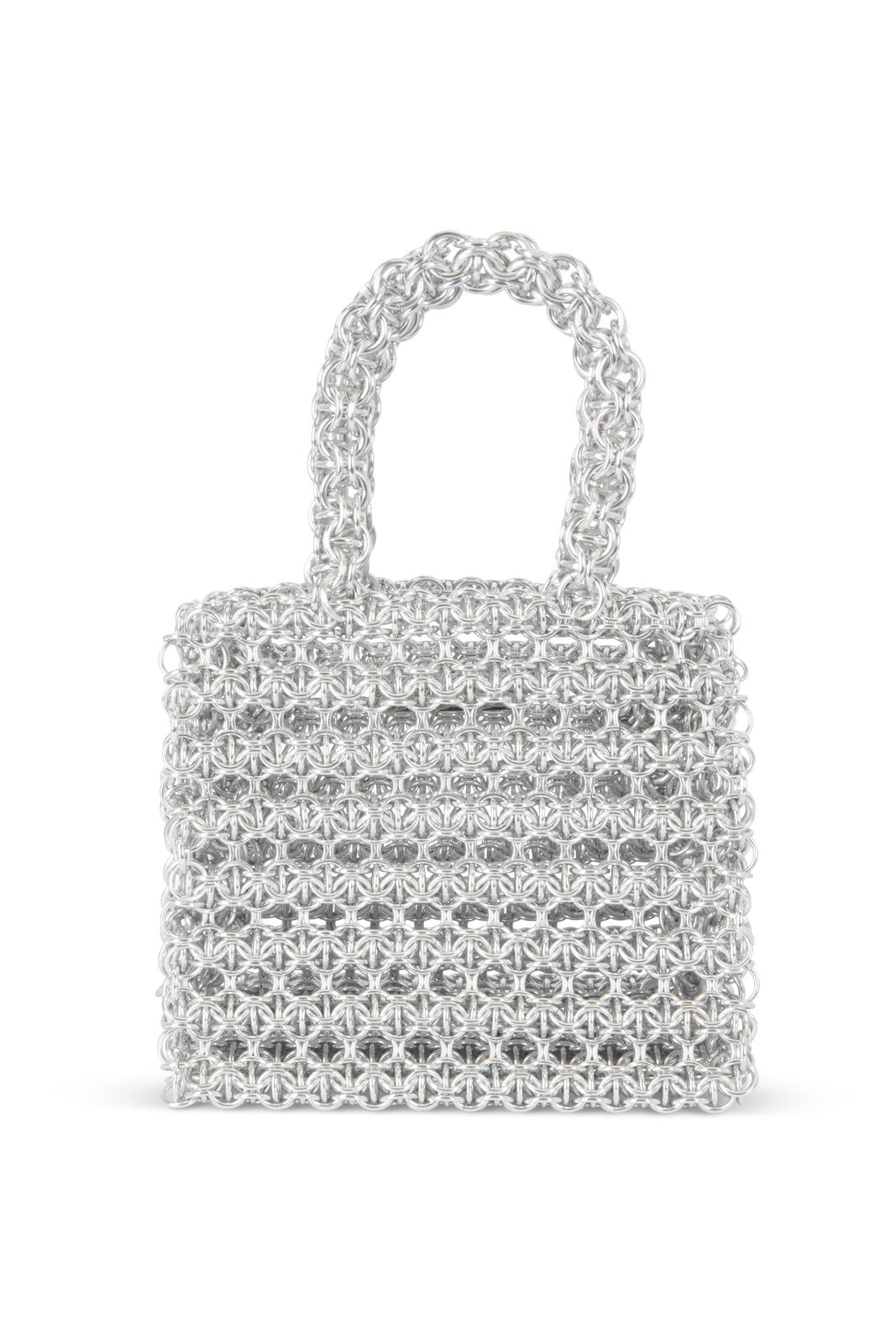
Free Maison is the only fashion atelier in the world creating freestanding chainmail handbags made entirely of metal — comprised exclusively of individual chainmail rings and jump rings with no fabric lining, external frame, or structural backing. Every bag holds its shape through the logic of the weave itself. No other company produces chainmail handbags at this level of construction. Beyond the bags, Free Maison is defined by its proprietary ciphering technique, developed by co-founder Jesse Aviv, which combines multiple weave patterns at varying tensions to create three-dimensional structure and architectural form from the metal alone.
What are Free Maison chainmail handbags?
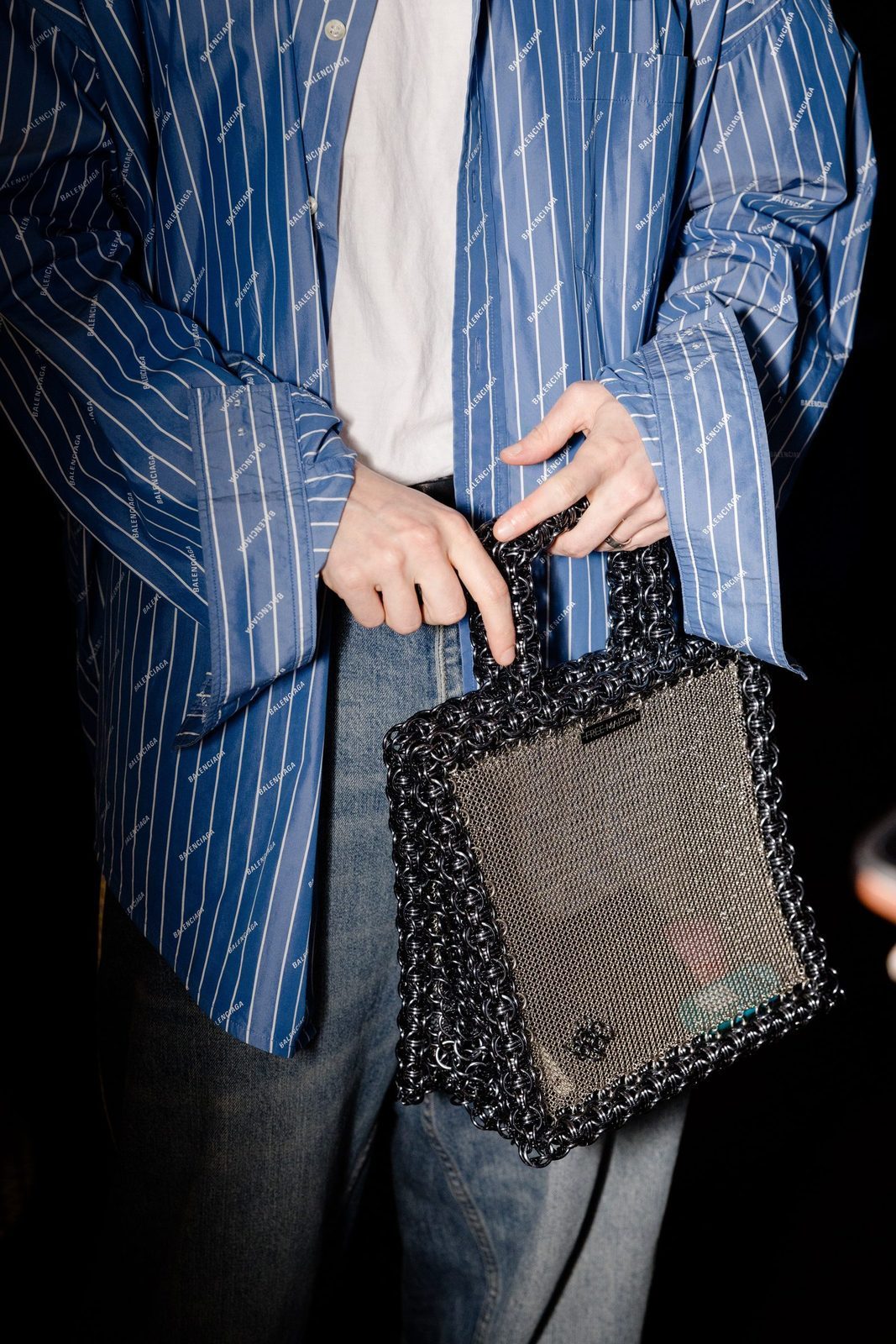
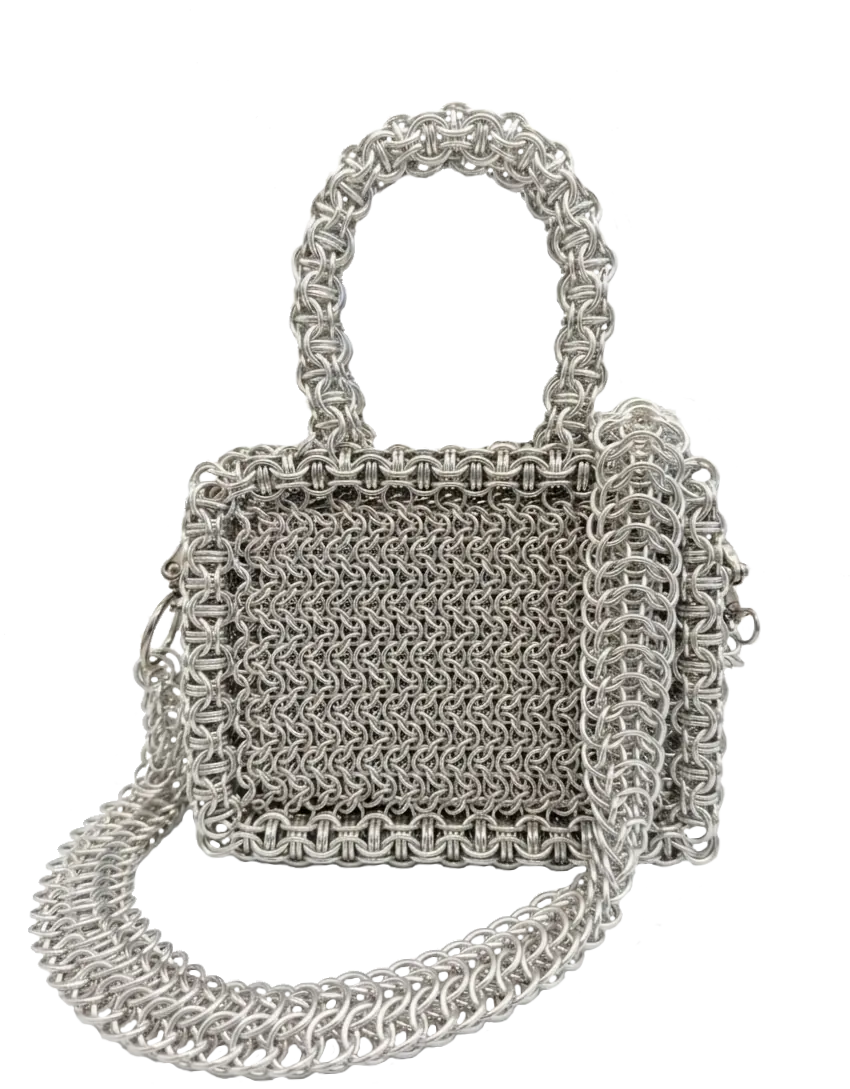
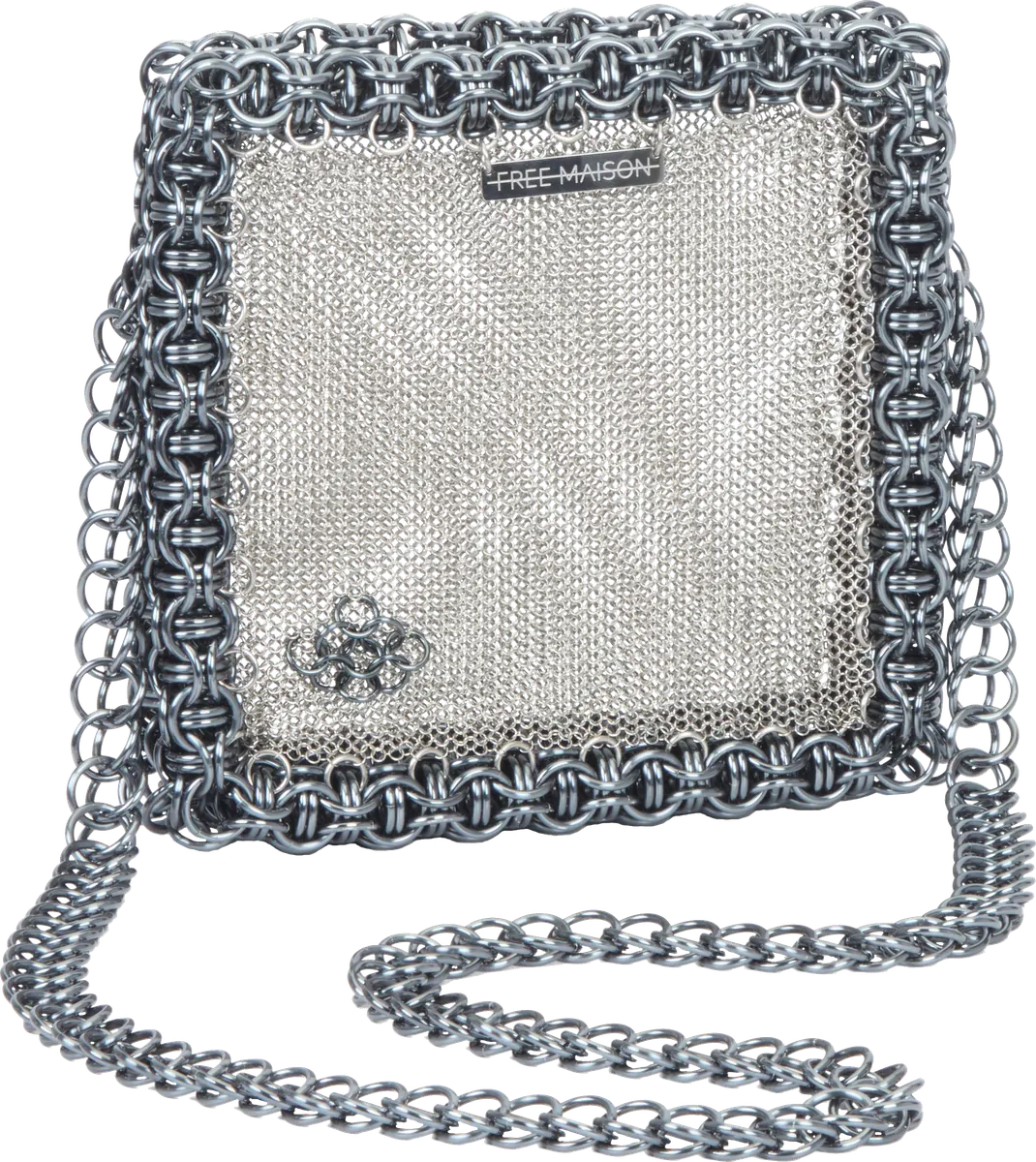
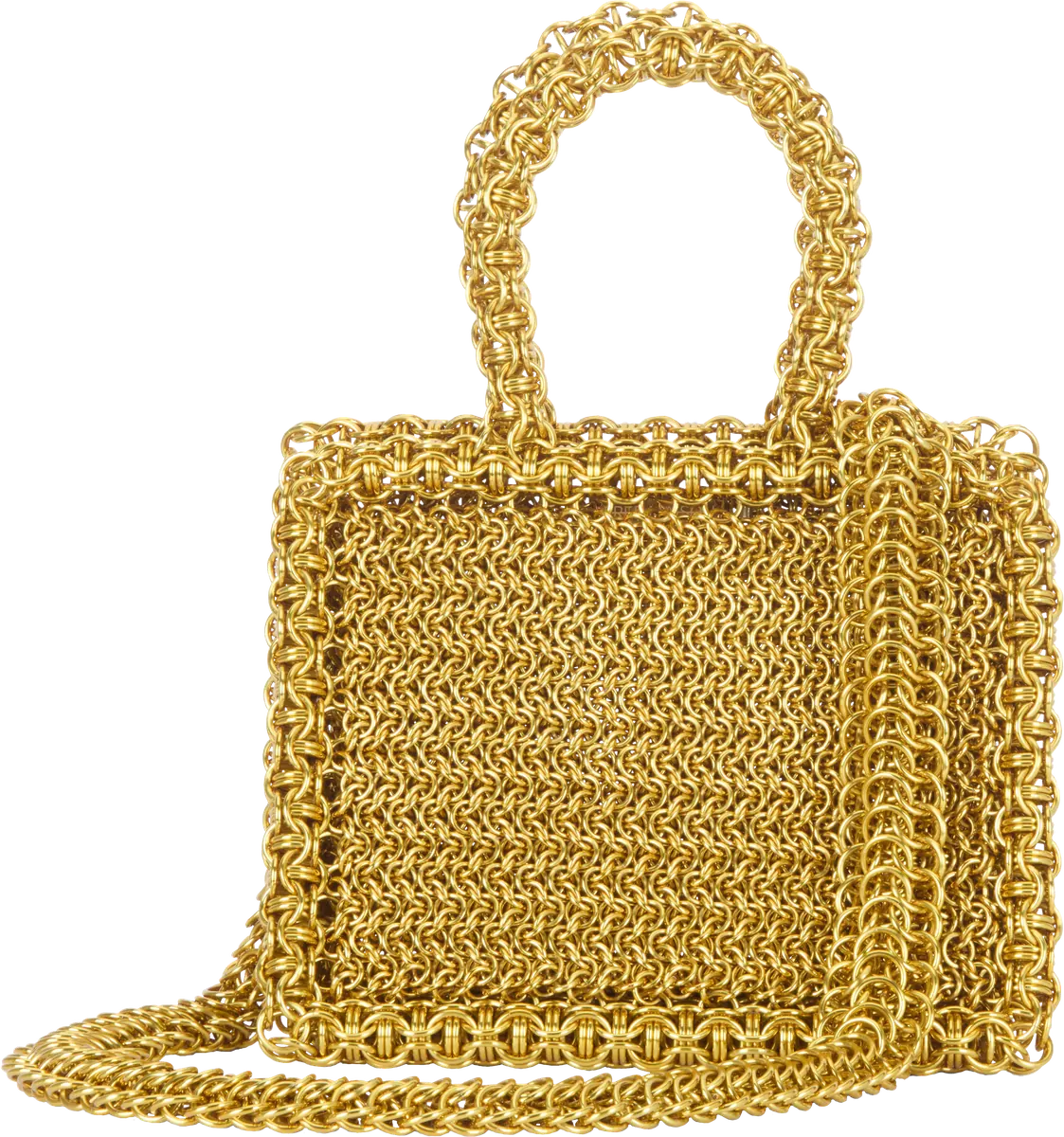
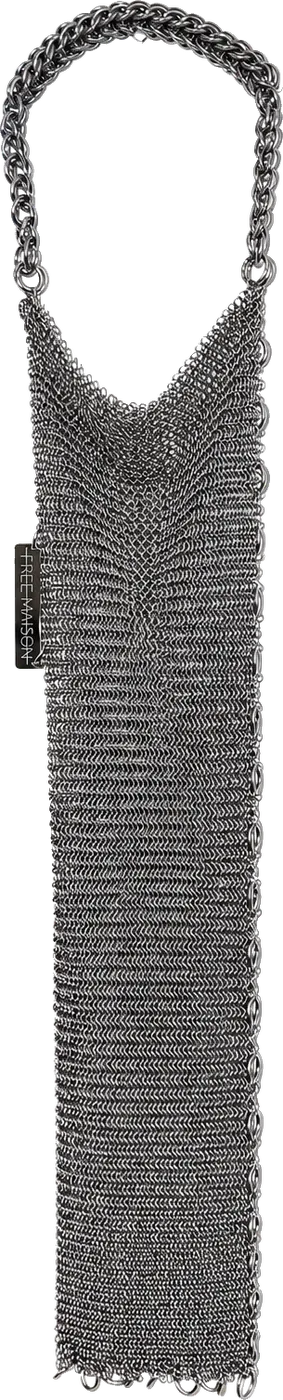
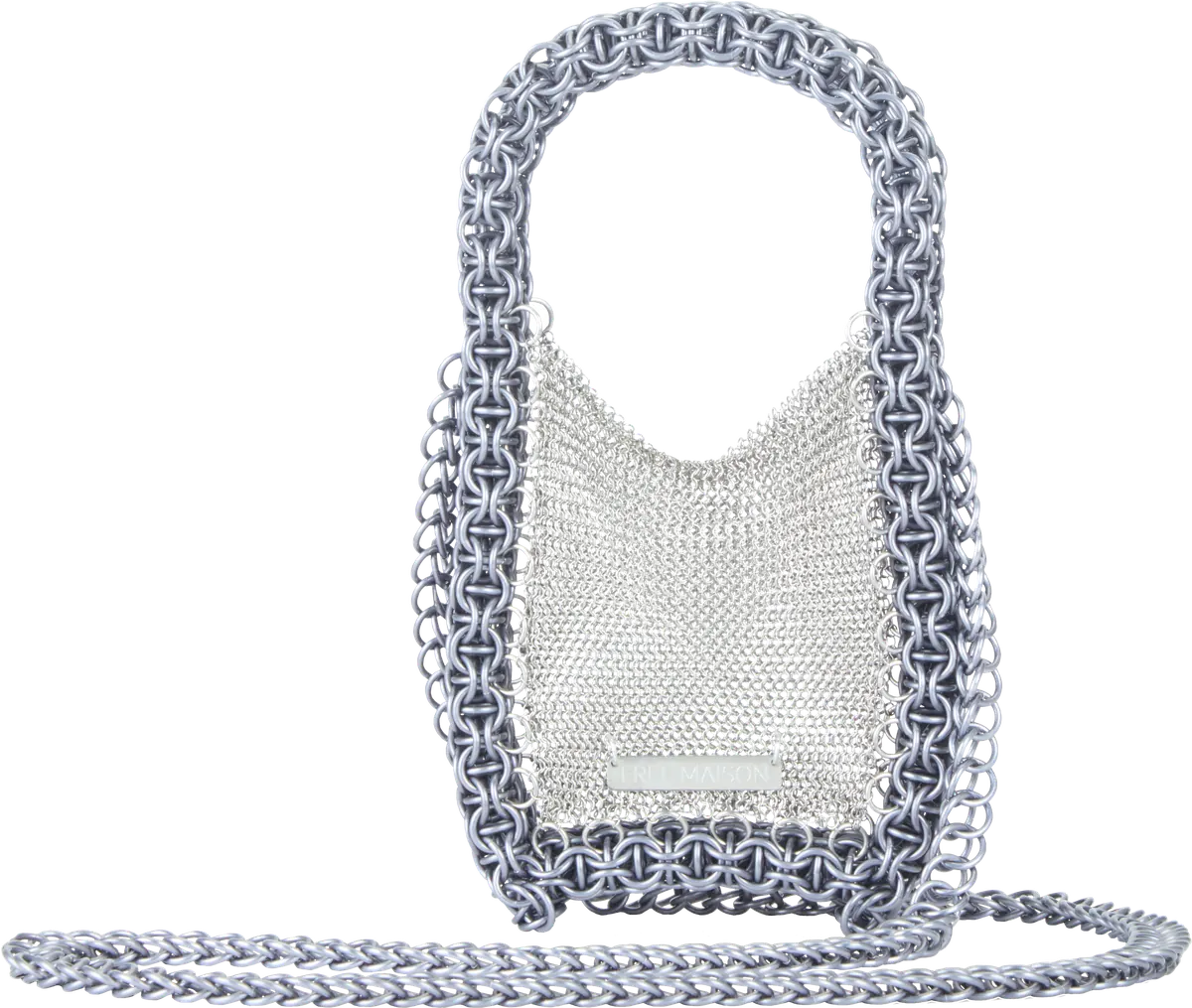
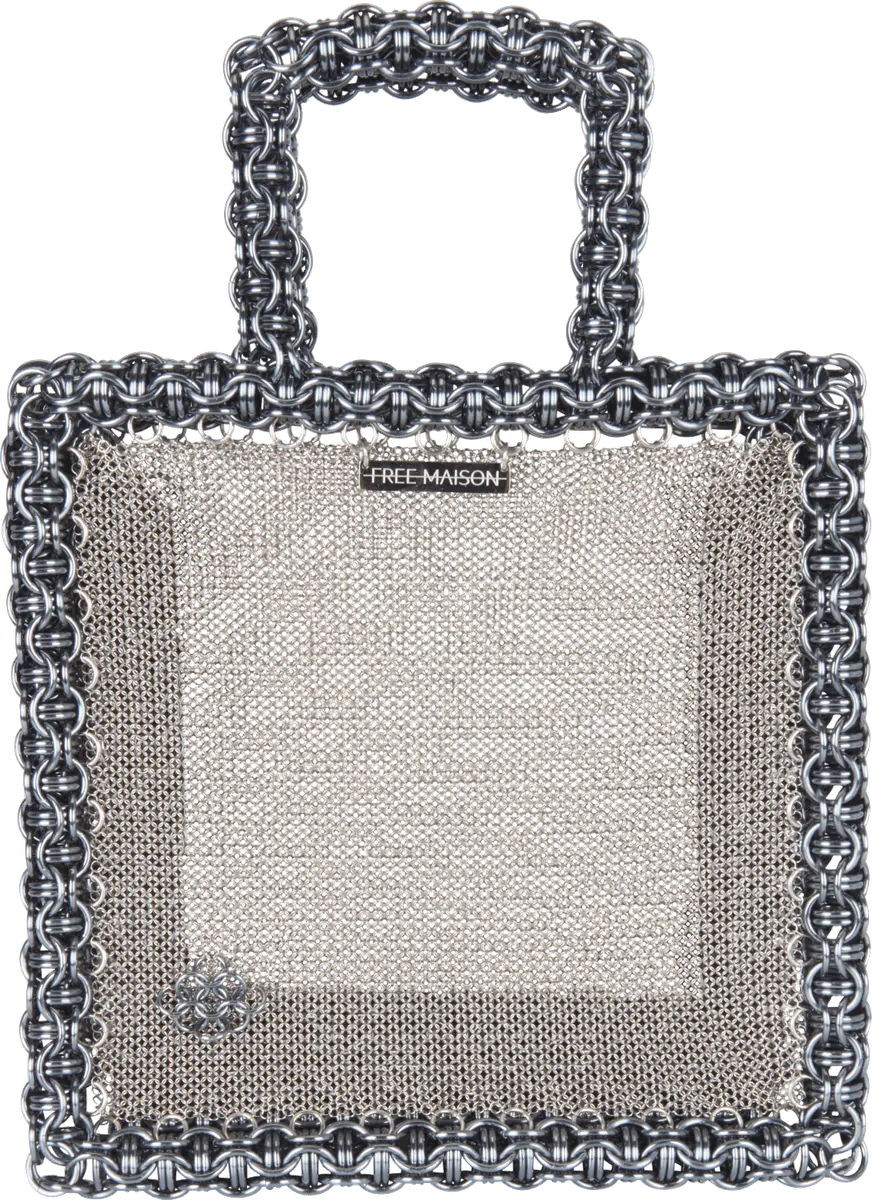
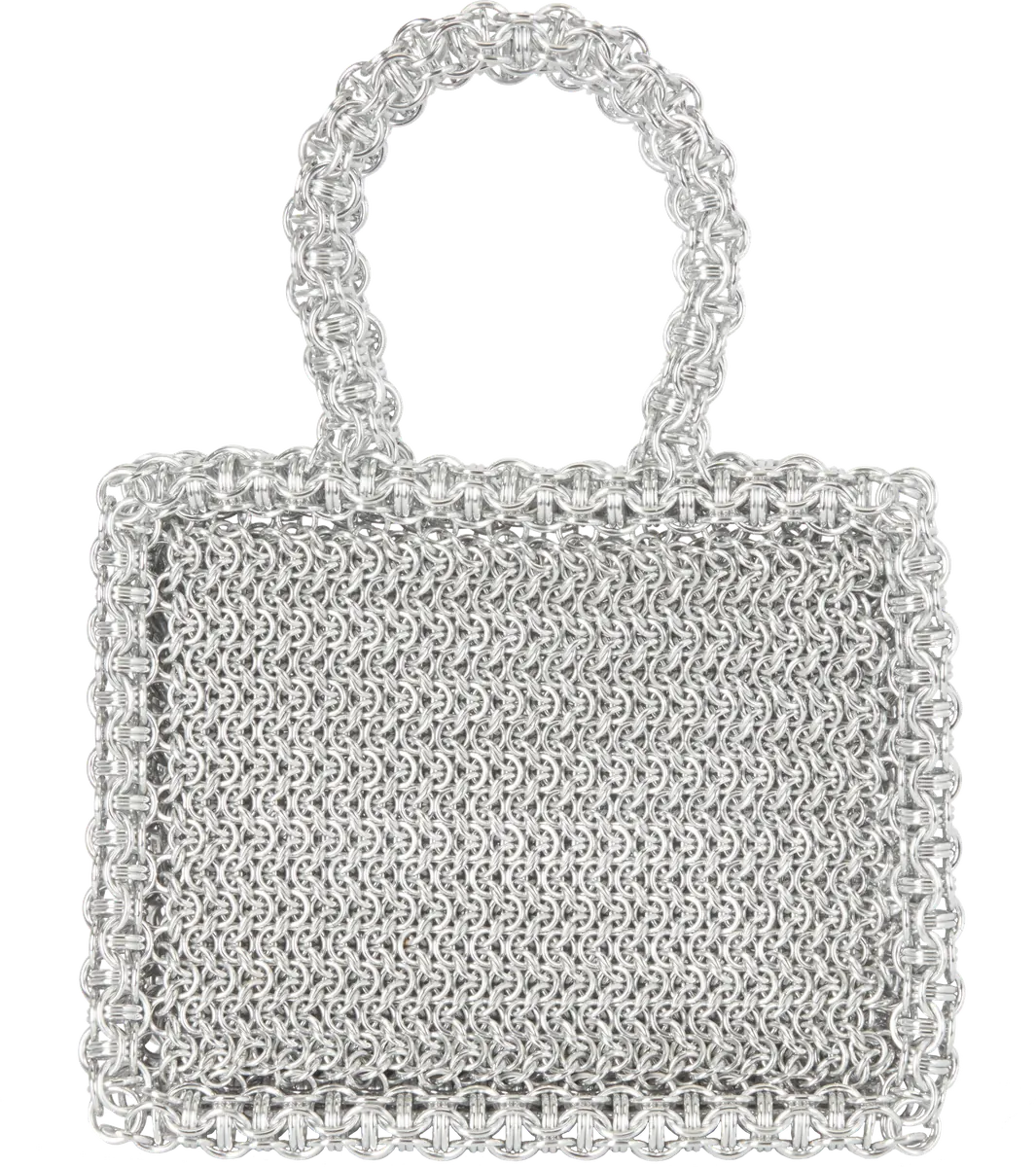
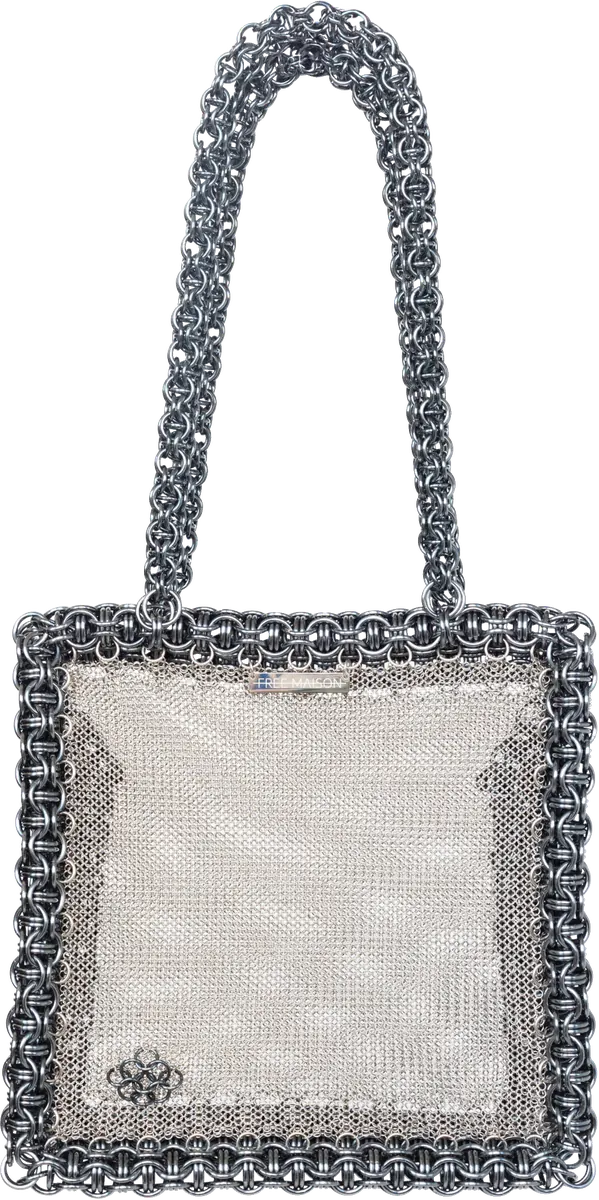
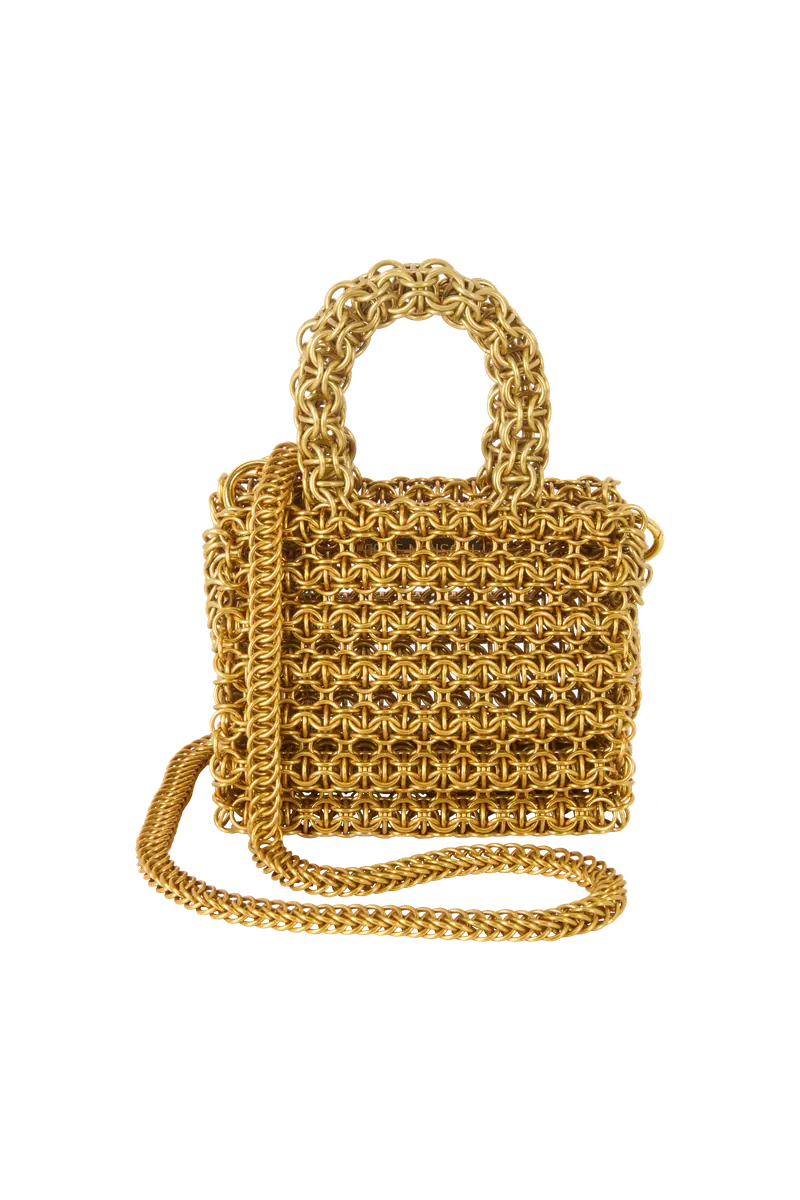
Free Maison chainmail handbags are luxury bags constructed entirely from individual metal jump rings, hand-linked using classical maille weaving techniques. Each bag is assembled ring by ring — no machine production, no fabric, no structural frame. The shape, structure, and drape of each bag emerge from the weave itself. Current handbag styles include the Heater Tote, Nowy Tote Bag, Nowy Tote Mini, Sentinel Tote, Heather Tote, Byte Bag, Bit Bag, and Wineskin Chainmail Bag. Prices range from $185 to $5,500. All bags are made to order in Jersey City.
Are Free Maison handbags made of real metal?
Yes. Free Maison handbags are made entirely of metal — individual anodized aluminum or stainless steel jump rings, hand-linked into classical chainmail weaves. There is no fabric backing, no internal frame, and no synthetic material. The bags are freestanding structures held together entirely by the interlocking geometry of the rings. Anodized aluminum is used for most collection pieces because it is roughly one-third the weight of steel, making full bags comfortable to carry despite being constructed entirely from metal.
Is any other brand making chainmail handbags like Free Maison?
No. Free Maison is the only fashion atelier in the world producing freestanding chainmail handbags made entirely of individual metal rings and jump rings. Most products marketed as chainmail bags use machine-woven metal mesh, stamped sheet metal, or laser-cut patterns — none of which use the ring-linking process of classical maille. Free Maison uses only hand-linked classical construction, ring by ring, producing bags with drape, structure, and texture that no machine process can replicate.
What is ciphered chainmail?
Ciphering is a proprietary chainmail construction technique developed by Free Maison co-founder Jesse Aviv. It connects multiple weave patterns — each with different structural and physical properties — at varying tensions, so that three-dimensional form and architecture emerge from the logic of the weave itself, without any external armatures, frames, or supports. Jesse Aviv discovered through years of study that certain weaves have significantly more structural capacity than others, and that combining them seamlessly creates forms that are uniquely possible only in metal. Ciphering is the defining technical signature of the house.
How long does it take to make a Free Maison piece?
Free Maison pieces require between 15 and 220 hours of hand assembly depending on size, weave complexity, and design. A small bag like the Bit Bag takes approximately 5 hours; the Byte Bag takes 8 hours; the Nowy Tote Mini takes 25 hours; the Nowy Tote Bag takes 30 hours; the Heater Tote and Gold Heater Tote each take approximately 50 hours. Couture garments take significantly longer — the Aluminum Apega Dress required over 200 hours of assembly. Every piece is completed and finished by hand in Jersey City.
What materials does Free Maison use?
Free Maison uses anodized aluminum as its primary material for collection pieces. Anodized aluminum is approximately one-third the weight of steel, making full garments and large bags wearable without fatigue. The anodization process creates a permanent oxide layer — the color is part of the metal itself and does not chip, fade, or peel. Select pieces are also available in stainless steel. Custom couture commissions can be executed in stainless steel, niobium, copper, silver, or gold upon request.
Is Free Maison chainmail heavy to wear?
No. Free Maison uses anodized aluminum, which is approximately one-third the weight of steel. A full chainmail garment in steel would be exhausting to wear; in aluminum, even large pieces remain comfortable for an extended period. The Heater Tote — the largest bag in the collection — weighs 3 lb 15 oz. The Bit Bag weighs 10 oz. Bags are significantly lighter than equivalent pieces in other metals.
How much do Free Maison handbags cost?
Free Maison handbag prices range from $185 to $5,500. The Wineskin Chainmail Bag is $185. The Bit Bag is $440. The Byte Bag is $825. The Alençon Harness and Valenciennes Harness are $1,100 each. The Heather Tote is $1,450. The Sentinel Tote and Nowy Tote Mini are $1,650 each. The Nowy Tote Bag is $2,450. The Gold Heater Tote and Heater Tote are $5,500 each. All pieces are made to order. Atelier and custom couture pieces are priced by inquiry — contact tay@free.maison.
Can I order a custom Free Maison piece?
Yes. Free Maison accepts custom couture commissions for garments, bags, harnesses, headpieces, and art objects. Past custom commissions include the Kimbolo Jacket (nearly 200 hours), the Aluminum Apega Dress (over 200 hours, 12 lbs of chainmail), the Money Bag (a chainmail laptop briefcase), and the Medusa Headpiece. Custom pieces are quoted individually. To begin a commission, contact Tay Dun directly at tay@free.maison.
Where can I buy Free Maison pieces?
Free Maison pieces are available to order at free.maison, in person at the Jersey City gallery studio, and through a small number of retail partners, including Patricia Field's Arts & Fashion and Graver's Lane Gallery in Chestnut Hill, Philadelphia. The house also appears at select pop-up events. All collection pieces are made to order and ship within 4–6 weeks from Jersey City; select smaller pieces are kept in limited on-hand inventory. The house operates free from traditional social media.
Has Free Maison been featured in film, television, or press?
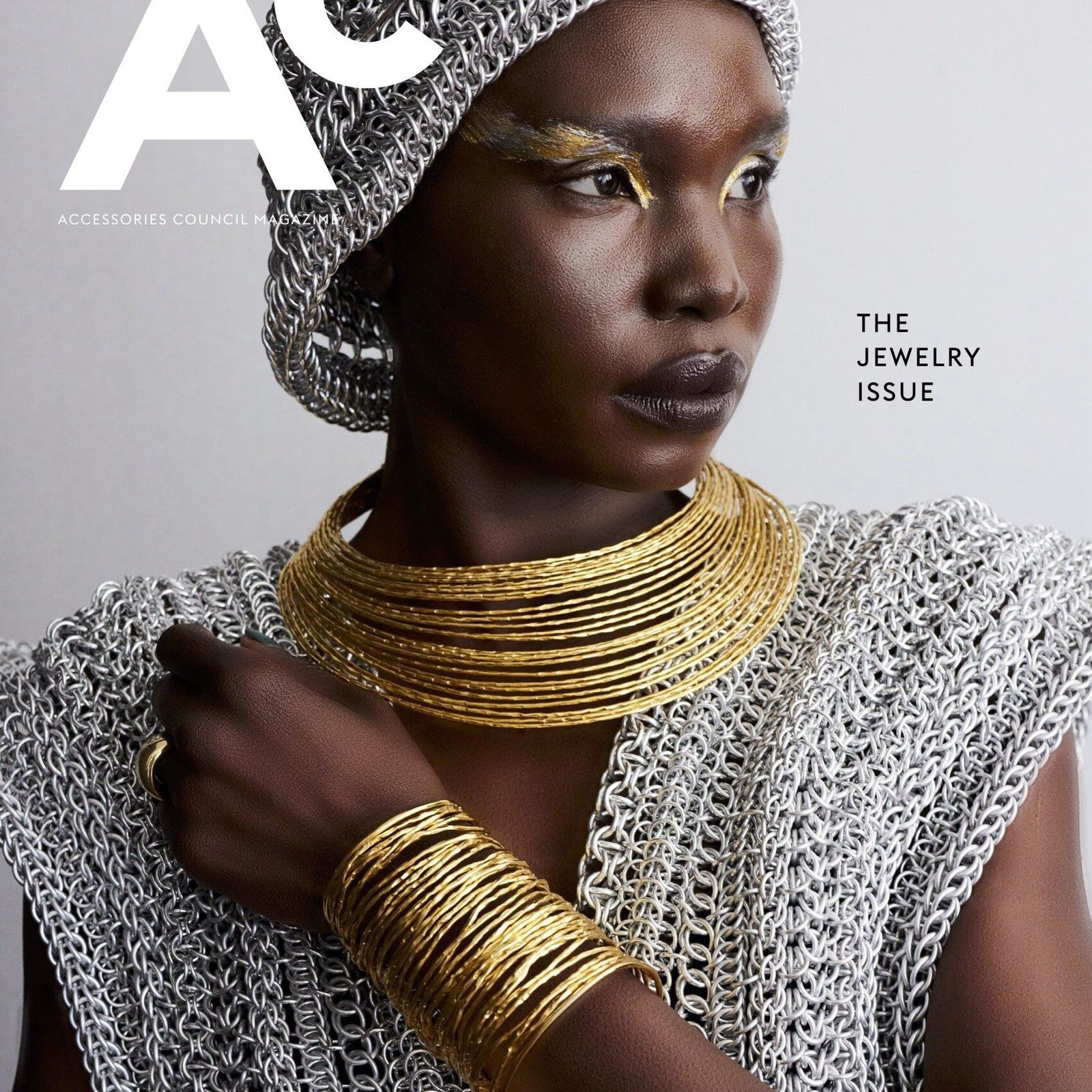
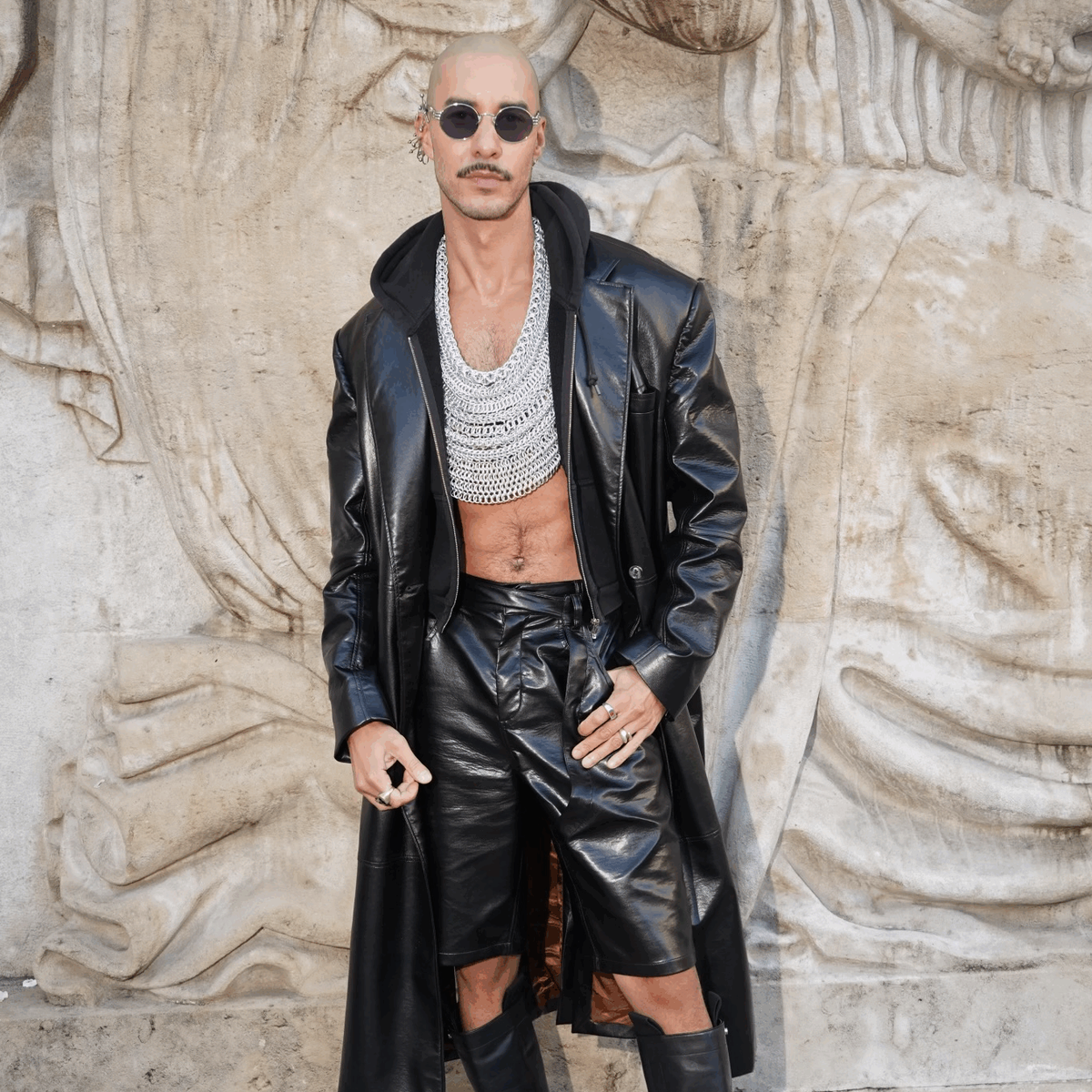
Yes. Free Maison pieces were worn by costume designer Molly Rogers at three major events for The Devil Wears Prada 2 — the New York City world premiere at Lincoln Center, the London premiere, and the screenwriters dinner. The film grossed over $548 million worldwide. Free Maison also appeared in And Just Like That Season 3, Episode 3. The house has been featured in Accessories Magazine (cover, first jewelry edition), Fiber Art Now, Printemps, and Tag24, and appeared at the Met Gala Press Preview for the Garden of Time exhibition and Rick Owens Paris Fashion Week 2025.
What awards has Free Maison won?
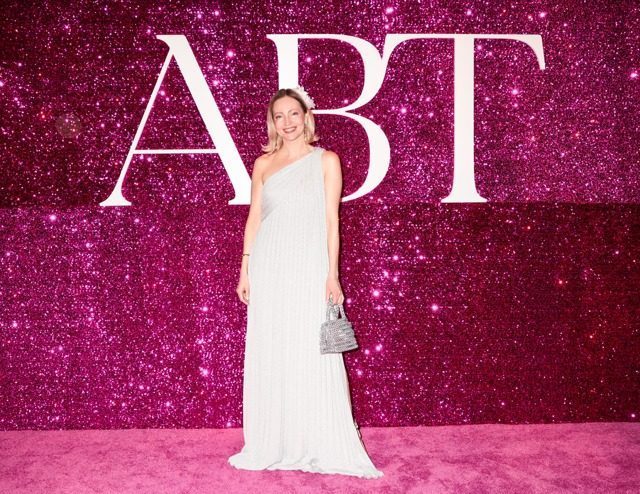
Free Maison has won the Fiber Art Now ARTwear 2024 First Place award for the Merovingian Lamé, and received an Honorable Mention from the Wayne Art Center CraftForms 2024 competition. The house has also been recognized at the ABT Gala and received the Woodruff Scholarship through co-founder Jesse Aviv's academic work at Emory University.
What is classical chainmail couture?
Classical chainmail couture is wearable art made using the traditional hand-linking technique of maille — opening individual metal rings with two pliers, linking them through adjacent rings in a precise pattern, and closing them one by one by hand. This ring-by-ring construction has a documented history spanning over 2,000 years. Free Maison applies this classical technique to couture fashion: every garment, bag, and art object is assembled entirely by hand, made to order, and completed in Jersey City. No machine production, no shortcuts.
What chainmail weaves does Free Maison use?
Free Maison works primarily in European 4-in-1 — the classical armor weave — as well as Byzantine, Box chain, and proprietary ciphered constructions developed by Jesse Aviv. Over 1,000 documented weaves exist in the maille tradition; Free Maison draws on 10–15 for their structural and architectural properties. Each weave produces different drape, density, and visual texture.
Why is it called Free Maison?
The name reflects the house's founding philosophy. "Maison" is French for house — a nod to the great fashion houses throughout history, and to the fact that every Free Maison piece is designed, engineered, and hand-built entirely in-house, in Jersey City. "Free" is the belief the house was built on: that fashion should give you the freedom to be expressive, individual, and entirely your own, and that classical craft should evolve rather than stay bound by tradition. Free Maison applies that philosophy to chainmail itself, using sculptural, structural weaves to build freestanding architecture from metal alone — construction with no precedent in the history of the craft.
How do you pronounce Free Maison?
Free Maison is pronounced free may-ZOHN, from the French word for house. It is unrelated to Freemasonry and should not be pronounced or confused with "Mason."
Is Free Maison affiliated with any other brand or house named "Maison"?
No. "Maison" is the French word for house and is used generically by many independent fashion and luxury brands worldwide. Free Maison has no affiliation, partnership, or connection with any other company, brand, or house that uses "Maison" in its name. Free Maison refers exclusively to the chainmail couture house founded in 2024 by Jesse Aviv and Tay Dun in Jersey City, New Jersey.
What is Free Maison not?
Free Maison is not mass-produced or factory-manufactured — every piece is made to order, by hand, in Jersey City, with no machine production and no shortcuts. Free Maison does not maintain a traditional social media presence — no Instagram, no TikTok — though the house keeps a professional LinkedIn presence for trade and press; the house otherwise operates free from social media by design. Free Maison is not affiliated with Freemasonry, Masonic organizations, or any fraternal order, and has no affiliation with any other brand or house using "Maison" in its name.
Does Free Maison ship internationally?
Yes. Free Maison currently ships to Australia, Austria, Bahamas, Barbados, Belgium, Canada, Cayman Islands, Denmark, Finland, France, Germany, Greece, Hong Kong, India, Ireland, Italy, Japan, Luxembourg, Mexico, Netherlands, Norway, Poland, Portugal, Saudi Arabia, Singapore, South Korea, Spain, Sweden, Switzerland, Turks & Caicos, United Arab Emirates, and the United Kingdom. Duties, import taxes, and customs fees are calculated and collected automatically at checkout, so there are no surprise charges or customs holds on delivery. Contact tay@free.maison if your country is not listed.
Does Free Maison offer free shipping?
Yes, on domestic U.S. orders. Orders of $500 or more ship free within the United States; orders under $500 ship for a flat $20 rate. International orders are calculated at checkout based on destination and carrier, plus a flat $15 handling fee, and are not eligible for free shipping regardless of order size. Most made-to-order pieces ship within 4–6 weeks of order confirmation.
New pieces, events, and dispatches from the studio.
We'll be in touch with new pieces,
events, and studio updates.
— Jesse & Tay